
North America

CITE
We have made every effort to follow citation style rules, but there may be some minor differences. If in doubt, please refer to the appropriate citation style manual.
Grenada. (2026). In Q-files Encyclopedia, Geography, North America. Retrieved from
https://www.q-files.com/geography/north-america/grenada
"Grenada." Geography, North America, Q-files Encyclopedia, 1 Apr. 2026.
https://www.q-files.com/geography/north-america/grenada.
Accessed 30 Oct. 2026.
Grenada 2026. Geography, North America. Retrieved 30 October 2026, from
https://www.q-files.com/geography/north-america/grenada
Geography, North America, s.v. "Grenada," accessed October 30, 2026.
https://www.q-files.com/geography/north-america/grenada


Grenada
The tiny island nation of Grenada lies at the southern tip of the group known as the Windward Islands. It is made up of one main island, Grenada, a smaller island to the north, Carriacou, plus a number of smaller ones, all of which form part of the Grenadine island chain. Grenada’s islands are volcanic; its landscape is mountainous, covered by tropical shrubs and forests, and rich volcanic soil. Grenada has a tropical climate: hot and wet for part of the year and cooled by ocean winds in the dry season. Lying just south of the main “hurricane belt”, Grenada escapes many of the hurricanes that hit neighbouring islands—although it suffered badly when Hurricane Ivan struck in 2004.


People
Nearly all Grenadians are descendants of the enslaved Africans brought by the English and French in the 17th century to work on plantations. A small number are descended from Indians who arrived in the late 1800s. Although English is the language of government, most people speak Grenadian Creole, a mixture of English and African languages, or French patois.

Economy
Grenada is one of the world’s biggest producers of spices—around a fifth of the world’s supply of nutmeg is grown on this tiny island. Other spices grown here include cinnamon, cloves and ginger. Bananas and cocoa are important crops too. Apart from farming, Grenada makes most of its foreign income from tourism; many tourists visit the island on cruise ships, stopping off to enjoy its beaches and water-sports.


Consultant: Nicholas Harris
Facts about Grenada
Population 114,621 (2024 estimate)
Area 344 sq km
Highest Point Mount Saint Catherine 840 m (2756 ft)
Capital St George’s, population 39,000
Languages English, Grenadian Creole
Religions Christian (Roman Catholic) 53%, Christian (Protestant) 47%
Ethnicity black African 82%, mixed black / European 13%, mixed Indian / European 5%, Carib and others 5%
Currency East Caribbean dollar (XCD)
Chief exports nutmeg, mace, bananas, cocoa, fruit and vegetables, clothing

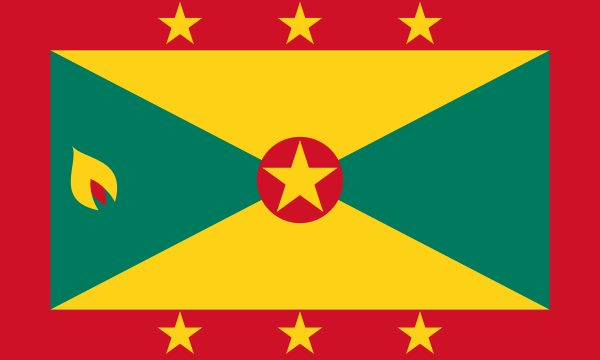
History of Grenada
15th century
Carib people live on the island
1498
Christopher Columbus sights Grenada and names it after a Spanish city
1650
The French build first European settlement at St George’s, the present-day capital
1783
Control of Grenada passes to Britain; African slaves are brought to work on cotton, tobacco and sugar plantations
1795
Julian Fedon, an African planter, leads a rebellion against British rule
1834
Slavery abolished throughout the British Empire
1885–1956
Britain uses Grenada as a base from which to govern the British Windward Islands
1958–62
Grenada is part of the Federation of the West Indies
1967
Grenada is given control over its own government; Britain continues to run its foreign affairs
1974
Grenada becomes fully independent
1979
Marxist–Leninist New Jewel Movement overthrows the government in a coup and establishes the People's Revolutionary Government (PRG), headed by Maurice Bishop as prime minister
1983
US invades and occupies Grenada for eight days, following the arrest and execution of Bishop by the People's Revolutionary Government
2004
Hurricane Ivan hits Grenada, destroying nearly every building on the island and damaging crops
2005
Hurricane Emily strikes the northern part of the island, causing an estimated US $110 million worth of damage
2024
Hurricane Beryl causes widespread damage across Grenada and Carriacou
pics

Without in any way limiting Q-files Ltd’s exclusive rights under copyright, any use of this publication to “train” generative artificial intelligence (AI) technologies to generate text is expressly prohibited. Q-files Ltd reserves all rights to license use of this work for generative AI training and development of machine learning language models.