
North America

CITE
We have made every effort to follow citation style rules, but there may be some minor differences. If in doubt, please refer to the appropriate citation style manual.
Guadeloupe. (2026). In Q-files Encyclopedia, Geography, North America. Retrieved from
https://www.q-files.com/geography/north-america/guadeloupe
"Guadeloupe." Geography, North America, Q-files Encyclopedia, 1 Apr. 2026.
https://www.q-files.com/geography/north-america/guadeloupe.
Accessed 30 Oct. 2026.
Guadeloupe 2026. Geography, North America. Retrieved 30 October 2026, from
https://www.q-files.com/geography/north-america/guadeloupe
Geography, North America, s.v. "Guadeloupe," accessed October 30, 2026.
https://www.q-files.com/geography/north-america/guadeloupe


Guadeloupe
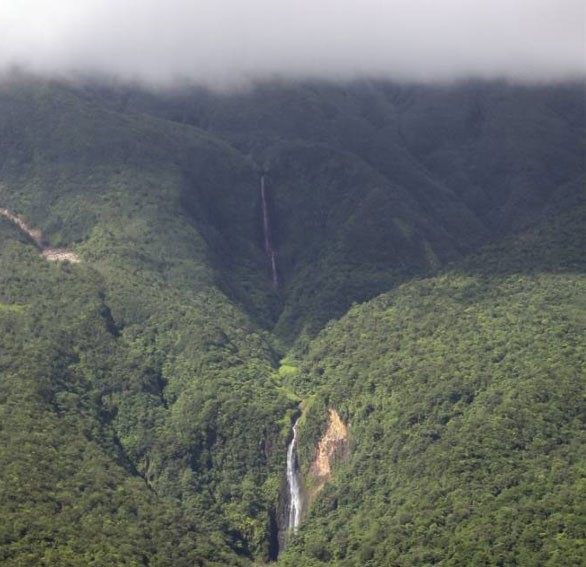
One of the Leeward Islands in the eastern Caribbean Sea, Guadeloupe is an overseas department of France. Guadeloupe is made up of two main islands, together forming a butterfly shape. Basse-Terre, to the west, and Grande-Terre, to the east, are separated by a narrow channel. Basse-Terre is covered by high, volcanic mountains while Grande-Terre is flatter, with rolling hills, plains and mangrove swamps around its coast. Both islands are covered by tropical forests and scrublands. The climate is hot, breezy and tropical. Between June and October the islands are at risk from hurricanes.


People
Guadeloupe’s population is mainly made up of the descendants of Africans brought to work on sugar plantations in the 18th century. They are Roman Catholic; most people speak French along with Creole, a mixture of French and African languages. Nearly everyone in Îles des Saintes is of French descent; very few Africans were brought to these islands because the French settlers there were fishermen, not sugar planters.
Economy
Guadeloupe has a long history of sugar production; sugar cane has been grown here since the mid-17th century. Although sugar is still a major export, other crops such as bananas, flowers, squash and aubergines are becoming more important. France supplies much of Guadeloupe’s food, along with products to support the tourist industry, a fast-growing source of income on the islands. Most tourists visit from France.
Facts about Guadeloupe
Population 378,561 (2024)
Area 1629 sq km
Highest Point La Grande Soufrière, 1467m (4813 ft)
Capital Basse-Terre, population 9419
Other major cities Pointe-à-Pitre (pop. 14,855; urban area 250,952)
Languages French, Antillean Creole
Religions Christian (Roman Catholic) 95%, Christian (Protestant) 1%, others 4%
Ethnicity black African 90%, white 5%, East Indian, Lebanese, Chinese and others 5%
Currency Euro (EUR)
Chief exports bananas, sugar, rum
Consultant: Nicholas Harris
History of Guadeloupe
11th century
Carib people live on the island
1493
The explorer Christopher Columbus is the first European to land in Guadeloupe
1635
French settlers Charles Lienard and Jean Duplessis Ossonville set up a colony on the islands
1674
Guadeloupe is officially claimed by France
1670s–1700s
Sugar trade flourishes in Guadeloupe; thousands of Africans work on the sugar plantations as slaves
1759–63
Britain captures and occupies Guadeloupe; it is returned to France at the Treaty of Paris in exchange for Canada
1793–94
Slave rebellion breaks out; Britain invades; French governor Victor Hugues frees slaves to fight with him against the British
1802
French troops recapture the island from rebellious slaves and slavery is re-introduced
1810–14
Britain seizes control of Guadeloupe and passes it to Sweden (1813), which cedes it to France in 1814
1848
Slavery abolished in Guadeloupe
1865–66
Outbreak of cholera kills 12,000 of Guadeloupe’s 150,000 residents
1946
Guadeloupe becomes an official overseas department of France
1974
Guadeloupe is made an administrative centre: it sends representatives to the French National Assembly in Paris
2007
Two northern islands, Saint-Martin and Saint-Barthélemy, break away from Guadeloupe and become separately governed French territories
2009
Strikes and protests break out over cost of living and low wages
pics
Without in any way limiting Q-files Ltd’s exclusive rights under copyright, any use of this publication to “train” generative artificial intelligence (AI) technologies to generate text is expressly prohibited. Q-files Ltd reserves all rights to license use of this work for generative AI training and development of machine learning language models.