
North America

CITE
We have made every effort to follow citation style rules, but there may be some minor differences. If in doubt, please refer to the appropriate citation style manual.
Haiti. (2026). In Q-files Encyclopedia, Geography, North America. Retrieved from
https://www.q-files.com/geography/north-america/haiti
"Haiti." Geography, North America, Q-files Encyclopedia, 1 Apr. 2026.
https://www.q-files.com/geography/north-america/haiti.
Accessed 13 Sep. 2026.
Haiti 2026. Geography, North America. Retrieved 13 September 2026, from
https://www.q-files.com/geography/north-america/haiti
Geography, North America, s.v. "Haiti," accessed September 13, 2026.
https://www.q-files.com/geography/north-america/haiti


Haiti
Haiti occupies the western part of the island of Hispaniola in the West Indies, which it shares with the Dominican Republic. It also includes the islands of Gonâve and Tortue (Tortuga). Haiti is dominated by high, rugged mountains that lie inland from the coastal plains. The plains have a hot, humid climate, while conditions in the mountains are cooler and wetter. Haiti used to covered by forests, but over the last century nearly all of its trees have been cut down. This has led to soil erosion—making it more difficult to grow crops and putting the treeless land at risk from floods.


People and economy
Haiti’s people are descended from Africans who were brought to the island as slaves in the 17th century. In rural areas, nearly everyone depends on farming to make a living. The soil is poor; most people grow maize, beans and cassava on small family farms. In the city, many people work in textile factories producing clothes for export. Many Haitians work abroad, especially in Dominican Republic and the Bahamas.
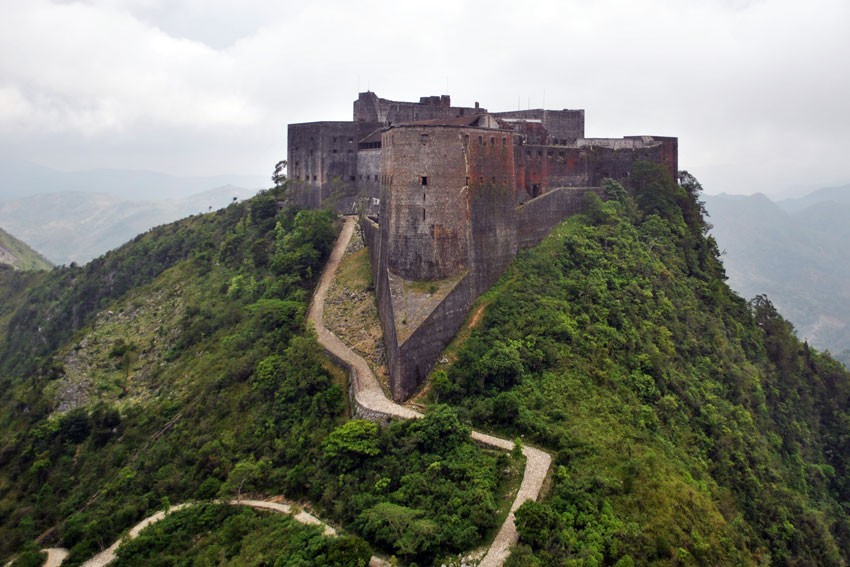
Cap‑Haïtien has attracted tourists from overseas. Labadee beach, 10 kilometres (6 miles) to the city's northwest, serves as a stopover for cruise ships, generating significant income for Haiti.

Poverty
Haiti is one of the poorest countries in the Americas. Only about a quarter of Haitian children go to school, while a large number of adults cannot read or write. The country now has hardly any natural resources—it has cut down nearly all of its forests—and many years of rule by a violent and unstable government have left its economy in ruins. An already poor country, it has struggled to recover from the damage caused by a major earthquake in 2010, which destroyed much of its capital city, Port-au-Prince. Since 1990 Haiti has received billions of dollars of foreign aid from the US, Canada, China and the EU.


Restavek children
Many parents in Haiti, especially those from rural areas, who are too poor to care for their children may send them to live with wealthier (or less poor) families—often their own relatives or friends, and usually in the cities. The children are known as restaveks, after the French rester avec, meaning "to stay with". They work as domestic servants in exchange for food and accommodation (and sometimes an education), although some are at serious risk of abuse. The restavek system, regarded as a form of slavery, is believed to affect more than 400,000 children. A quarter of Haitian children aged between 5 and 17 live away from their biological parents. Some restaveks who were dismissed, or ran away from the families they worked for, are forced to live on the streets.
Consultant: Nicholas Harris
Facts about Haiti
Population 11,470,261 (2023 estimate)
Area 27,560 sq km
Highest Point Chaine de la Selle 2680 m (8793 ft)
Capital Port-au-Prince, population 1,234,742 (metro area 2,618,894)
Other major cities Cap-Haïtien (pop. 534,815), Port-de-Paix (250,000), Jacmel (137,966)
Languages French, Creole
Religions Christian (Roman Catholic) 80%, Christian (Protestant) 16%, others and none 4%
Ethnicity black 95%, mulatto (mixed European/black African) and white 5%
Currency Haitian gourde (HTG)
Chief exports clothing, cocoa, mangoes, coffee

History of Haiti
7th–15th centuries
Arawak people, the Taíno, live on the island
1492
Christopher Columbus lands on the island, claiming it for Spain and naming it Hispaniola: “Little Spain”
16th century
French pirates settle in the west of the island, where they are well-placed to attack ships in the Caribbean
16th–18th centuries
Thousands of African slaves are brought to the island as slaves by the French
1697
Spain and France divide Hispaniola between them: the western part (modern-day Haiti) is taken by France and called Saint-Domingue
1791–1804
Slaves revolt, calling for freedom and civil rights. Toussaint Louverture, a former slave, leads the rebellion
1794
The French government abolishes slavery in Saint-Domingue
1801
Toussaint Louverture leads a campaign to rid the island of French, Spanish and British colonists. His troops capture Santo Domingo (Dominican Republic) and briefly control the entire island
1802
Napoleon Bonaparte sends more than 20,000 French troops to try and retake the island, but many of them die from yellow fever
1803
French forces are defeated by Haitian army led by Jean-Jacques Dessalines
1804
The independence of Saint-Domingue is proclaimed under the native name of "Haiti", with Dessalines, a former slave, as its leader (emperor). Remaining white population of white French colonists are massacred.
1806
Dessalines is assassinated; Haiti divides into a black-controlled north, the Kingdom of Haiti, and a mixed-race south, the Republic of Haiti
1821
President Jean Pierre Boyer begins to reunify Haiti’s northern and southern halves
1822
Haitian troops invade and occupy Santo Domingo, the Spanish eastern part of Hispaniola
1825
King Charles X of France attempts to reconquer Haiti. President Boyer agrees to a payment of 150 million francs in exchange for France recognizing Haitian independence. Haiti does not finish repaying the debt until 1947, during which time Haiti's economy is crippled.
1844–55
Dominican War of Independence breaks out when rebels seize control of Santo Domingo, the Spanish eastern part of Hispaniola. For the next 11 years, the Dominicans fight to preserve their independence from Haiti
1859
Faustin Soulouque, who became Emperor Faustin I in 1849, abdicates the Haitian throne following a revolution. The revolution's leader, General Fabre Giffard, becomes president.
1915
Conflict between black and mixed-race communities; US invades and occupies Haiti until 1934
1937
Dominican Republic’s army massacres up to 30,000 Haitians living on the Dominican side of the border
1956
Mass protests against corruption and a general strike force President Paul Magloire to flee the country
1957
Francois Duvalier, known as “Papa Doc”, is elected President of Haiti
1964
Duvalier declares himself president for life, and rules the country as a dictator
1971
Duvalier dies and is succeeded by his son, Jean-Claude Duvalier. Known as “Baby Doc”, he continues to rule as a brutal dictator until he is himself ousted in 1986.
1986–1994
Period of unrest as elected presidents (including Jean-Bertrand Aristide, in 1990) are overthrown in three military coups
1994
US troops enter the country peacefully under Operation Uphold Democracy to oversee the return of Jean-Bertrand Aristide as president.
2004
Revolt in northern Haiti spreads to capital and president is forced into exile. Severe floods leave over 5000 people dead or missing
2010
A magnitude 7.0 earthquake hits Haiti’s capital, Port-au-Prince, killing up to 300,000 people
2016
Hurricane Matthew brings high winds torrential rain and flooding which damages hospitals and roads and kills around 3000 people; the disease cholera spreads out of control
2021
(July) Following three years of protests over increased fuel prices, President Jovenel Moïse is assassinated
2021
(August) A magnitude 7.2 earthquake strikes the Tiburon Peninsula. At least 2250 people are killed and more than 12,000 injured.
2023 onwards
Most of Port-au-Prince, including the airport, seaport and major highways, falls under the control of heavily armed criminal gangs. The number of people having to leave their homes reaches 362,500 (as of April 2024). Prime minister Ariel Henry is forced to resign (April 2024). Transitional Presidential Council takes over the Haitian government and is scheduled to stay in power until 2026.
pics
Without in any way limiting Q-files Ltd’s exclusive rights under copyright, any use of this publication to “train” generative artificial intelligence (AI) technologies to generate text is expressly prohibited. Q-files Ltd reserves all rights to license use of this work for generative AI training and development of machine learning language models.