
North America

CITE
We have made every effort to follow citation style rules, but there may be some minor differences. If in doubt, please refer to the appropriate citation style manual.
St Kitts and Nevis. (2026). In Q-files Encyclopedia, Geography, North America. Retrieved from
https://www.q-files.com/geography/north-america/st-kitts-and-nevis
"St Kitts and Nevis." Geography, North America, Q-files Encyclopedia, 1 Apr. 2026.
https://www.q-files.com/geography/north-america/st-kitts-and-nevis.
Accessed 30 Oct. 2026.
St Kitts and Nevis 2026. Geography, North America. Retrieved 30 October 2026, from
https://www.q-files.com/geography/north-america/st-kitts-and-nevis
Geography, North America, s.v. "St Kitts and Nevis," accessed October 30, 2026.
https://www.q-files.com/geography/north-america/st-kitts-and-nevis


St Kitts and Nevis
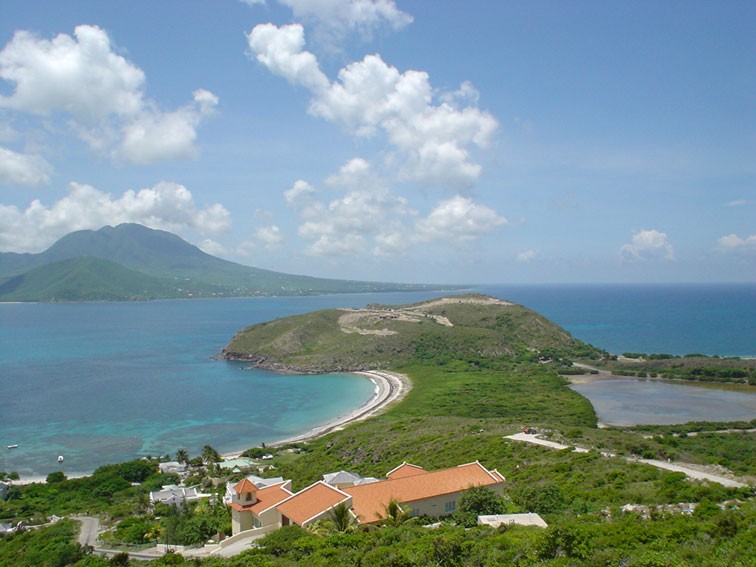
St Kitts and Nevis is an island nation, part of the Leeward Island group in the West Indies. Nevis lies about 1.6 kilometres (1 mile) to the southeast of St Kitts, which is where the capital Basseterre is situated and where most of the country’s people live. Both islands are volcanic and mountainous, covered by tropical rainforests; the land levels out towards the coasts. Both islands have a warm sunny climate. Like many eastern Caribbean islands, they lie in the Atlantic hurricane belt and are at risk from devastating tropical storms.


People
People from St Kitts are called Kittitians, and people from Nevis are called Nevisians. Most islanders are descended from enslaved Africans brought to work on sugar cane plantations in the 17th and 18th centuries. The country’s population is shrinking as each year more than a thousand people emigrate abroad, mainly to the US.
Economy
For much of the 20th century, sugar was the islands’ main export, but today most sugar cane plantations have closed down. Many have been cleared to make room for holiday resorts or factories: industries such as tourism and textile production now bring in more money than sugar. Offshore banking has also become an important industry, especially on Nevis.
Consultant: Nicholas Harris
Facts about St Kitts and Nevis
Population 54,338 (2023 census)
Area 261 sq km
Highest point Mount Liamuiga 1156 m (3793 ft)
Capital Basseterre, population 16,696
Language English
Religions Christian 95%, others and none 5%
Ethnicity black African 93%, mixed 2%, white 2%, Indian 2%, others 1%
Currency East Caribbean dollar (XCD)
Chief exports machinery, vegetables, bananas, electronics, tobacco

History of St Kitts and Nevis
12th–15th centuries
Carib people live on the islands
1493
Christopher Columbus discovers St Kitts and Nevis
1623
First British colony in the West Indies is set up on St Kitts
1625
France also sets up a colony on St Kitts and the island is divided between Britain and France
1626
British and French settlers massacre 2000 Caribs
1628
British set up a colony on Nevis
17th century
Britain and France battle for control of St Kitts
1783
France agrees that it no longer claims St Kitts and control passes to Britain
1871
St Kitts and Nevis is joined with Anguilla and becomes a British dependency
1932
Centre-left Labour Party founded; its members begin to campaign for independence
1983
St Kitts and Nevis becomes an independent country
1994
Anti-government riots in Basseterre; a state of emergency is declared
1997
A referendum is held on whether Nevis should separate from St Kitts, but islanders vote to stay in the union
1998
Hurricane George strikes the islands, damaging the sugar cane crop and 80% of the islands’ buildings
2003
Enormous tourist resort opens on Frigate Bay, St Kitts, the largest in the eastern Caribbean
2005
Government closes down the state-owned sugar industry; 4% of the workforce lose their jobs
pics
Without in any way limiting Q-files Ltd’s exclusive rights under copyright, any use of this publication to “train” generative artificial intelligence (AI) technologies to generate text is expressly prohibited. Q-files Ltd reserves all rights to license use of this work for generative AI training and development of machine learning language models.