
Romans
Roman army
In the early days of the republic, only citizens (free-born Romans) who owned land were allowed to join the army. Very few of them were full-time soldiers. Once Rome began to fight wars overseas, a bigger and better army was needed. From then on, any citizen, whether a landowner or not, could enlist. Non-citizen troops, known as auxiliaries, made up half the army's fighting men. At the height of the Roman Empire, soldiers were highly trained professionals. Soldiers’ wages were good and the army paid for their food, clothing and weapons. At the time, the Roman army was the best organized, trained and equipped fighting force in the western world.
Army organization
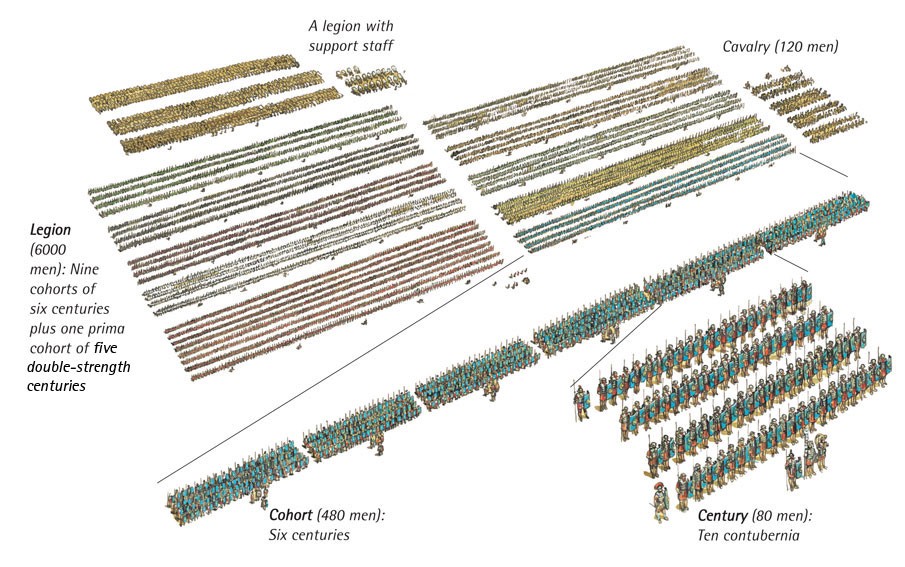
The Roman army was divided into groups of about 6000 men, known as legions. The contubernium was the army’s basic unit: it consisted of eight soldiers who lived, trained and fought together. Ten contubernia (80 men) made up a century, and six centuries made up a standard cohort. Each legion had nine standard cohorts, together with one special cohort, called the prima cohort, which consisted of 10 centuries, or 800 men. Every century had its own commander (centurion) and standard bearer, the signifer. The bearer of the legion’s standard, a gold or silver eagle, was called the aquilifer. A legion was commanded by a legate, who had the assistance of six tribunes.
Around half the Roman army was made up of auxiliaries, or non-citizen soldiers. They were not organized into legions, but into cohorts (for infantry) and alae (for cavalry).
Legionary
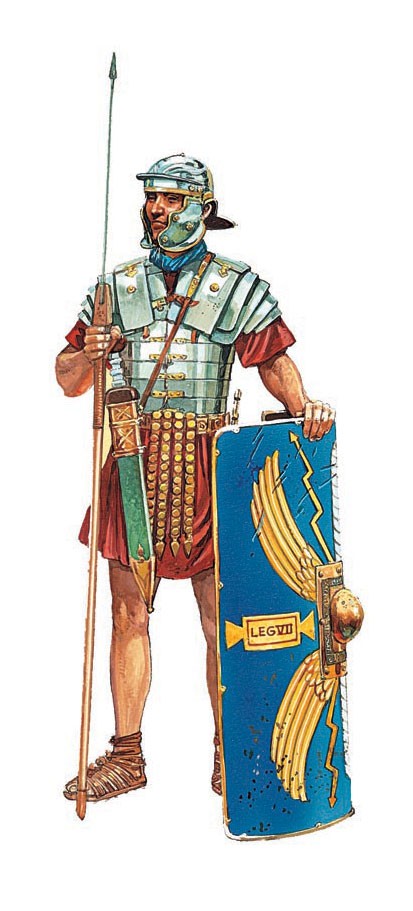
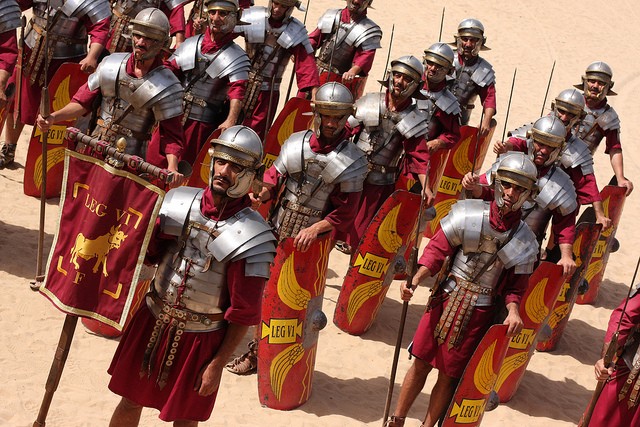
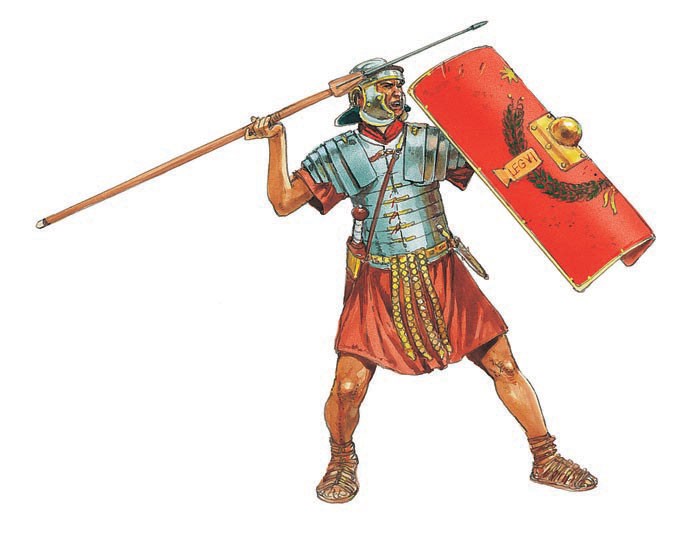
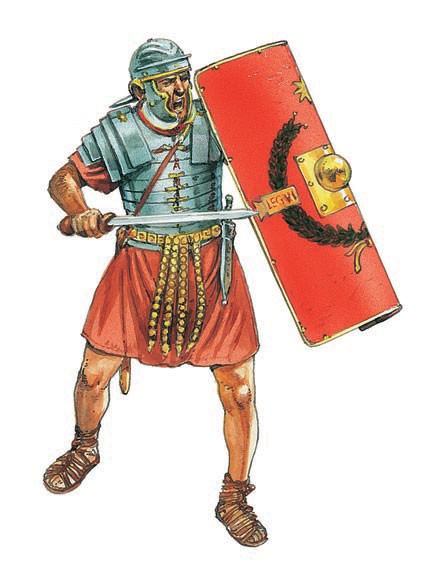
Roman footsoldiers were known as legionaries. A legionary wore an iron helmet and armour over a woollen tunic and a leather kilt. He carried a gladius (sword), a dagger (pugio), a scutum (shield) and two pila (throwing spears).
The Roman Empire was vast, and much of a legionary’s time was spent marching from place to place. In times of war, he might have had to march up to 30 kilometres (20 miles) a day to reach the battlefield, carrying his weapons, shield, bedroll, cooking pans and provisions. Legionaries were all Roman citizens. They had to be at least around 1.75 metres (5 feet 9 inches) tall and physically fit with good eyesight.

Centurion
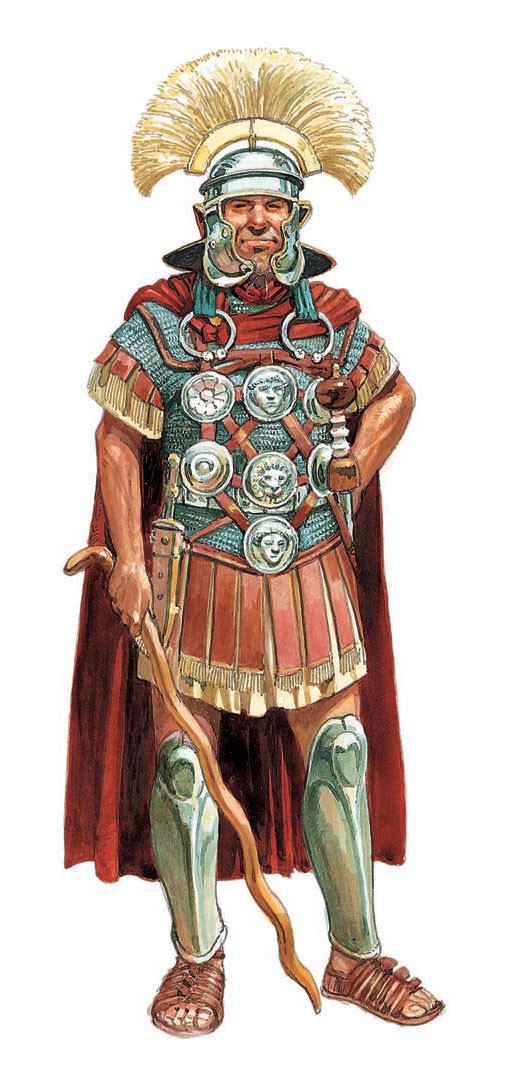
The centurion was in charge of a century, a group of 80 legionaries. He wore silvered armour, decorated with disc-shaped medallions called phalerae. The plume on his helmet ran crossways rather than front to back like that of a legionary. He carried a crooked vine stick used to beat disobedient soldiers.
Centurions were responsible for the training and discipline of the men under them. They often led their men into battle, fighting alongside them. The primus pilus was the senior centurion in a legion (group of 6000 men).
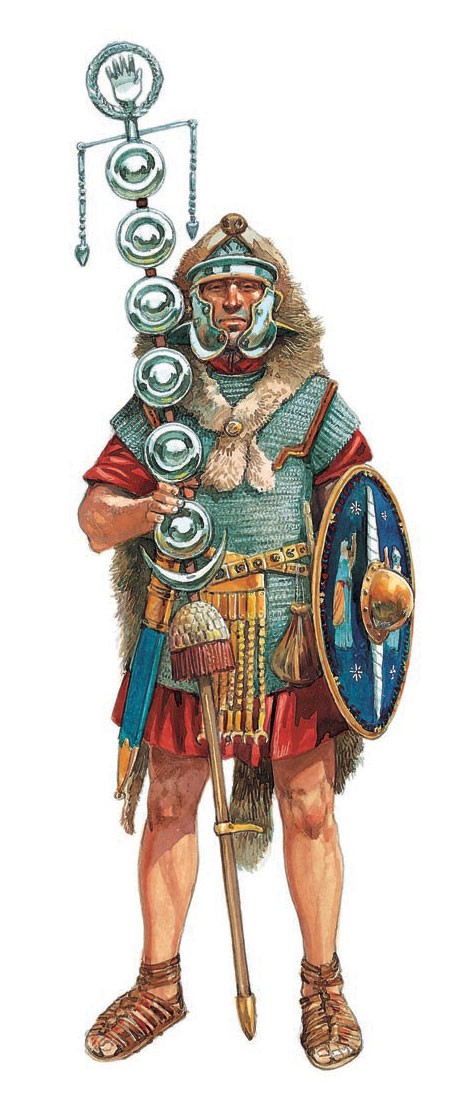
Signifer
The signifer carried the century’s standard (signum)—a military flag or pole, marched into battle. The pole was often topped by a representation of a human hand, standing for the oath of loyalty taken by legionaries. The role of signifer was dangerous as he had to stand in the front rank with only a small shield to defend himself.
Signifers also organized the soldiers’ “burial club”. Legionaries paid a small amount of their salary each week into this fund towards the cost of their own funeral.
Aquilifer
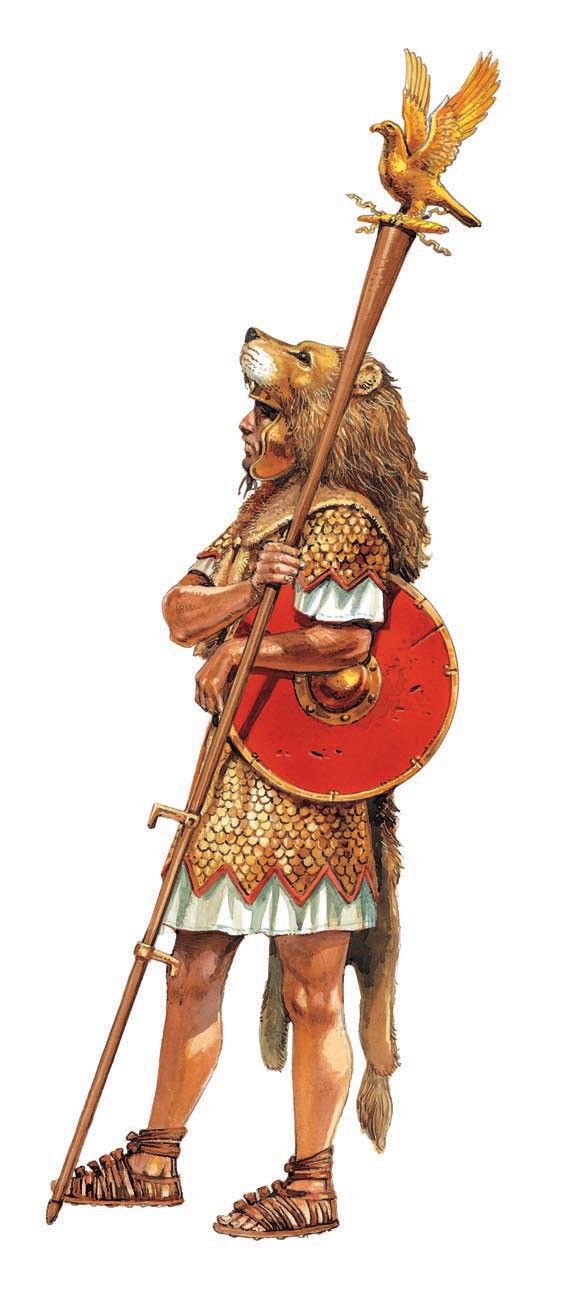
The aquilifer carried the standard of the legion—a gold or silver eagle. The eagle was called the aquila. Standard bearers had a great responsibility not to lose the standard in battle. This would have brought disgrace to the whole legion. The army went to great lengths to protect the standard bearer and to recover the aquila if it was lost.
An aquilifer received twice the pay of an ordinary legionary. His role was to maintain the legion's honour and he often spurred on the troops and led the way forward even when those around him hesitated.
Cavalry
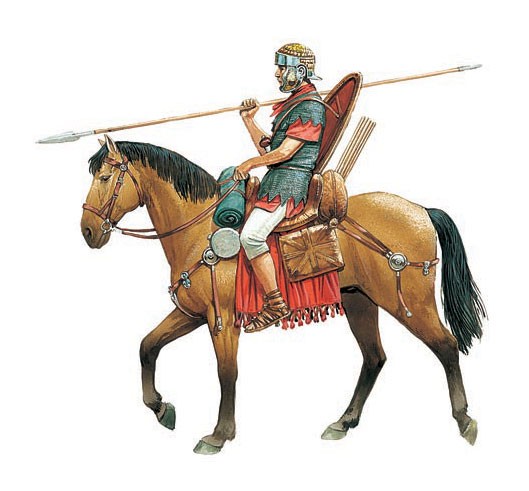
There were about 120 cavalry soldiers in the legion. They often came from wealthy families. The cavalry soldier carried a sword, a one-handed spear for thrusting, and several smaller spears, called javelins, for throwing.
Armour
All soldiers wore cuirass—leather or metal body armour. It was made of several strips joined together to make it more flexible than a single piece. Some soldiers, such as the signifer and the centurion, wore chainmail, made from hundreds of individual rings of metal linked together.
Weapons
All men used their weapons in their right hand and their shield in their left. Spears were launched at the enemy over the heads of the men in front. Sword fighting was for combat at close quarters. The rectangular shield curved around the body, protecting it so that only the fighting arm was exposed. The shield was made of wood and canvas, reinforced with iron around its edge. An iron lump, called a boss, on the front, deflected most blows from swords.

Testudo
In the testudo ("tortoise") formation, men marched close together, overlapping their shields both over their heads and in front of them as they advanced. This formed an almost impenetrable barrier, protecting the men from arrows and spears. It allowed the soldiers to get close to the enemy, and was particularly useful during a siege.
Battle tactics
The Roman army used the same tactics whenever they went into battle. The most important of these was maintaining an unbroken frontline. The footsoldiers surged forwards with their shields overlapping. This made it hard for weapons to break through the line of shields.

The ranks consisted of both legionaries and auxiliaries. Some troops were held in reserve. They could be moved in immediately to replace tired or fallen men, filling in any gaps that appeared.
Sieges
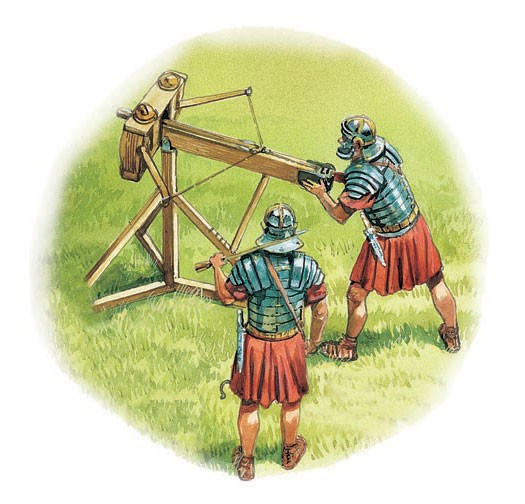
To capture cities, the Roman army would mount a siege, surrounding the city walls so that nobody could escape, nor any food or equipment be brought in. Soldiers then used catapults to launch an attack on the city. These included the onager, a large catapult that smashed rocks against the walls, and the scorpio, or triggerfish, which catapulted darts at the enemy ranks. Another weapon used was the ballista, a large and powerful crossbow. It fired bolts tipped with iron that could penetrate even the strongest armour. The soldiers also used battering rams to break down the city gates.
Marching camp
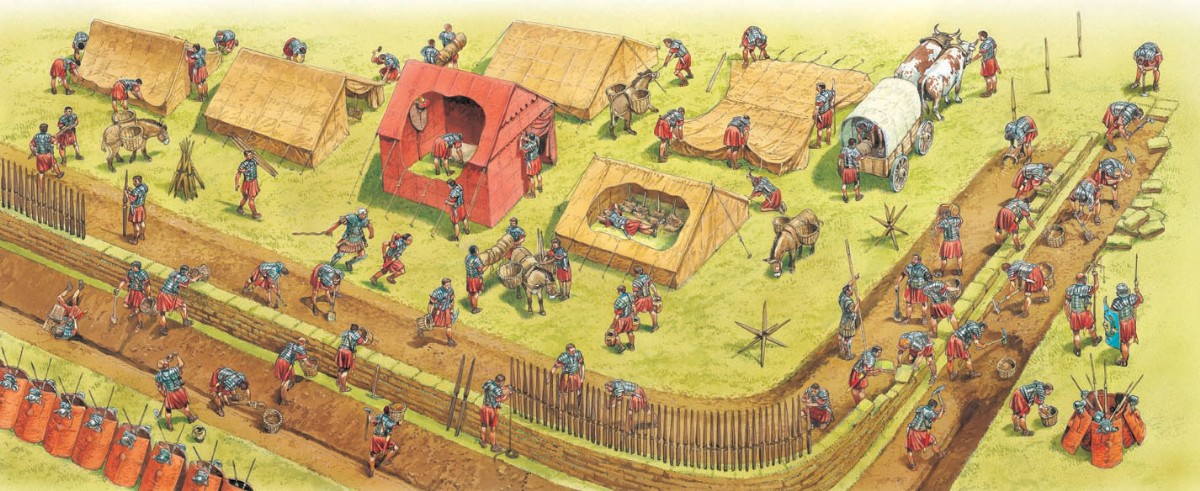
The Roman army on the move might march up to 30 kilometres (20 miles) a day. As evening approached, scouts were sent out to find and mark out a suitable site to make camp. If needed for several days, the camp was made secure by clearing turf and digging a defensive ditch around it. Ramparts were built from the turf and a palisade of sharpened stakes set on top of them. For a temporary defence on overnight camps, a barrier of bundles of sharpened stakes was erected around the camp edge to deter intruders. One century was detailed to stand guard overnight.
Consultant: Philip Parker