
Q-news

CITE
We have made every effort to follow citation style rules, but there may be some minor differences. If in doubt, please refer to the appropriate citation style manual.
Fossil of a dinosaur that may have died on the last day of the dinosaurs is revealed. (2022). In Q-files Encyclopedia, , Q-news. Retrieved from
https://www.q-files.com/news/fossil-of-a-dinosaur-that-may-have-died-on-the-last-day-of-the-dinosaurs-is-revealed
"Fossil of a dinosaur that may have died on the last day of the dinosaurs is revealed." , Q-news, Q-files Encyclopedia, 1 Sep. 2022.
https://www.q-files.com/news/fossil-of-a-dinosaur-that-may-have-died-on-the-last-day-of-the-dinosaurs-is-revealed.
Accessed 13 Sep. 2026.
Fossil of a dinosaur that may have died on the last day of the dinosaurs is revealed 2022. , Q-news. Retrieved 13 September 2026, from
https://www.q-files.com/news/fossil-of-a-dinosaur-that-may-have-died-on-the-last-day-of-the-dinosaurs-is-revealed
, Q-news, s.v. "Fossil of a dinosaur that may have died on the last day of the dinosaurs is revealed," accessed September 13, 2026.
https://www.q-files.com/news/fossil-of-a-dinosaur-that-may-have-died-on-the-last-day-of-the-dinosaurs-is-revealed


Fossil of a dinosaur that may have died on the last day of the dinosaurs is revealed
A team of palaeontologists examining the fossil remains of a dinosaur, a Thescelosaurus, discovered in the US state of North Dakota, have come to a stunning conclusion. They think that the perfectly preserved leg, which includes even remnants of skin, can be accurately dated to the time the asteroid which almost certainly caused the dinosaurs’ extinction struck Earth 66 million years ago. In fact, the team say this particular creature breathed its last on the very day all dinosaur species went extinct. The fossil dig, which began in 2019, along with the later analysis of the find, has been filmed for a BBC documentary presented by Sir David Attenborough.
11th April 2022
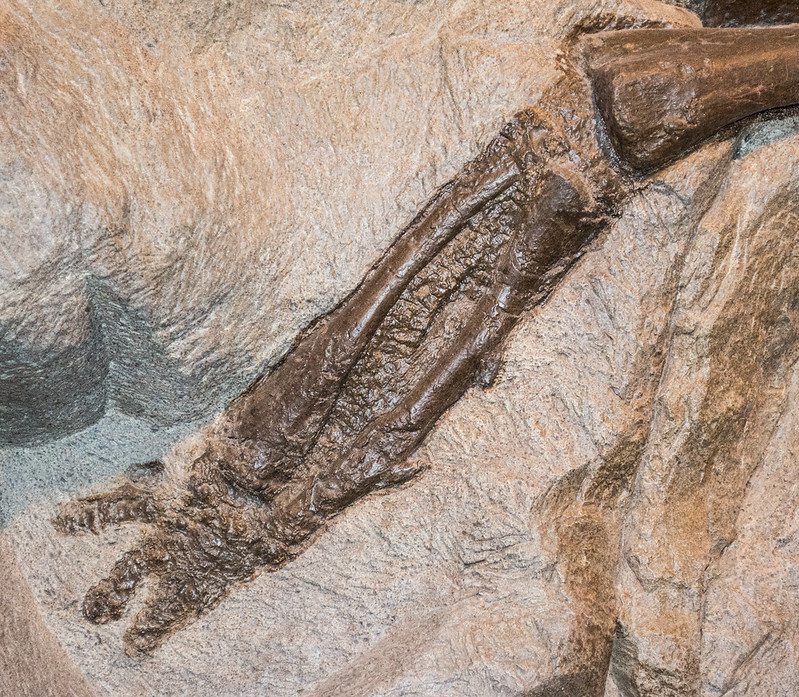

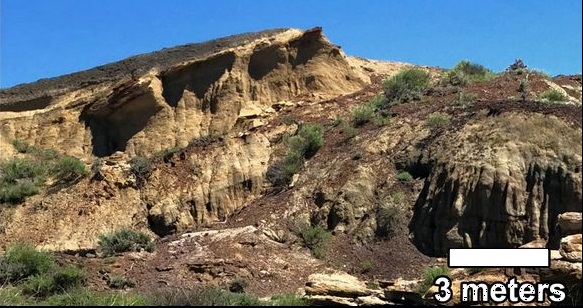
The leg of a Thescelosaurus, a small plant-eating ornithischian dinosaur, was found lying between layers of sediment laid down by the asteroid impact in Tanis, a fossil site in the US state of North Dakota. In Cretaceous times, this locality was a floodplain at the northern end of the Western Interior Seaway, a narrow arm of shallow sea that snaked southwards from the central region of what is today North America. Tanis is some 3000 kilometres (1900 miles) from the place a large asteroid crashed to Earth, the Chicxulub crater on Mexico's Yucatán Peninsula 66 million years ago.

The dinosaur's leg appears to have been ripped off quickly. Because there is no evidence of bite marks or missing pieces, it was not scavenged (as would normally be the case) but buried more or less immediately. Scientists think that giant tsunami waves up to 10 metres (33 feet) high, triggered by massive earthquakes—themselves caused by the asteroid crashing to Earth—would have overwhelmed any living creature found close to the shore. The water, full of debris from the impact that was raining down from the skies, buried the dinosaur and other animals in piles of sediment, suffocating them to death. The sediments later hardened to rock, entombing the Thescelosaurus until its discovery 66 million years later.

Discovered at Tanis along with Thescelosaurus are fossils of fish that breathed in the debris, a turtle that was skewered by a tree branch, a Triceratops hip bone, small mammals tucked inside their burrows and the embryo of a pterosaur still in its egg.

The fish, a sturgeon and paddlefish, contain key evidence. Stuck in their gills are spherules. These are tiny balls of glass formed when rocks are melted, blasted into the air as droplets and immediately froze solid. Along with trillions of tons of dust and debris filling the sky, the spherules cascaded back to Earth. As they dropped into the river, the fish would have breathed them in through their gills. Inside the spherules, scientists found what they call "inclusions", microscopic fragments of rock that, through chemical analysis, were found to come from the asteroid itself.
The claims made for the Tanis specimens, first made public in 2019, are still to be subjected to proper scrutiny by other experts. Some scientists have already expressed doubts, saying it is possible that the animals whose fossils are preserved at Tanis could have died some time before the asteroid impact. Their remains were then churned up by earthquakes before being re-buried in the later sediments—in such a way that made it look as if they all died together on that cataclysmic day.
The Tanis site is a chaotic jumble of fossils, with land and aquatic creatures mixed in together. Whether or not they all met their end on the last day of the dinosaurs, there is no doubt they all lived in the last years of the Cretaceous, a period in Earth's history from which fossils are extremely scarce. This makes the find extremely significant, yielding much new information for palaeontologists to study.
pics
Without in any way limiting Q-files Ltd’s exclusive rights under copyright, any use of this publication to “train” generative artificial intelligence (AI) technologies to generate text is expressly prohibited. Q-files Ltd reserves all rights to license use of this work for generative AI training and development of machine learning language models.