
Q-news

CITE
We have made every effort to follow citation style rules, but there may be some minor differences. If in doubt, please refer to the appropriate citation style manual.
North Atlantic right whales at risk of extinction. (2023). In Q-files Encyclopedia, , Q-news. Retrieved from
https://www.q-files.com/news/north-atlantic-right-whales-at-risk-of-extinction
"North Atlantic right whales at risk of extinction." , Q-news, Q-files Encyclopedia, 10 May. 2023.
https://www.q-files.com/news/north-atlantic-right-whales-at-risk-of-extinction.
Accessed 13 Sep. 2026.
North Atlantic right whales at risk of extinction 2023. , Q-news. Retrieved 13 September 2026, from
https://www.q-files.com/news/north-atlantic-right-whales-at-risk-of-extinction
, Q-news, s.v. "North Atlantic right whales at risk of extinction," accessed September 13, 2026.
https://www.q-files.com/news/north-atlantic-right-whales-at-risk-of-extinction


North Atlantic right whales at risk of extinction
The North Atlantic right whale is one of the most endangered species on Earth. Just 340 individuals, including only about 100 breeding females, are believed to remain (down from around 500 a decade ago). Vessel collisions—the whales' habitat and migration routes are close to major ports along the Atlantic coastline of the US—and entanglement in commercial fishing gear are the major threats. Increasing ocean noise levels from shipping are also a factor. The noise is believed to interfere with the whales' ability to communicate, find food and navigate. Global warming has played a role in the declining numbers of the right whale. As the ocean warms, the whales travel further north from their usual winter feeding area off Cape Cod in search of food. In the waters of Maine, they swim among the lobster lines of the state's intensive lobster industry, increasing their risk of entanglement.
13th December 2022

North Atlantic right whale

The North Atlantic right whale (Eubalaena glacialis) is a baleen whale, one of three right whale species belonging to the genus Eubalaena. The other two are the North Pacific right whale, which is found in the North Pacific Ocean, and the Southern right whale, which is found in the southern hemisphere.

North Atlantic right whales have a broad back with no dorsal fin, a long arching mouth that begins above the eye and a V-shaped blowhole. Their head has knobbly white patches of rough skin, called callosities. These provide a habitat for whale lice (cyamids) covering their otherwise black or dark grey skin. Each right whale has a unique pattern of callosities that scientists use to identify individual whales.
Adult North Atlantic right whales average between 13 and 16 metres (43–52 feet) in length. Calves are about 4.25 metres (14 feet) long at birth.
North Atlantic right whales are found mostly in Atlantic coastal waters. Many spend the spring and summer off New England or further north into Canadian waters, where they feed and mate. In the autumn, they migrate more than 1600 km (1000 miles) south to their calving grounds off South Carolina, Georgia and Florida, an area with heavy shipping traffic.
Right whales can probably live for at least 70 years. However, females currently live only to around 45 years old due to human-caused factors—not old age. Females may be more susceptible than males to death from injuries caused by entanglement or vessel collisions.

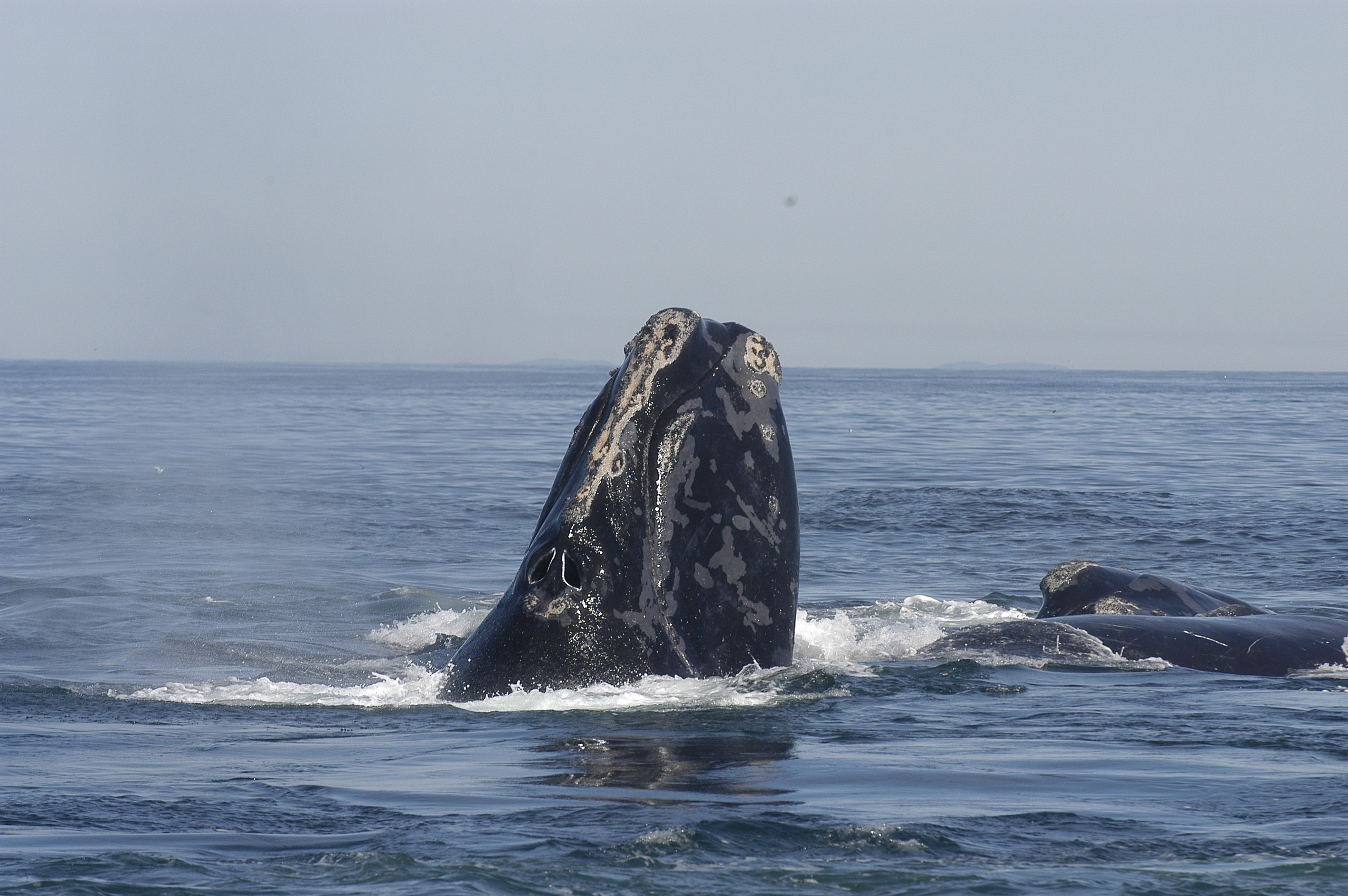
By the early 1890s, commercial whalers had hunted North Atlantic right whales to the brink of extinction. Because of their docile nature, their habit of swimming slowly close to the surface and quite near the coast, and their high blubber content which makes them float when they are killed, right whales were once a key target for whalers. This gave them their name: they were the "right" whales to hunt. Whaling was banned in 1937 and is no longer a threat. But the North Atlantic right whales have never recovered their pre-whaling numbers.
Entanglement

Too many of the North Atlantic right whales, biologists say, are getting entangled in fishing gear for the critically endangered species to survive. More than 85% of the animals have been entangled at least once in their lifetimes. The lines can cut into a whale’s body, causing serious injury, and may result in infection and even death. Entangled whales are forced to tow heavy ropes for many kilometres over months or even years, before either being freed or shedding it by themselves—or succumbing to their injuries.
The time spent entangled can prevent the whales from feeding and sap the energy they need to swim, feed and, in the case of females, to give birth and suckle their young. Scientists think entanglements are one reason why female right whales may be having fewer calves.


What is termed an "Unusual Mortality Event" began in 2017 when 17 right whale deaths were recorded. Since then, 34 right whales have died, while a further 16 have been seriously injured, mainly due to entanglements and vessel collisions. Though the numbers are small, they are having a significant impact on an endangered species for which deaths are taking place faster than births.
Protecting the whales
New protections for the right whales introduced by the USA's National Oceanic and Atmospheric Administration (NOAA) in August 2021 have had a significant impact on the lobster industry in Maine, which employs more than 10,000 lobstermen. The new regulations are designed to prevent the lobstermen from trapping the lobsters in baited pots attached to buoys by lines. It is these lines that can entangle the whales. The lines will be either reduced in number or deliberately weakened so that whales can break free before becoming seriously injured.
In 2022, some retailers stopped selling Maine lobster in response to guidelines set out by the the Marine Stewardship Council and Seafood Watch.

Is there a future for lobster fisheries?

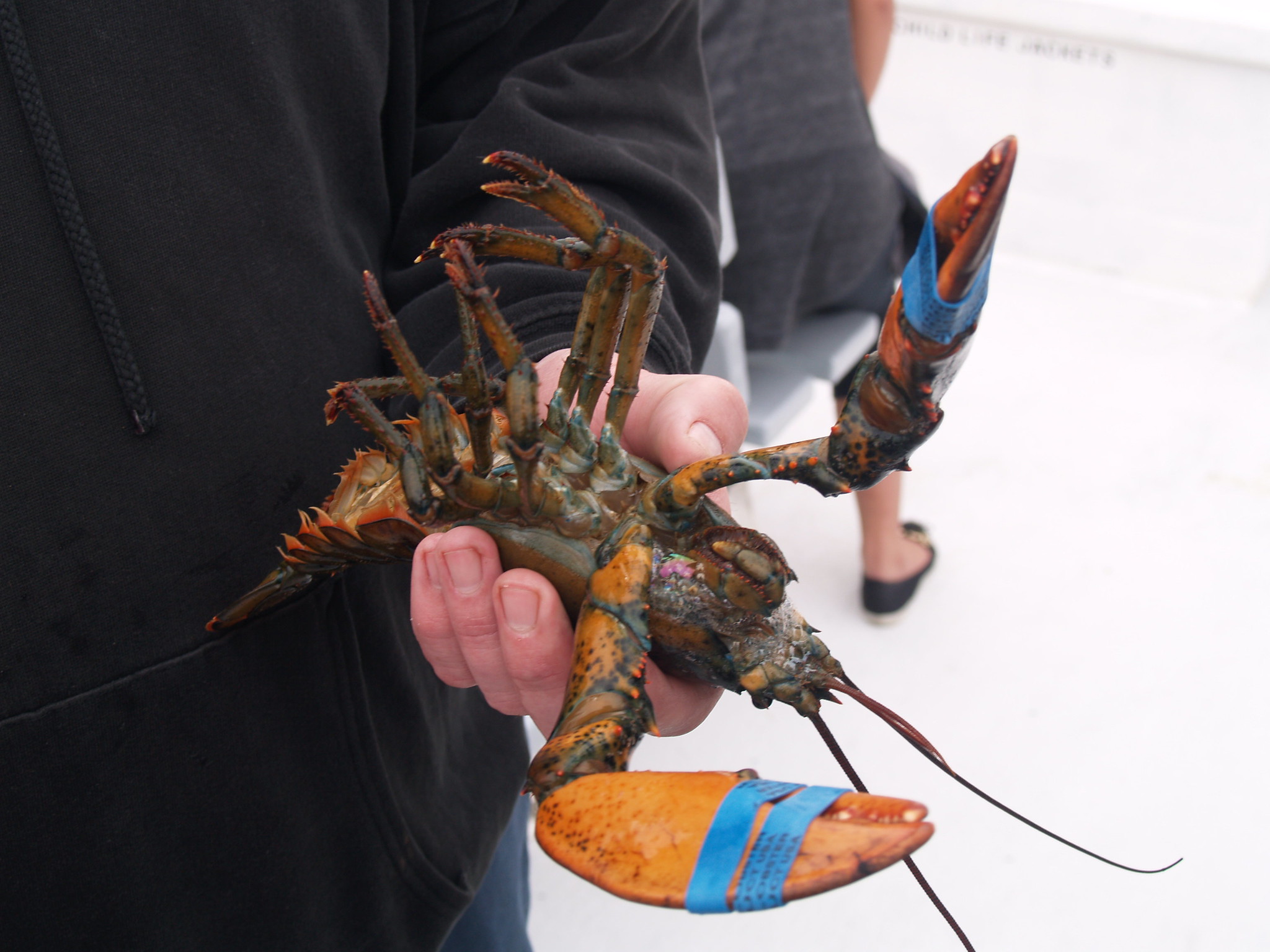
For their part, Maine lobstermen—for whom lobster fishing is their livelihood—say they are already doing everything required under the law to reduce the risk of entangling right whales. They have already fitted weak links in their lines and marked gear with purple to identify traps. They point out that the last whale known to get entangled in lobster lines from Maine was in 2004.
Some scientists argue that it rarely possible to determine exactly where a whale got entangled in the first place. And sometimes the only evidence of entanglement is deep scars on a whale's dead body when it is washed ashore.
Technology offers a way forward. “Ropeless” lobster pots, which can be triggered by acoustic signals to rise to the surface using an inflatable device, are now available. They are, however, more costly than traditional lobstering equipment.
pics
Without in any way limiting Q-files Ltd’s exclusive rights under copyright, any use of this publication to “train” generative artificial intelligence (AI) technologies to generate text is expressly prohibited. Q-files Ltd reserves all rights to license use of this work for generative AI training and development of machine learning language models.