
Astronomy

CITE
We have made every effort to follow citation style rules, but there may be some minor differences. If in doubt, please refer to the appropriate citation style manual.
Hayabusa2 mission to asteroid Ryugu. (2026). In Q-files Encyclopedia, Space, Astronomy. Retrieved from
https://www.q-files.com/space/astronomy/hayabusa2-mission-to-asteroid-ryugu
"Hayabusa2 mission to asteroid Ryugu." Space, Astronomy, Q-files Encyclopedia, 25 Mar. 2026.
https://www.q-files.com/space/astronomy/hayabusa2-mission-to-asteroid-ryugu.
Accessed 13 Sep. 2026.
Hayabusa2 mission to asteroid Ryugu 2026. Space, Astronomy. Retrieved 13 September 2026, from
https://www.q-files.com/space/astronomy/hayabusa2-mission-to-asteroid-ryugu
Space, Astronomy, s.v. "Hayabusa2 mission to asteroid Ryugu," accessed September 13, 2026.
https://www.q-files.com/space/astronomy/hayabusa2-mission-to-asteroid-ryugu


Hayabusa2 mission to asteroid Ryugu
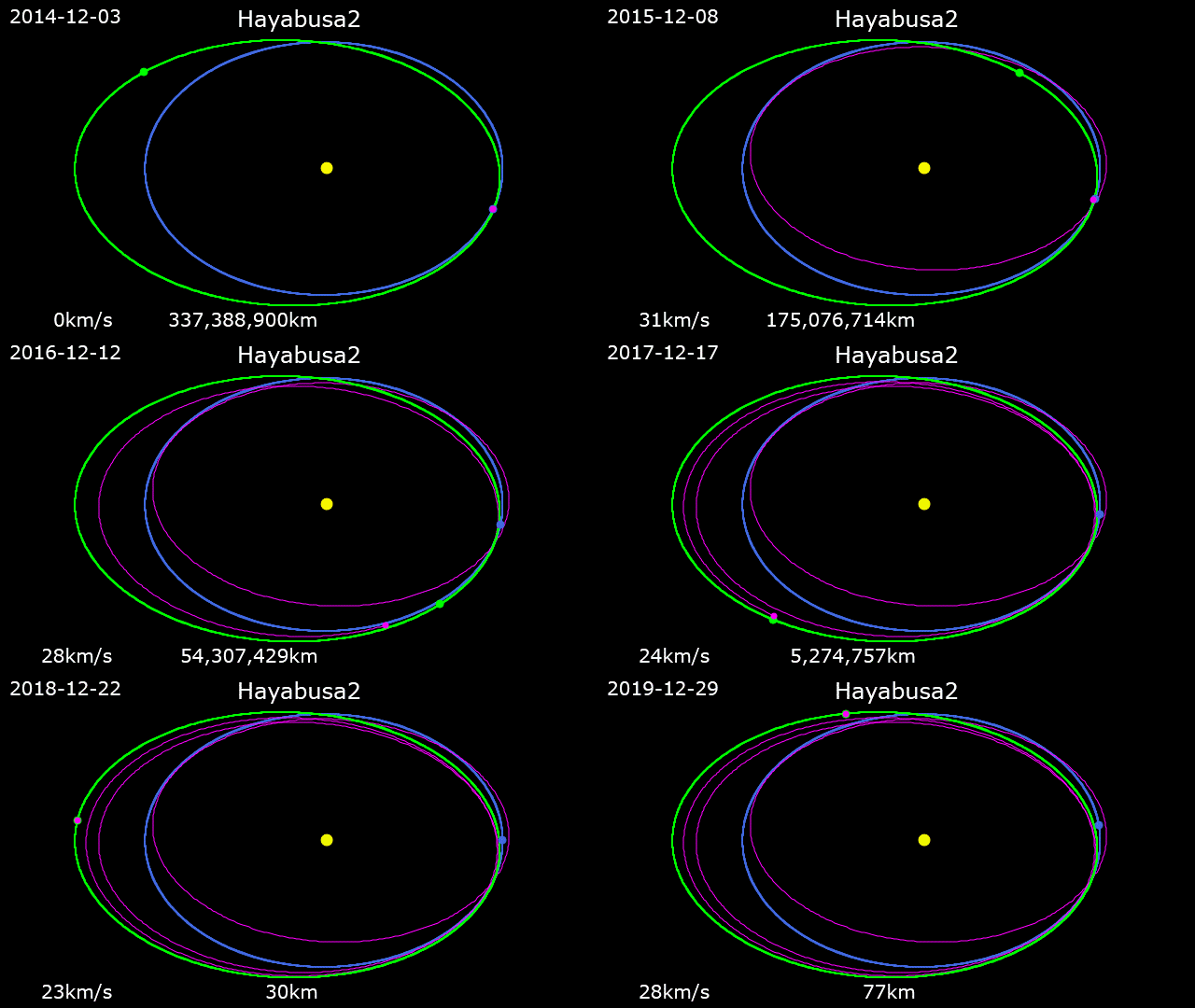
The Japan Aerospace Exploration Agency (JAXA) space probe Hayabusa2 (hayabusa is Japanese for "falcon") was launched on 3rd December 2014. Its mission was to study the asteroid Ryugu, collect rock samples from it and bring them back to Earth for detailed analysis. Hayabusa2 arrived at Ryugu on 27th June 2018. It departed the asteroid in December 2019 to return the samples it collected from the asteroid to Earth in December 2020. The space probe is equipped with a number of scientific instruments, including a range of cameras, a Light Detection And Ranging (LIDAR) instrument, a sampling device, an impactor (SCI) and four robotic rovers. Hayabusa2 released them—at different dates—from an altitude of about 60 metres (200 feet), allowing them to fall freely to Ryugu's surface.


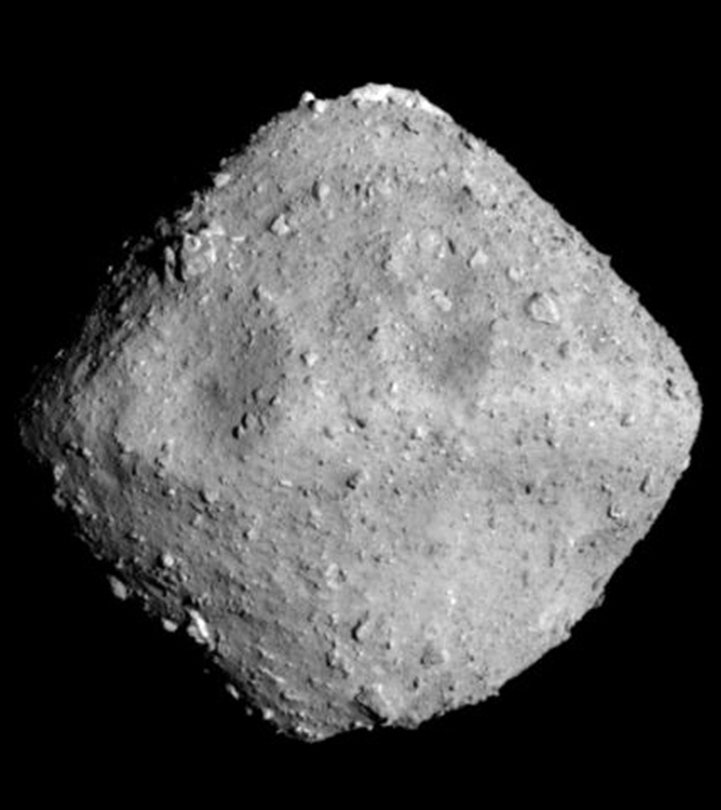
Ryugu
The asteroid Ryugu orbits the Sun between Earth and Mars, sometimes moving inside Earth's orbit. It comes to within 95,400 kilometres (60,000 miles) of Earth and so is classified as a Near-Earth Object (NEO). Ryugu is a type of asteroid that is made up of mixture of minerals, ice and organic compounds formed at the time of the birth of the Solar System. Studying it is expected to provide more knowledge about the origin of water and living things on Earth—whether these could have come from asteroids.
It may also be possible, from close study of Ryugu, to find a way reduce the threat of any future collision by developing an effective defence. (At present, no asteroid is known to be on a collision course with Earth.)


The asteroid was named Ryugu ("Dragon Palace") after a magical underwater palace in a Japanese folktale. In the story, the fisherman Urashima Taro travels to the palace on the back of a turtle. When he returns, he carries with him a mysterious box—rather like Hayabusa2 returning with samples from the asteroid.

Hopping rovers
The first two small cylindrical robots, 18 centimetres in diameter and 7 centimetres tall (about 7 by 3 inches), were successfully landed on the Ryugu asteroid on 22nd September 2018. They took advantage of the asteroid’s low gravity by hopping around on its surface. The robots were designed to leap as high as 15 metres (50 feet) and stay in the air for as long as 15 minutes, enabling them to survey the asteroid’s landscape from above.
MASCOT
One of Hayabusa2's rovers, called MASCOT (Mobile Asteroid Surface Scout), carried out detailed observation of Ryugu's surface, investigating the rocks and magnetic properties of the asteroid. MASCOT was released from the space probe in early October 2018 and, upon landing, hopped around on Ryugu, conducting measurements for about 16 hours. MASCOT could hop up a distance of 70 metres (230 feet), enabling it to make observations at several different locations on the asteroid.


Impactors
On two occasions, in February and April 2019, Hayabusa2 shot copper missiles ("impactors") at Ryugu. The first was intended to collect material from the surface. It began with the probe's descent, firing the impactor into the ground and gathering the resulting rock fragments in a catcher, before ascending.
The second impactor was designed to obtain material from beneath the surface. This required the use of a free-flying gun to blast a small crater in Ryugu's surface with greater force than the first impactor. Hayabusa2 then descended a second time to collect the "pristine" material from inside the asteroid—rock that has not been exposed to solar radiation or cosmic radiation. Analysing it may reveal whether elements from space helped give rise to life on Earth.
Return journey
In November 2019, Hayabusa2 started its return journey to Earth. In December 2020, a re-entry capsule with containers that carried the asteroid samples was released into Earth's atmosphere and down to the surface for collection by mission scientists. The probe itself sailed on past Earth. Hayabusa2 has now been directed towards other asteroids to explore. It will perform a fly-by of Torifune in July 2026 and rendezvous with an NEO of the Apollo group in July 2031.


Consultant: Mike Goldsmith
pics


Without in any way limiting Q-files Ltd’s exclusive rights under copyright, any use of this publication to “train” generative artificial intelligence (AI) technologies to generate text is expressly prohibited. Q-files Ltd reserves all rights to license use of this work for generative AI training and development of machine learning language models.