
Astronomy

CITE
We have made every effort to follow citation style rules, but there may be some minor differences. If in doubt, please refer to the appropriate citation style manual.
Cassini mission to Saturn. (2026). In Q-files Encyclopedia, Space, Astronomy. Retrieved from
https://www.q-files.com/space/astronomy/cassini-mission-to-saturn
"Cassini mission to Saturn." Space, Astronomy, Q-files Encyclopedia, 25 Mar. 2026.
https://www.q-files.com/space/astronomy/cassini-mission-to-saturn.
Accessed 2 Nov. 2026.
Cassini mission to Saturn 2026. Space, Astronomy. Retrieved 2 November 2026, from
https://www.q-files.com/space/astronomy/cassini-mission-to-saturn
Space, Astronomy, s.v. "Cassini mission to Saturn," accessed November 2, 2026.
https://www.q-files.com/space/astronomy/cassini-mission-to-saturn


Cassini mission to Saturn
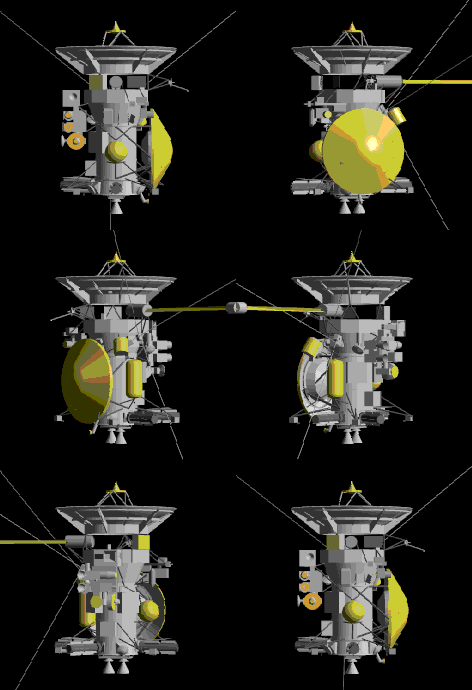
The Cassini–Huygens mission, was a collaboration between NASA, the European Space Agency (ESA) and the Italian Space Agency (ASI) to send a probe to study the planet Saturn, its rings and its moons. The spacecraft was made up of the Cassini orbiter and Huygens lander, which landed on Saturn's largest moon, Titan. Launched on 15th October 1997 and orginally planned to last until May 2008, the Cassini mission was extended twice. It ended on 15th September 2017, when the space probe was deliberately steered into Saturn's atmosphere. There it burned up in order to prevent any risk of contaminating Saturn's moons.


Arrival at Saturn
After a seven-year voyage, on 1st July 2004 the Cassini space probe flew through the gap between Saturn’s F and G rings and completed an orbit of the planet. It was the first spacecraft ever to have orbited Saturn. In a series of fly-bys between July and December 2004, Cassini collected images of Titan, including the lakes of methane on its surface, which looked quite similar to the lakes of water on Earth.
Huygens on Titan
After the Cassini probe made a series of fly-bys of Titan, the Huygens lander separated from the main craft on 25th December 2004. It parachuted down to Titan's surface on 14th January 2005. For 90 minutes it transmitted pictures and information back to Earth. It was the first landing ever accomplished on a moon other than our own.
Spectacular images captured by both Cassini and Huygens reveal a complex network of narrow drainage channels on Titan's surface, running from brighter highlands to lower, flatter, dark regions. These channels merge into river systems flowing into lake beds featuring offshore “islands” similar to those on Earth. However, the liquid involved is not water but methane, a liquid in Titan's extremely cold surface temperatures. Titan's lakes are the first stable bodies of surface liquid to have been found outside of Earth. Most of them lie close to the poles, covering only a small portion of Titan’s surface, which is mostly desert.


The ground is like a beach, but one where the sand is made of ice grains and the pebbles rounded pellets of ice. There aere plains covered in longitudinal sand dunes, formed by winds. Titan also has what may be volcanoes, spewing out plumes of water and ammonia, and mountains with peaks covered in methane snow.
Enceladus fly-bys
Later in 2005 Cassini began a series of fly-bys of Saturn’s moon Enceladus. The images it took of the region surrounding the moon's south pole revealed smooth, crater-free plains with numerous small ridges and scarps. Snaking across this region were four long grooves, each fringed by a mint-green stripe. From these so-called “tiger stripes”, ice volcanoes erupted fountains of water vapour and tiny hailstones 500 kilometres (300 miles) into space. The ejected ice particles were later shown to form Saturn’s E Ring.


The "salty" composition of the fountains suggested they came from a salt-water ocean, around 10 kilometres (6 miles) deep, beneath the moon's crust. Cassini also detected traces of organic compounds in some dust grains, raising the possibility that the ocean might harbour life.
The organic compounds were thought to come from what are known as hydrothermal vents, fissures (narrow openings) in the ocean bed where water seeping into the bedrock is heated and blasted upwards. In the Earth’s oceans, the minerals contained in the jets of water known as “black smokers” provide nutrients for bacteria and colonies of life-forms growing up around them. Scientists were keen to find out whether the same might be found on Enceladus.
In October 2015, the Cassini probe was steered through a fountain of icy spray spurting out of Enceladus’s south polar region on order to find out exactly what chemicals were in the spray. The probe flew through a plume 49 kilometres (30 miles) above the moon’s icy surface. The low flight path enabled Cassini to sample heavier molecules, including organic chemicals. The findings confirmed the likely presence of hydrothermal vents on Enceladus.


Grand Finale
As Cassini’s mission drew to an end and it started to run out of fuel, scientists were keen to ensure that the probe should not go out of control and crash land on to Enceladus or Titan, where any Earth microbes still clinging to parts of the spacecraft might contaminate the moons. So the mission control team decided to destroy the space probe deliberately by steering it directly into Saturn’s atmosphere.

Following its last fly-by of Titan on 21st April 2017, Cassini began what the mission control team called its "Grand Finale”. It looped around Saturn, making a total of 22 dives between the rings and the planet. As it travelled, the tiny probe came within about 3000 kilometres (2000 miles) of Saturn's cloud tops and a mere 300 kilometres (200 miles) of the innermost edge of the rings. Hurtling at speeds of about 124,000 km/h (77,000 mph), Cassini used its dish-shaped antenna (4 metres / 13 feet across) as a shield against any stray rock particles that might have struck it. The sequence of orbits ended with with a final plunge into the planet’s atmosphere on 15th September 2017.


Consultant: Mike Goldsmith
pics


Without in any way limiting Q-files Ltd’s exclusive rights under copyright, any use of this publication to “train” generative artificial intelligence (AI) technologies to generate text is expressly prohibited. Q-files Ltd reserves all rights to license use of this work for generative AI training and development of machine learning language models.