
Planet Earth

CITE
We have made every effort to follow citation style rules, but there may be some minor differences. If in doubt, please refer to the appropriate citation style manual.
Earth's interior. (2026). In Q-files Encyclopedia, Earth, Planet Earth. Retrieved from
https://www.q-files.com/earth/planet-earth/earths-interior
"Earth's interior." Earth, Planet Earth, Q-files Encyclopedia, 6 Mar. 2026.
https://www.q-files.com/earth/planet-earth/earths-interior.
Accessed 22 Sep. 2026.
Earth's interior 2026. Earth, Planet Earth. Retrieved 22 September 2026, from
https://www.q-files.com/earth/planet-earth/earths-interior
Earth, Planet Earth, s.v. "Earth's interior," accessed September 22, 2026.
https://www.q-files.com/earth/planet-earth/earths-interior


Earth's interior
On the outside, the Earth seems hard and solid. But if you could make a journey down a deep hole almost 6400 kilometres (4000 miles) to the centre of the planet, you would notice several changes as you descend. It becomes warm, then hot. This comes from what is called geothermal energy. The average increase in temperature is about 3°C for every 100 metres (8°F for every 500 feet) of depth. You pass through hard, rocky crust down through the hot, thick, molten rocks of the mantle to the liquid outer core. When you reach the inner core there is no rock at all: it is almost solid metal. Studying shock waves from earthquakes has enabled scientists to build an accurate picture of the interior layers of the Earth.
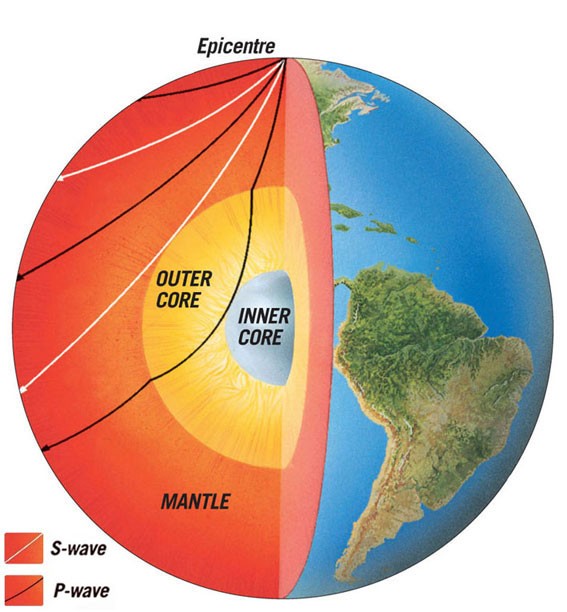
Layers inside the Earth
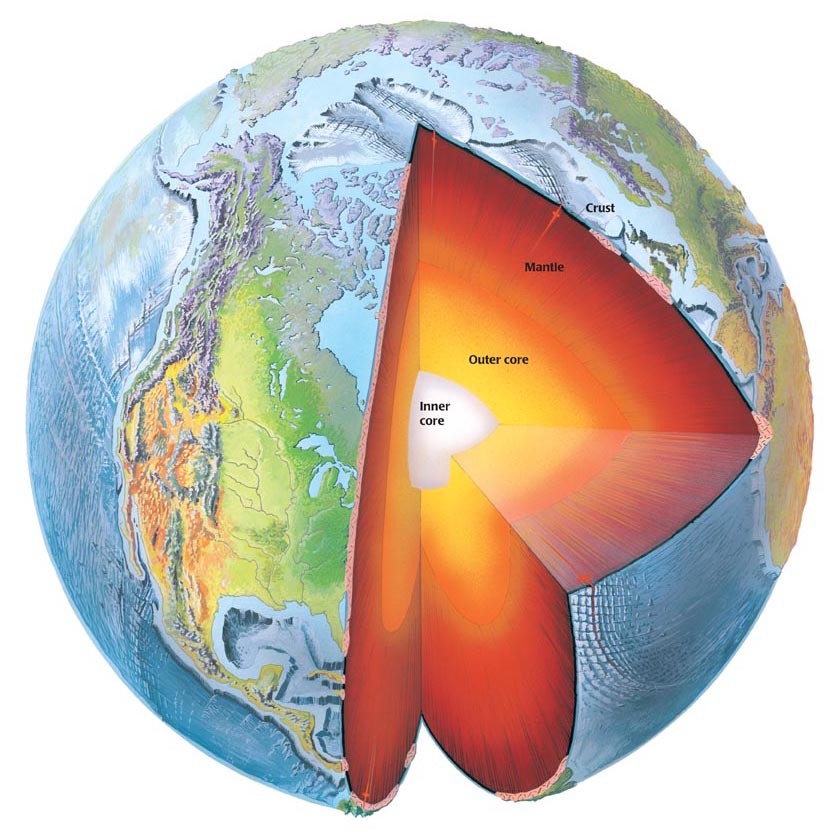
The four main layers of the Earth are the crust, mantle, outer core and inner core. At the base of the crust is a boundary called the Moho (Mohorovicic discontinuity). This separates the crust from the mantle and the temperature here is about 1500°C (2700°F). The mantle is about 2900 kilometres (1800 miles) thick. The next layer is the outer core which is about 2200 kilometres (1400 miles) thick. At the centre is the inner core, a solid ball of iron with a radius of about 2500 kilometres (1550 miles).
Crust
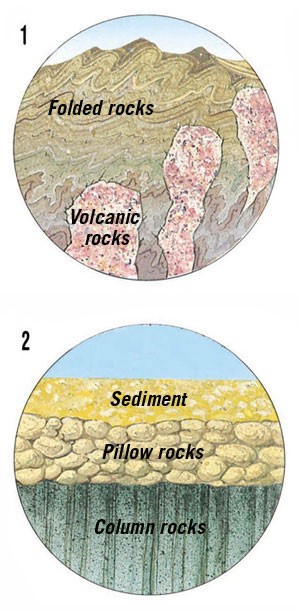
The crust is thinner in proportion to the whole Earth than the skin on an apple. The crust itself is solid rock and varies in depth. Under the oceans it is about 5–10 kilometres (3–6 miles) thick, with the liquid ocean above. The oceanic crust is made mainly of basalt-type rocks. Under the main land masses, or continents, it is 35–70 kilometres (20–40 miles) thick and made chiefly of granite-type rocks. The higher the mountains above, the deeper the crust below.
Continental crust consists of complicated masses of old rocks, broken up, squashed together and heated many times over. Oceanic crust is composed of rocks that are much younger. Beneath a layer of sediment lie volcanic rocks that have cooled in the shapes of pillows and columns.
The crust, taken together with a thin layer of the upper mantle, is known as the lithosphere. It is split into large slabs called tectonic plates.
Mantle
The boundary between the crust and the mantle is called the Mohorovicic Discontinuity, or Moho for short. The mantle stretches roughly halfway down to the centre of the Earth. The mantle has two layers. Its upper part is about 600 kilometres (375 miles) thick and made of crystals of rock with molten or liquid rock between them. Its temperature is about 1500°C (2700°F) and the molten rock, known as magma, can flow like hot tarmac. It is under great pressure and sometimes bursts out of holes or cracks at weak points in the crust as the red-hot lava of volcanic eruptions.
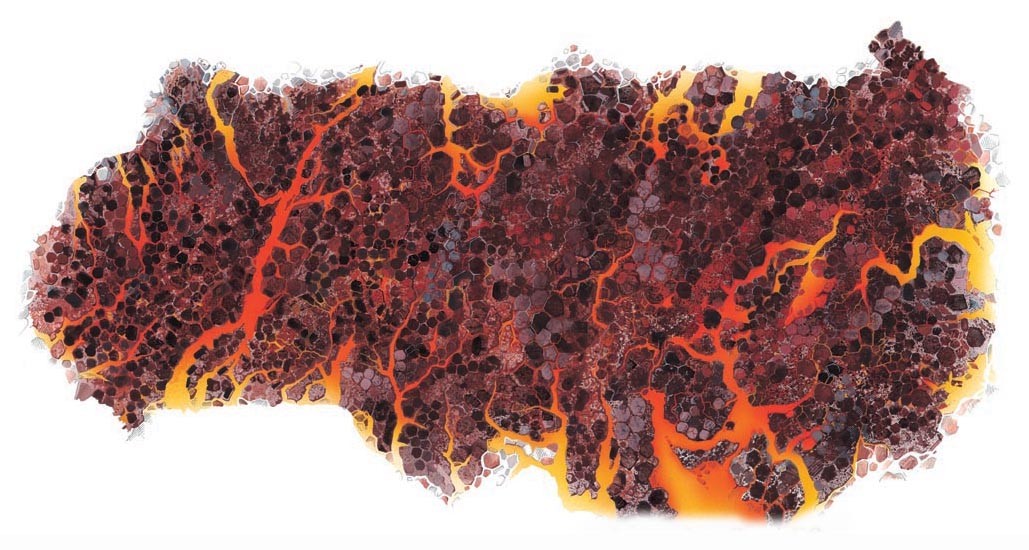
The lower mantle is about 2400 kilometres (1500 miles) thick. Here, the pressure is so great that the rock here is solid—but not completely rigid. It is “plastic” and, very gradually, moves.
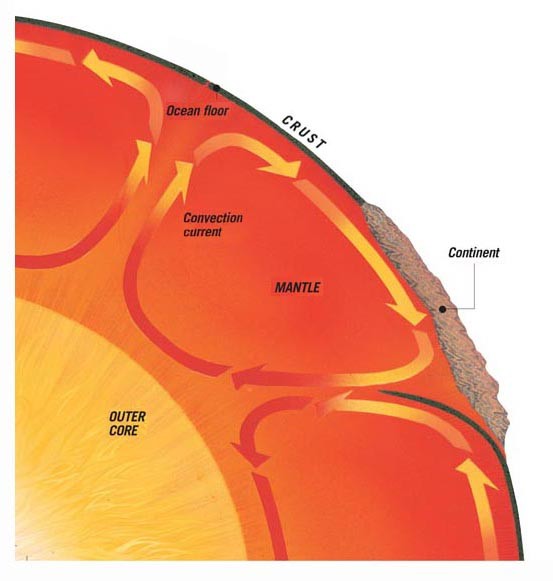
Heat flows through the mantle in giant circles, called convection currents. As plumes of heated rock rise and fan off in different directions, the ocean floor at the Earth’s surface is gradually spread apart. When cooler rock sinks down in subduction zones, it is swallowed up in the depths of the mantle. Eventually the rock will be re-heated close to the outer core and sent on its way back up to the surface.
Outer core
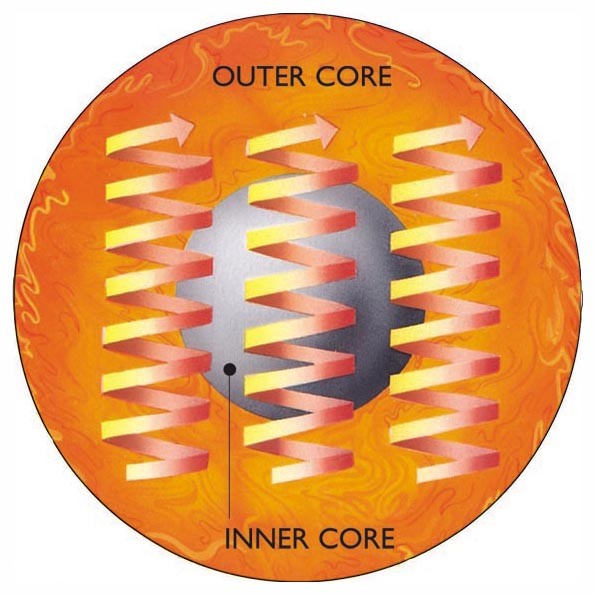
This boundary between the mantle and the core is called the Gutenberg Discontinuity, after the scientist who first discovered it. Suddenly, after the monotonous, dense rock of the mantle, there is a sudden change. The material is no longer rock, but metal—mainly iron plus small amounts of nickel, plus probably a little sulphur and oxygen. The temperature soars up to about 4000°C (more than 7000°F) just inside the core-mantle boundary. The iron of the outer core is liquid, and, as a result of the Earth's rotation, flows in giant corkscrew-like currents, or “rollers”. These produce the magnetic field of the Earth.
Inner core
The temperature rises still more at the inner core, to perhaps up to 5400°C (9800°F) at the centre of the planet. But the enormous pressure—about 3.6 million times that at the surface—means that the iron crystals are squashed into a solid ball. The inner core may gradually be growing at the expense of the outer core, as more liquid material solidifies at the boundary between the two layers.
How the core formed
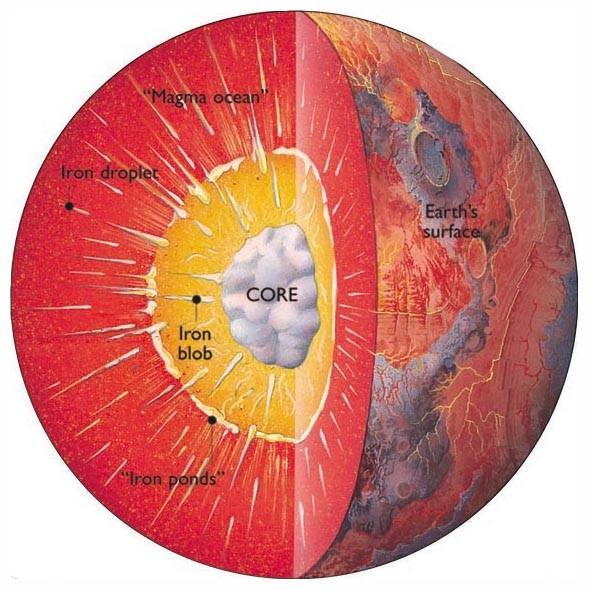
Some 4600 million years ago the Earth—along with the Sun and other planets—formed from clouds of gas and dust in space. Some of this matter clumped together to form the early Earth. At this time, the Earth was intensely hot. A large “magma ocean” containing various materials swirled around just beneath the surface. Silica (silicon combined with oxygen), which has a lower density, rose upwards to form the rocks of the Earth’s upper layers, the mantle and crust. The dense metal, iron, sank slowly to form the planet’s core. Iron-rich droplets sunk to the bottom of the magma ocean. There, the droplets collected in “iron ponds”, before sinking further as large blobs to accumulate in the central core.
Studying meteorites
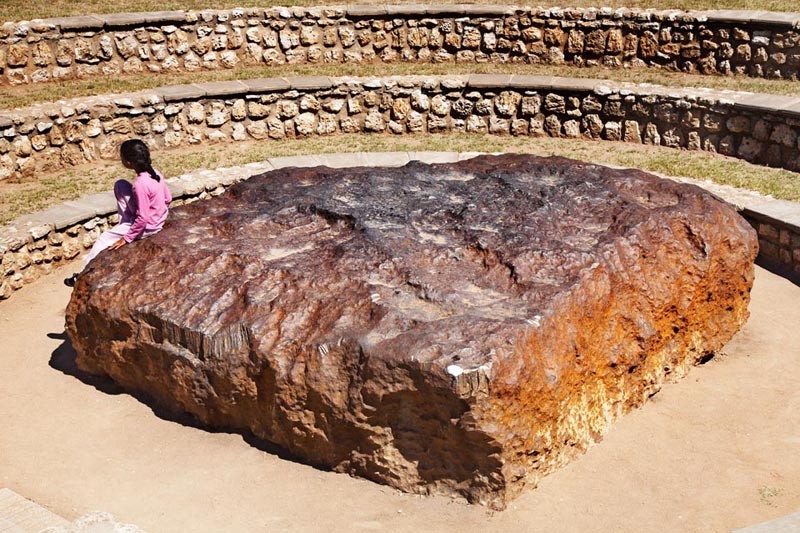
Meteorites are fragments of asteroids or planet-like bodies that have crashed to Earth from space. Meteorites of different composition that have been found around the world probably originate from the different layers inside asteroids. There are dense, iron meteorites that probably came from asteroid cores, while stony meteorites came from the asteroids' mantles or crusts. From this evidence, scientists conclude that the Earth's core must also be made of iron.
Consultant: Ian Fairchild
pics
Without in any way limiting Q-files Ltd’s exclusive rights under copyright, any use of this publication to “train” generative artificial intelligence (AI) technologies to generate text is expressly prohibited. Q-files Ltd reserves all rights to license use of this work for generative AI training and development of machine learning language models.