
Exploration
Ferdinand Magellan
In 1519 five ships set sail from Spain. They were commanded by Ferdinand Magellan. Although Magellan was born in Portugal, he was in the service of King Charles I of Spain. He planned to sail down the coast of South America and round its southernmost tip. His aim was to sail west to find a route to the Spice Islands in the Far East, because the eastwards route around Africa was forbidden to Spanish ships by Portugal. In fact, Magellan’s fleet became the first to sail right around the world, although Magellan himself was killed on the journey, in the Philippines.


Sailing west
The Portuguese had controlled the spice trade since Vasco da Gama’s voyage to India in 1498. The Spanish were keen to gain this trade, too, but their way to the Spice Islands in the Far East was barred by the Treaty of Tordesillas (1494), which gave that route to Portugal. Like Columbus, Magellan believed it was possible to reach the Spice Islands from Europe by sailing west. So Magellan was offered five ships by the Spanish to find this new route.
Magellan's ships


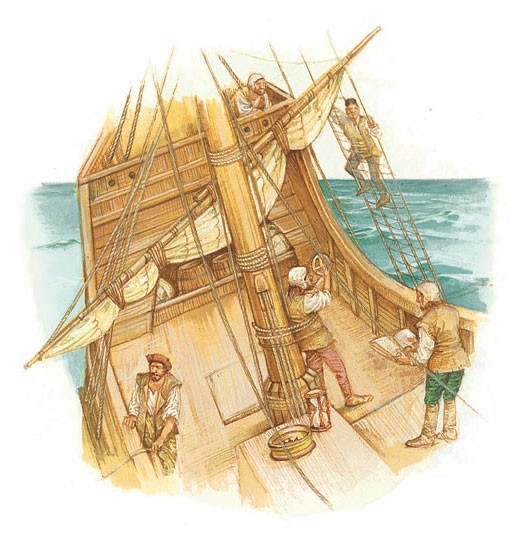
Magellan set out with five ships and 277 men of several different nationalities, including Portuguese, Italian, German, Greek, English and French as well as Spanish. His flagship was the Trinidad, the only ship in the fleet armed with cannon, as defence against pirates. The wooden ship, only around 30 metres (100 feet) long, had to carry sufficient food for a long journey.
The other ships were the San Antonio, Concepción, Santiago and Victoria. Valuable supplies were lost when the Santiago was wrecked off the coast of South America.
Patagonia
During 1519 the fleet sailed down the coast of South America, searching for a passage through to another ocean. They spent the winter months in San Julián, in modern-day Argentina. Here, the crew saw locals whom they called patagones, or “big feet”, giving the region its modern name, Patagonia. While there, three of the ships mutinied, but Magellan dealt with the ring-leaders very harshly: he executed three of them and stranded two more ashore.


Strait of Magellan
Eventually, in October 1520, Magellan guessed he had found the passage, because the waters, reaching deep inland, were salty rather than the freshwater of a river mouth. The ships sailed through the hazardous, 600-kilometre (370-mile) channel into the Pacific. He called it the Estrecho de Todos los Santos ("All Saints' Channel") for the date they sailed: 1st November, All Saints' Day. It was later named the Strait of Magellan.
Across the Pacific
It took much longer than expected to cross the Pacific Ocean: four months. Many of the crew caught scurvy (caused by lack of vitamin C in their diet) or died of starvation. Food ran out. Even the rats were skinny, but the Spaniards ate them anyway. In the end they boiled their boots and ate them, too.

Magellan's ships reached the island of Guam in the western Pacific in March 1521. It was nicknamed “Thieves’ Island”, because the locals stole from the Europeans. As punishment, Magellan burnt down a village.

Return journey
Magellan was killed by islanders during a dispute in the Philippines, but his men made it to the Spice Islands (modern-day Maluku Islands, part of Indonesia). Here the Trinidad, along with its cargo of spices bound for Spain, was captured by Portuguese sailors. Under the captaincy of Juan Sebastián Elcano, the last surviving ship, the Victoria, sailed on across the Indian Ocean. She had to sail through unknown waters, weathering fierce storms and the threat of Portuguese attack.
Arrival in Spain
The Victoria finally reached Spain in September 1522, 1082 days after leaving. Only 18 men (plus four Spice Islanders), out of the 277 who set off, staggered ashore. After their return, the survivors took part in a procession to Seville Cathedral, to give thanks.


Consultant: Philip Parker