
India

CITE
We have made every effort to follow citation style rules, but there may be some minor differences. If in doubt, please refer to the appropriate citation style manual.
Mughal India. (2025). In Q-files Encyclopedia, History, India. Retrieved from
https://www.q-files.com/history/india/mughal-india
"Mughal India." History, India, Q-files Encyclopedia, 8 Apr. 2025.
https://www.q-files.com/history/india/mughal-india.
Accessed 20 Oct. 2026.
Mughal India 2025. History, India. Retrieved 20 October 2026, from
https://www.q-files.com/history/india/mughal-india
History, India, s.v. "Mughal India," accessed October 20, 2026.
https://www.q-files.com/history/india/mughal-india


Mughal India
The Mughal Empire was founded in 1526, when Babur, a ruler from Afghanistan, and his invading army were victorious over the Delhi Sultanate under Ibrahim Lodi in the First Battle of Panipat. The following year Babur took on and defeated the army of the Rajput Confederacy led by Rana Sanga of Mewar at the Battle of Khanwa. Babur could trace his ancestry back to the Mongol emperors Tamerlane and Genghis Khan of the 13th and 14th centuries. He was the first of the six great Mughals (Babur, Humayun, Akbar, Jahangir, Shah Jahan and Aurangzeb) who ruled over an empire that stretched across almost the whole of modern India. The Mughal rulers were Muslims, while the majority of their subjects were Hindus. The Mughal Empire in India lasted until 1858, when it was taken over by the British.

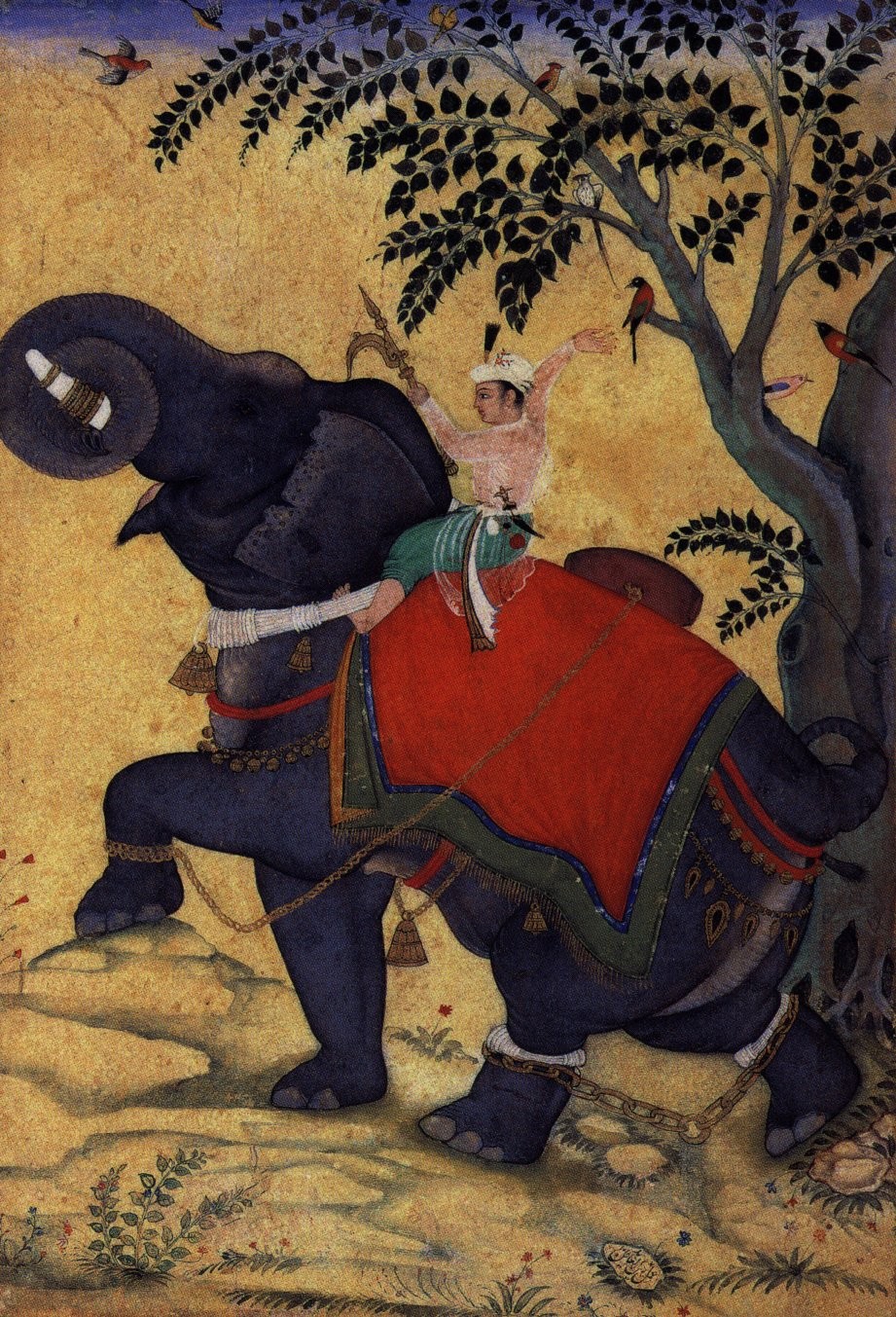
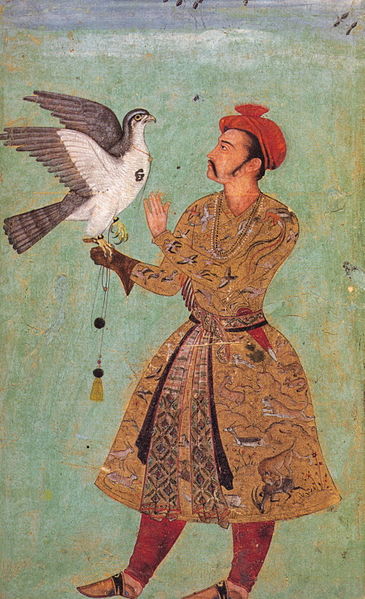
Akbar the Great
Babur’s grandson Akbar (reigned 1556–1605) is considered to be the greatest of the Mughal emperors. He came to power in 1556 when he was only 13 years old. His military campaigns, some undertaken while he was still a boy, consolidated Mughal rule in the Indian subcontinent. His armies took Delhi and Agra, then gained control of the Punjab. In the 1560s, Akbar began the conquests of Malwa and Rajputana, before annexing Gujarat (1573) and Bengal (1575). Afghanistan, Sindh, Kashmir, Qandahar (in Hindu Kush) and Balochistan were in Mughal hands by the 1580s and 90s.
Akbar founded a new capital southwest of Agra, in 1571. The walled city and imperial palace came to be known as Fatehpur Sikri, the "City of Victory", after his victorious Gujarat campaign in 1573.
The site was chosen because it was the birthplace of his son, Jahangir.
Akbar set up a centralized system of government that helped to develop a strong economy. In order to encourage peace among his subjects, his policies tolerated all religions. His courts at Delhi, Agra and Fatehpur Sikri become known as centres of the arts, letters and learning. Akbar also founded a library of 24,000 volumes.

Taj Mahal
The Taj Mahal lies beside the River Yamuna near Agra in the present-day state of Uttar Pradesh. When his beloved wife Mumtaz Mahal died in 1631, Akbar's grandson Shah Jahan (see below), vowed to build the most beautiful tomb in the world for her. Work on the tomb started in 1632 and continued for 22 years. No one knows for sure who designed it, although it is traditionally said to have been designed by Isa Khan, a Persian architect. Called the Taj Mahal ("Crown of Palaces"), the building is made of white marble, studded with thousands of jewels.

Mughal conquests
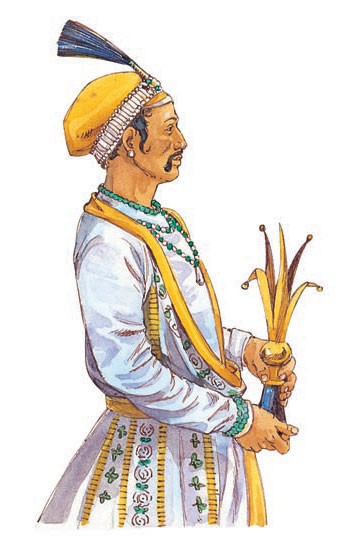
Shah Jahan (reigned 1628–58) extended the Mughal Empire southwards into the territories of the Deccan Sultanates. He defeated the Nizam Shahi dynasty and forced the Adil Shahis and Qutb Shahis to pay tribute. Shah Jahan's son Aurangzeb (1658–1707) continued the campaign of conquest by defeating the Deccan Sultanates of Golconda and Bijapur, and fighting rebellions led by the Marathas (see below). Aurangzeb's conquests gained him the title Alamgir ("Conqueror").

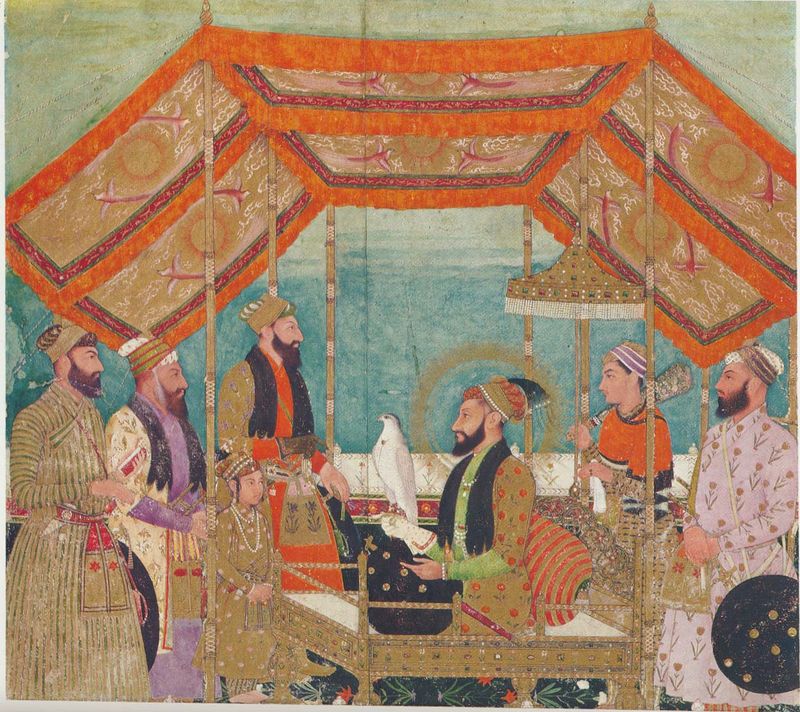
Under Aurangzeb, the Mughal Empire reached its greatest extent: it now spanned nearly the whole of the Indian subcontinent. The empire also surpassed Qing China as the world's largest economy and greatest manufacturing power. But Aurangzeb's military campaigns severely depleted the Mughal treasury, while the emperor's absence led to a loss of Mughal control in northern India.
Aurangzeb died in 1707 at the age of 88 and, following the death of his son Bahadur Shah five years later, the Mughal dynasty went into decline. The emperors lost authority and some local rulers took power themselves in their own provinces, leading to a break-up of the empire. Large parts of northern and central India, from the Punjab to Bengal, fell into the hands of the Maratha Empire.
Maratha Empire
The Marathas were Marathi-speaking nobility from the western Deccan (present-day Maharashtra). They rose to prominence under the leadership of Shivaji Bhosale (1630–80). He led a revolt against the Adil Shahi of Bijapur, one of the Deccan Sultanates, defeating their forces at the Battle of Pratapgarh in 1659. Shivaji also led revolts against the Mughals. In 1674, he was formally crowned Chhatrapati (monarch) of his realm at Raigad Fort.
Following Shivaji's death in 1680, his son Sambhaji took power, leading the Marathas through what would become the 27-year-long Deccan Wars against the Mughals. When Sambhaji was captured and killed in 1689, the fight continued under his brother Rajaram and, on his death in 1700, Rajaram's queen, Maharani Tarabai.
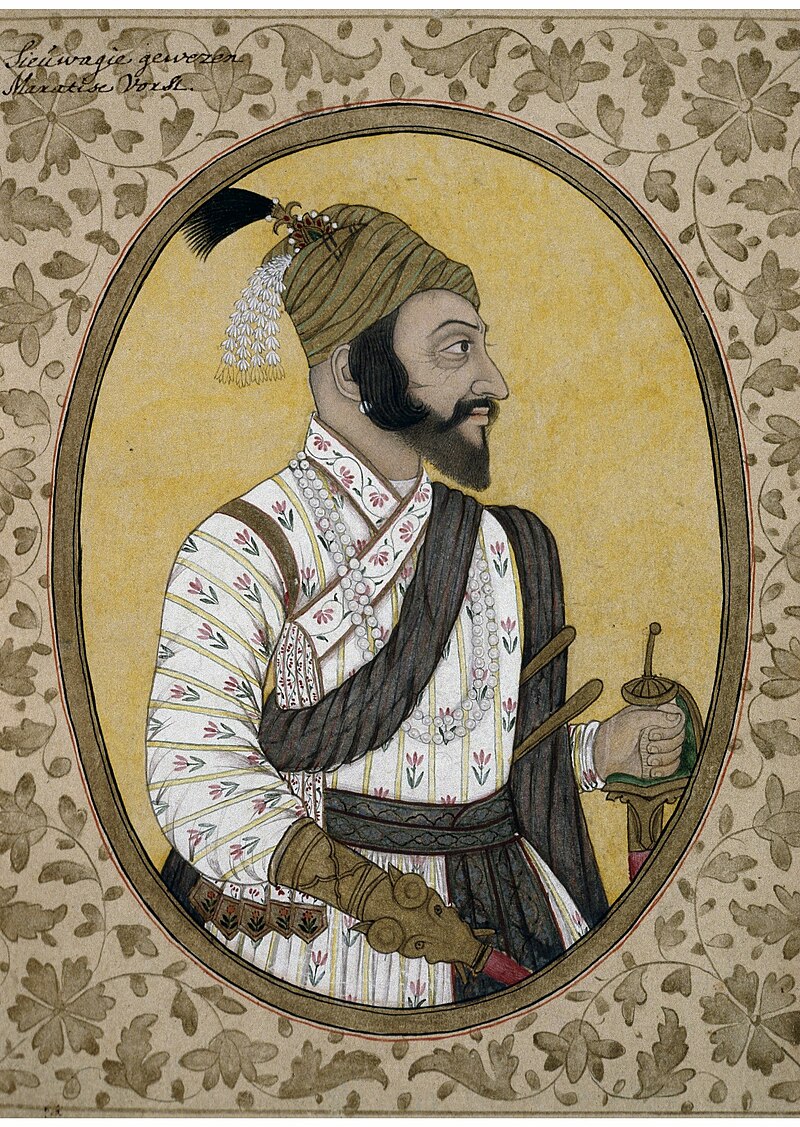
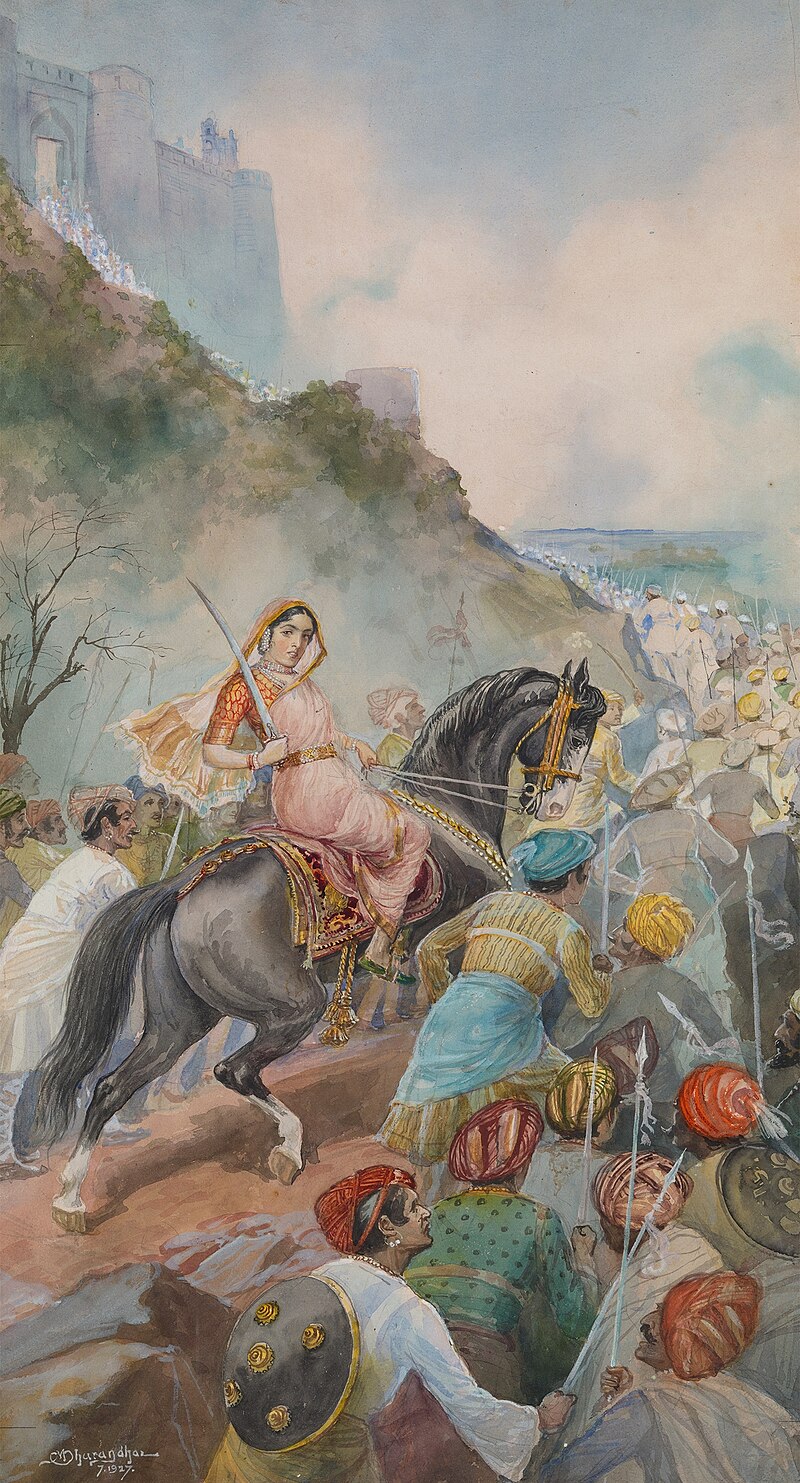
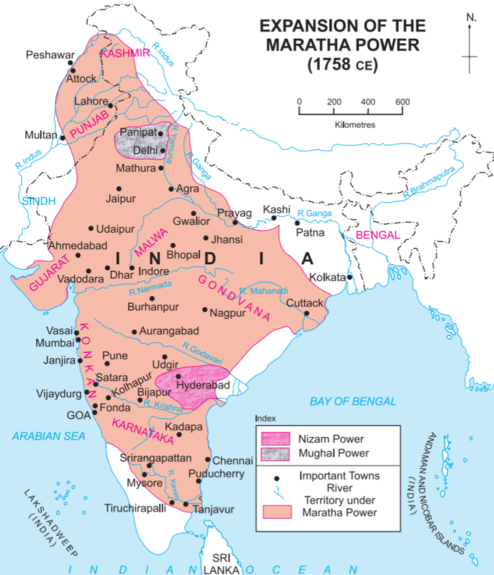
After the death of the Mughal emperor Aurangzeb in 1707, Sambhaji's son Shahu, who had been held in captivity by the Mughals, was released. Shahu appointed Balaji Vishwanath—and later, his descendants—as peshwas (prime ministers) of the Maratha kingdom.
Maratha territories expanded greatly under Balaji's son, Peshwa Bajirao. Following Shahu's death in 1749, the peshwas became the effective rulers of the Maratha Empire (also called the Maratha Confederacy) and extended their conquests of Mughal lands in northern and central India, including their capital, Delhi, in 1757.
In the face of Maratha advances, the Mughal emperor Shah Alam II sought help from the Emir of Afghanistan, who beat the Marathas back at the Third Battle of Panipat in 1761. But the Marathas soon recovered most of their lost territories under Peshwa Madhavrao I, recapturing Delhi from Afghan control in 1771. The Marathas then became the protectors of the Mughal dynasty.
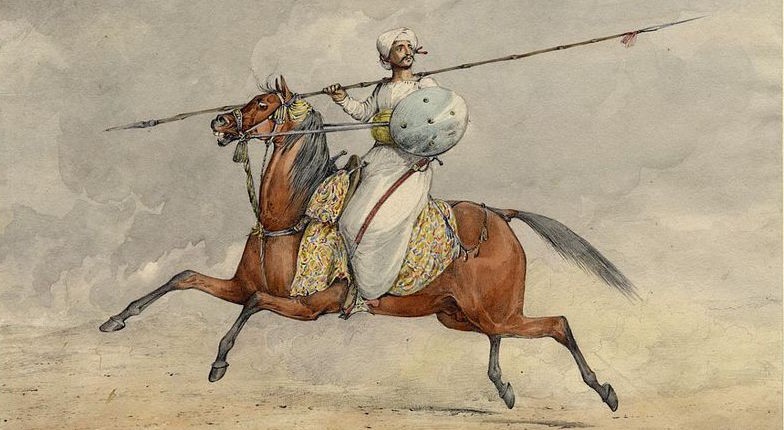
Maratha dominance in India was short-lived, however. They were themselves defeated by the British East India Company in the Second Anglo-Maratha War (1803–05). The British had already taken full control of the former Mughal province of Bengal in 1793. In 1818, after victory in the Third Anglo-Maratha War, they swept aside all remaining Maratha resistance. By 1857, much of India was in British hands. The last Mughal, Bahadur Shah Zafar, emperor in name only, was deposed by the British and forced into exile in 1858.

Sikh Empire
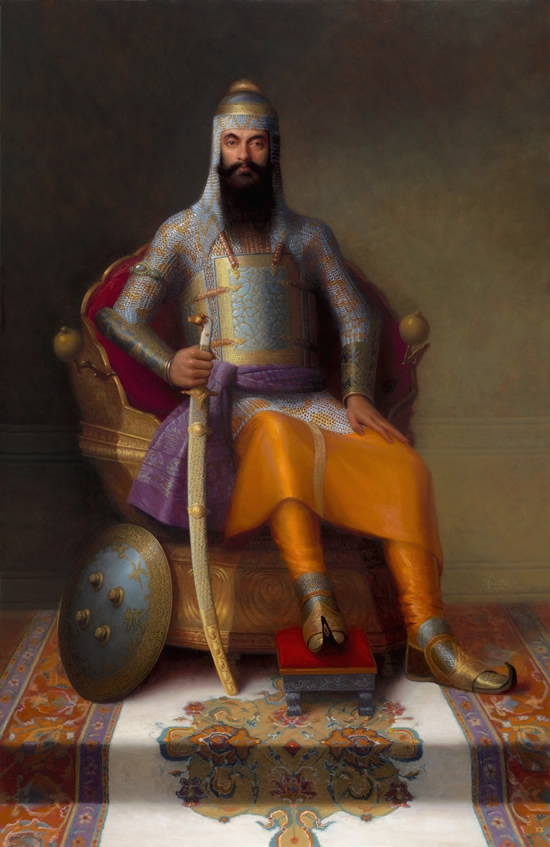
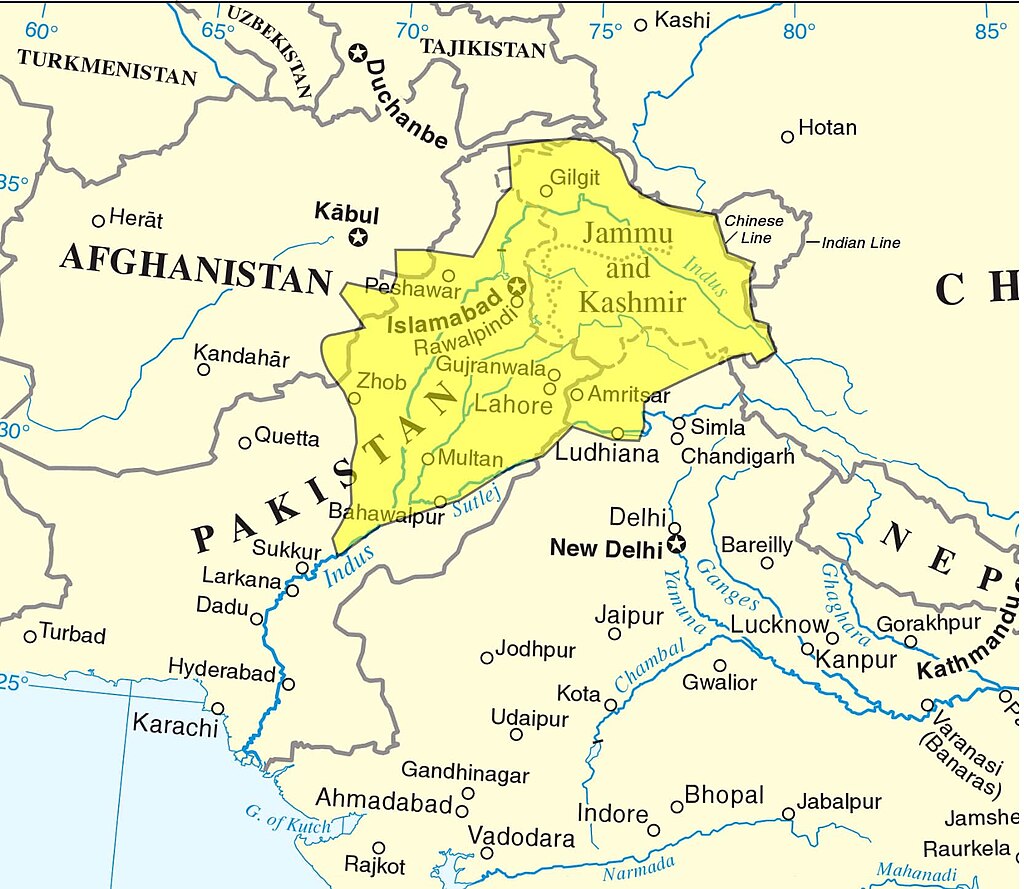
The Sikh Empire was founded in the Punjab region of northwestern India under the leadership of Maharaja Ranjit Singh (1780–1839). His troops captured Lahore from its Afghan ruler, Zaman Shah Durrani, in 1799. Ranit Singh went on to expel the Afghans from the Punjab after defeating them in the Afghan-Sikh Wars. At its peak in the early 19th century, the empire extended across a large area of northern India.
In 1809 Ranjit Singh rebuilt the Hamandir Sahib gurdwara in Amritsar, the chief place of worship for Sikhs. In 1830 he had the upper floors covered with gold, giving the building its English name, the Golden Temple. After the death of Ranjit Singh, the empire weakened, and eventually fell to the forces of the British East India Company in 1849. It was one of the last areas of the Indian subcontinent to be conquered by the British.
Consultant: Philip Parker
pics


Without in any way limiting Q-files Ltd’s exclusive rights under copyright, any use of this publication to “train” generative artificial intelligence (AI) technologies to generate text is expressly prohibited. Q-files Ltd reserves all rights to license use of this work for generative AI training and development of machine learning language models.