
EASY READ Ancient worlds

CITE
We have made every effort to follow citation style rules, but there may be some minor differences. If in doubt, please refer to the appropriate citation style manual.
EASY READ What did the Romans build?. (2025). In Q-files Encyclopedia, History, EASY READ Ancient worlds. Retrieved from
https://www.q-files.com/history/easy-read-ancient-worlds/easy-read-what-did-the-romans-build
"EASY READ What did the Romans build?." History, EASY READ Ancient worlds, Q-files Encyclopedia, 5 Dec. 2025.
https://www.q-files.com/history/easy-read-ancient-worlds/easy-read-what-did-the-romans-build.
Accessed 29 Oct. 2026.
EASY READ What did the Romans build? 2025. History, EASY READ Ancient worlds. Retrieved 29 October 2026, from
https://www.q-files.com/history/easy-read-ancient-worlds/easy-read-what-did-the-romans-build
History, EASY READ Ancient worlds, s.v. "EASY READ What did the Romans build?," accessed October 29, 2026.
https://www.q-files.com/history/easy-read-ancient-worlds/easy-read-what-did-the-romans-build


What did the Romans build?
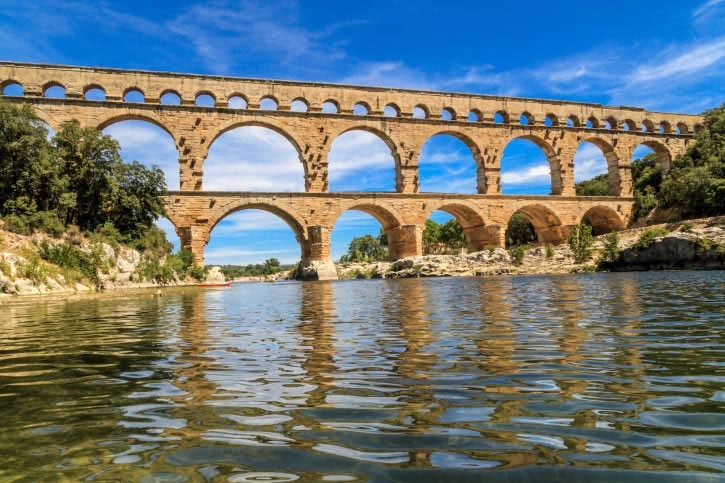
Aqueducts
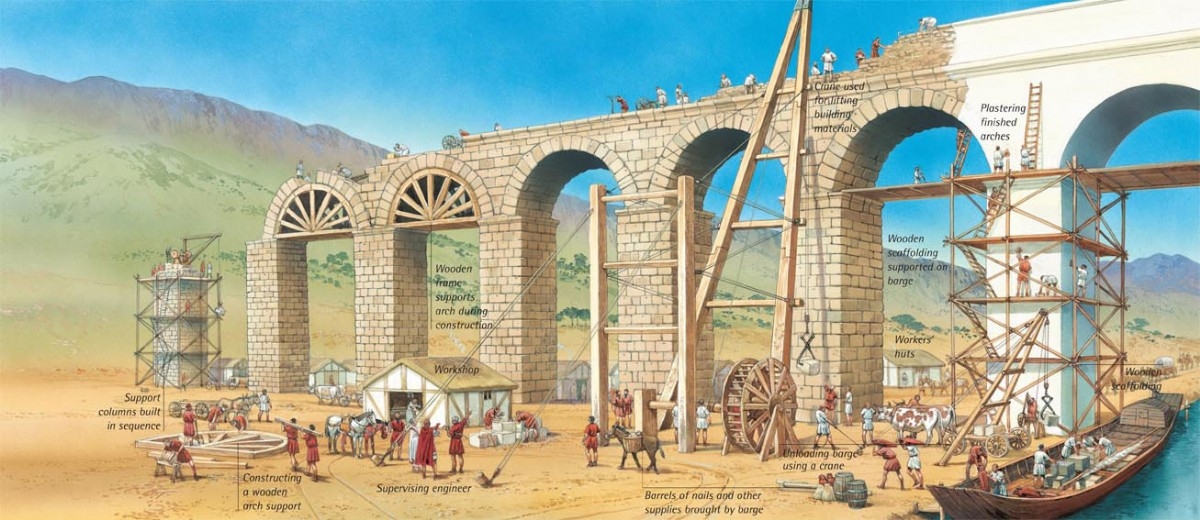
Romans built aqueducts to channel water direct from mountain springs to towns and cities all over the empire. Some aqueducts were more than 40 kilometres (25 miles) long. They had to be built with just the right slope along their length so that the water flowed freely. Where an aqueduct crossed a valley, engineers built a bridge made from stone or brick. Rounded arches were often used: they had great architectural strength.

Roads
Roman roads were built to last. Good roads allowed soldiers, messengers and the delivery of supplies to travel in all weathers. The Romans used their engineering expertise to build long-lasting, straight roads.
To build a road, workers would first dig out a trench. They then stamped down the base of the trench. A layer of sand was laid. Stones and clay followed, then a layer of concrete with stones or broken pottery. A final layer of concrete or flat slabs completed the road.

Concrete
The Romans invented concrete, a mixture of lime, volcanic ash, stones and water. After it had dried and hardened, it became a building material that was both strong and light. Many Roman buildings and structures have concrete cores, faced with marble, stone or brick.

The Pantheon in Rome, meaning "temple of every god” has a huge concrete dome. It measures 43.3 metres (142 feet) across. Built in about AD 126, it is still the world's largest unreinforced concrete dome today.
Ready to find out more?
Here is a page in another part of Q-files you might like to explore:
Roman engineering
Consultant: Philip Parker
pics

Without in any way limiting Q-files Ltd’s exclusive rights under copyright, any use of this publication to “train” generative artificial intelligence (AI) technologies to generate text is expressly prohibited. Q-files Ltd reserves all rights to license use of this work for generative AI training and development of machine learning language models.