
Birds

CITE
We have made every effort to follow citation style rules, but there may be some minor differences. If in doubt, please refer to the appropriate citation style manual.
Ducks, geese and swans. (2026). In Q-files Encyclopedia, Life, Birds. Retrieved from
https://www.q-files.com/life/birds/ducks-geese-and-swans
"Ducks, geese and swans." Life, Birds, Q-files Encyclopedia, 27 Apr. 2026.
https://www.q-files.com/life/birds/ducks-geese-and-swans.
Accessed 30 Oct. 2026.
Ducks, geese and swans 2026. Life, Birds. Retrieved 30 October 2026, from
https://www.q-files.com/life/birds/ducks-geese-and-swans
Life, Birds, s.v. "Ducks, geese and swans," accessed October 30, 2026.
https://www.q-files.com/life/birds/ducks-geese-and-swans


Ducks, geese and swans
Ducks, geese and swans are all birds that live in fresh- or saltwater habitats, feeding in the water and nesting on land, on reed platforms or even holes in trees. They feed on grasses, water plants, fish, insects and worms, using their wide flat beaks to dredge muddy riverbeds for worms, molluscs and insect larvae, and to pull up waterweeds. Ducks swim along the surface using their webbed feet as paddles. Swans and geese are larger than ducks, and have long, elegant necks. Geese also have notched bills, for pulling up grass.


Ducks
The duck family is divided between shelducks, dabbling ducks, diving ducks and sea ducks. The shelducks are a group of larger ducks, halfway between geese and ducks.
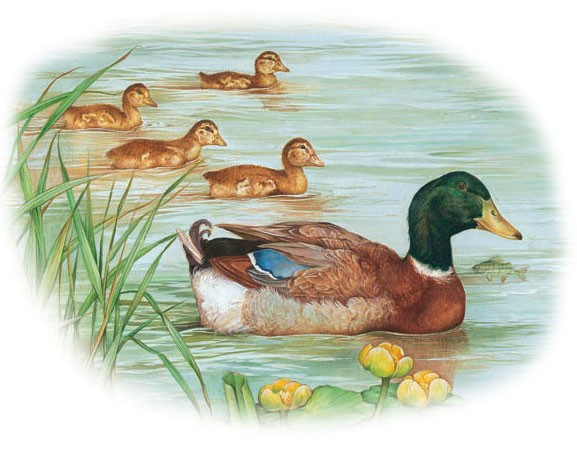
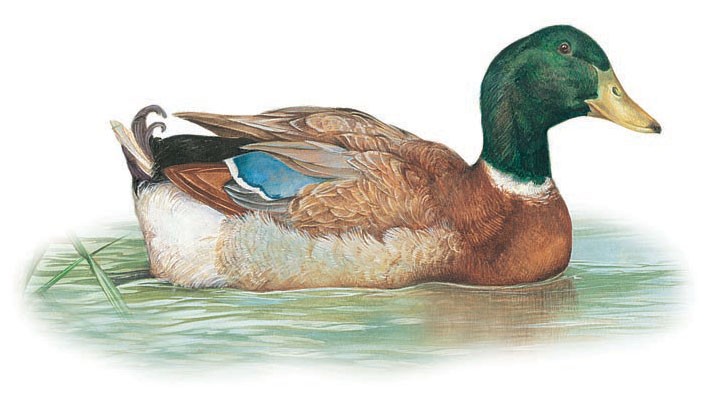
Dabbling ducks, or “puddle ducks", feed on the surface of water or on land, or as deep as they can reach by up-ending without submerging completely. The group includes the pintails, teals and mallards. Dabblers have a comb-like structure called a pecten along either edge of their beak. It strains the water inside beak, trapping any food. The ducks also use it to preen their feathers.

The diving ducks, the pochards or scaups, feed by diving beneath the surface of the water. The sea ducks include the long-tailed duck, scoters, goldeneyes, mergansers, bufflehead and eiders. They also feed by diving. Some, like the mergansers, have serrated edges to their bills to help them grip fish, their prey. They are also often known as "sawbills".


Geese
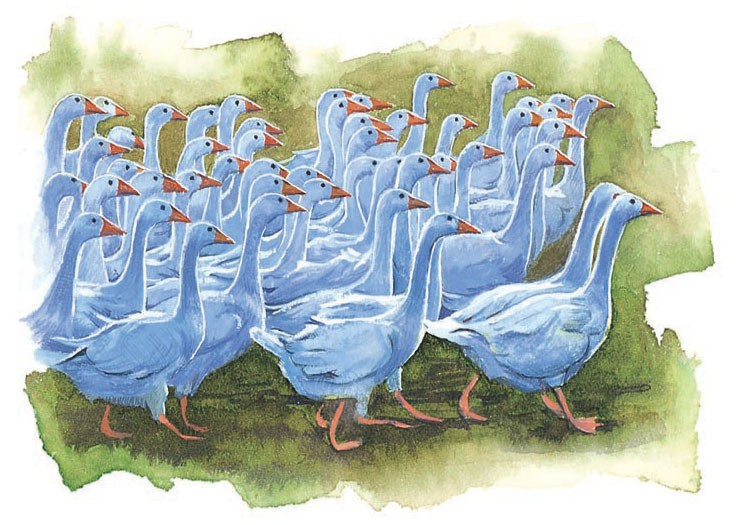
Species of geese belong to one of three types: black, which includes the Canada goose, grey, which includes the greylag and domestic goose (which is descended from the greylag), and white, which includes the snow goose. Geese mate for life, living in permanent pairs throughout the year. They are chiefly herbivorous, feeding mainly on grasses and cereal crops.
Most species are migratory, flying to their breeding grounds in spring—many thousands of kilometres away in the far north—and returning to warmer lands in autumn.

Swans
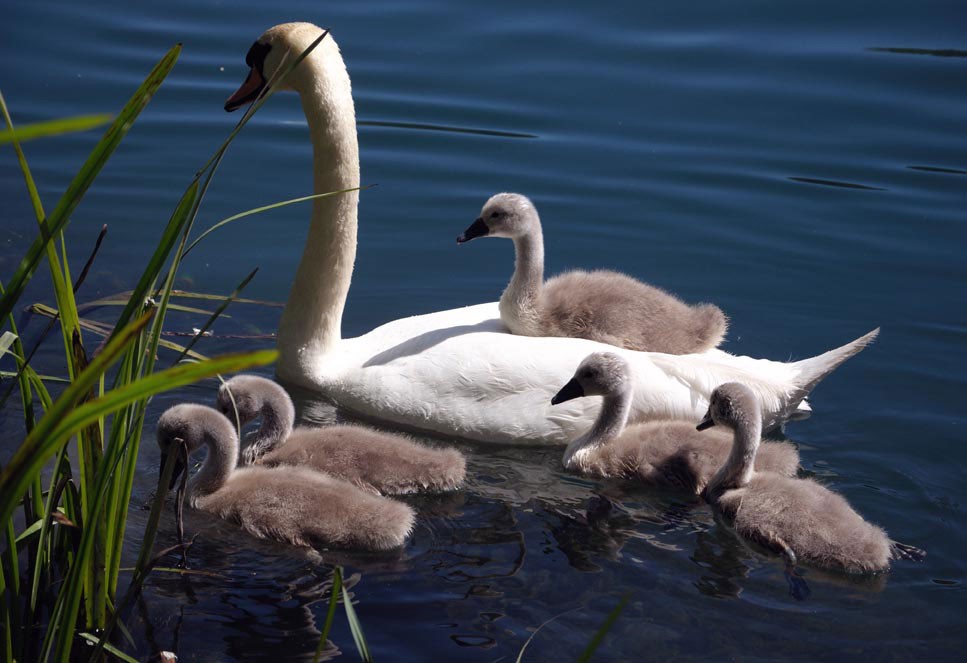
Swans are among the largest flying birds: their wingspans can measure up to 3 metres (10 feet). The four northern hemisphere species, the mute, trumpeter, tundra and whooper swans, are all white, but the Australian black swan is completely black save for white flight feathers on its wings.
Swans are herbivores, eating all parts of aquatic plants. All birds are toothless, but swans do have a jagged edge to part of their beaks which is used for snapping leaves and combing invertebrates off water plants. Swans build their nests on the ground, near water, and protect them aggressively. Swans normally mate for life.

Breeding
Ducks and geese lay their eggs on land that is close to water, often concealed under long grass or other vegetation. The nest may be lined with grass, leaves or twigs. Their young hatch out as fully-feathered babies, called ducklings, that can run and feed themselves (but not fly) almost straight away. Young geese are called goslings and young swans are called cygnets.
Swimming and feeding
Ducks, geese and swans all push themselves along the surface of the water using their feet, which are webbed, as paddles. Their feathers are coated with a waterproof substance that traps air and keeps the birds afloat. Both swans and ducks tip upside down to feed on invertebrates and plants, or dabble—feed at the surface.

Fast flyers

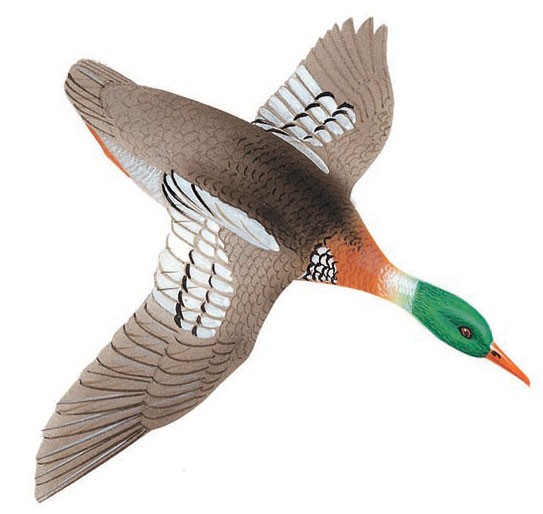
Ducks and geese are among the fastest birds in level flight. Species such as the red-breasted merganser, a sea duck, can fly at speeds of 128 km/h (80 mph). They have very large chest muscles, which attach to their wings. These give them enough power to lift themselves off the ground and keep them in the air.
To conserve energy on long journeys, such as during migration, geese and swans often fly in a “V” formation. The air movement created by the wingbeats of each bird gives extra lift to its neighbours.
Migration
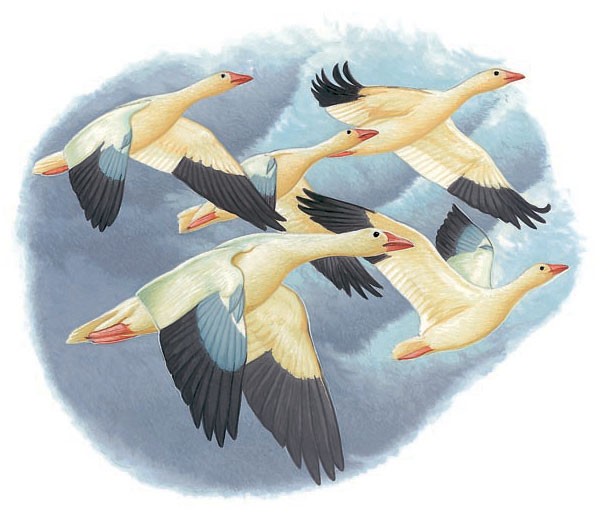
Many geese, ducks and swans migrate each year, to find food or to reach conditions more suitable for breeding. Each October, snow geese fly from their summer nesting grounds in the Arctic to spend winter in the warmer lands of southern USA and Mexico. They always take the same route west of the Rockies, known as the Pacific Flyway, flying in flocks of up to 1000 birds.
Unlike many geese, snow geese do not fly in neat, V-shaped formations, but snake across the sky in wavy lines. Families stay together during the journey, communicating with each other by honking. In the spring, the snow geese will fly back to their Arctic breeding grounds. On their return, they travel different routes and make fewer stops along the way.


Barnacle goslings
Like all geese, young barnacle geese (from northern Europe and the Arctic) are not fed by their parents. Just hours after hatching, barnacle goslings will leap from their cliff-side nest on to the grassy plain below. Here there is abundant food. If they do not make the leap, they cannot eat and so will die, but the drop is dangerous too. Many goslings are hurt on the rocks, and others fall prey to predators, particularly the Arctic fox.
Consultant: Chris Jarvis
pics



Without in any way limiting Q-files Ltd’s exclusive rights under copyright, any use of this publication to “train” generative artificial intelligence (AI) technologies to generate text is expressly prohibited. Q-files Ltd reserves all rights to license use of this work for generative AI training and development of machine learning language models.