
Ocean life
Arctic life
Much of the Arctic Ocean is covered with a thick layer of floating ice all year round. At its edges, rafts of broken ice, called pack ice, drift in the freezing cold waters. During the summer, some of the ice cracks and melts, forming waterways and large stretches of water. No plants can grow on the Arctic ice, so most life is found in the waters around it. During the summer, the days become longer, and the sun warms the waters. Phytoplankton, tiny plant material that floats in the water, quickly grows and multiplies in these conditions, providing food for millions of tiny animals called zooplankton.

Arctic waters

With the sudden increase in zooplankton, many animals migrate to the Arctic during the summer to exploit this rich source of food. Fish, squid, birds and even giant whales feed on the zooplankton. A shrimp-like creature called krill is a particular favourite. Seals hunt the fish, while walruses search for shellfish and crabs on the sea bed with their sensitive whiskers. The largest predators in the waters are orcas (killer whales), which feed on fish and seals, while on the ice the huge polar bear roams. Its white coat is perfect camouflage while it waits to grab a seal as it emerges from a hole in the ice to breathe.

Arctic whales
Many different kinds of whale gather in Arctic waters during the summer, but only the narwhal lives there all year round. It has two teeth. In the male, one of these teeth grows into a long, spiralling tusk. It may be used for fighting other males, or to show its dominance in the group. Narwhals feed by sucking in fish, shrimp, squid and octopus.
The beluga, or "white whale", is a relative of the narwhal. In summer it feeds on fish and crustaceans found on the seabed beneath the pack ice. In winter, it travels south. Hundreds of belugas gather together in North American river estuaries. The giant blue and humpback whales are summer visitors. They sift through mouthfuls of water to extract tiny sea creatures.
Orca
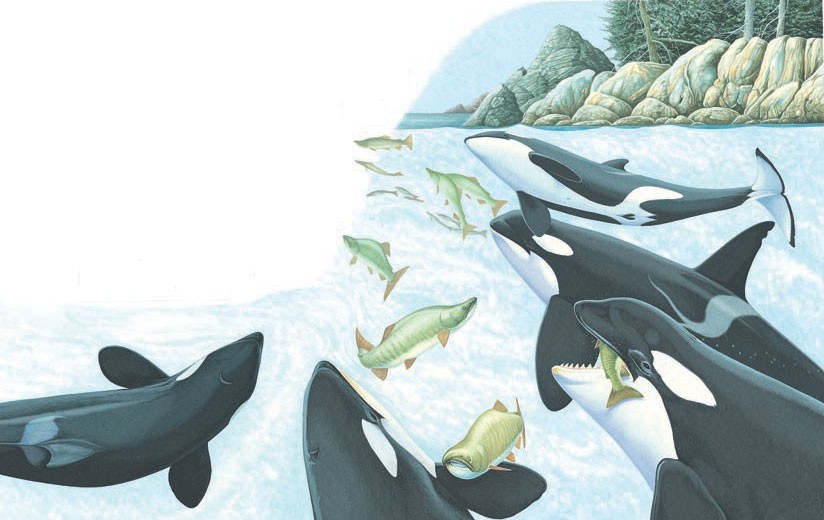
At up to 10 metres (33 feet) long, the orca (killer whale), is the largest of the dolphin family. It can be found in all oceans, but is commonest in polar waters. Orcas live and hunt together in groups, called pods.
Some orcas, known as "residents", feed exclusively on fish and squid. They live in family groups called pods, and return to the same feeding grounds again and again. Others, called "transients", do not eat fish, but hunt marine mammals such as sea lions, seals, walruses and even large whales. They roam widely along Arctic, Atlantic and Pacific coasts in search of prey. A third group, the "offshores", travel far from shore and feed mostly on schooling fish.

Polar bear
Polar bears live on the ice floes and frozen shores of the Arctic Ocean. They feed on seals by using their keen sense of smell to find their dens, or waiting for them to surface at breathing holes in the ice. They also hunt fish, sea birds, hares, reindeer and musk oxen. Polar bears can travel long distances each day in search of prey. Sometimes they must swim for many hours in the icy waters.
Walrus

Walruses huddle together in their hundreds on Arctic shores. If there is no room on the ground, they will happily lie on top of one another. On warm days, large groups bask together in the sun and their skins turn pink. Locating their food using their sensitive whiskers, walruses feed on shellfish, shrimps and crabs they dig up from the seabed with their snouts. Their tusks are used both to prise shellfish off rocks and haul their own bodies out of the water. They may also be used for fighting.


Arctic winter
In winter, most of the ocean freezes over again and the days are short and dark. Without sunshine to make food, phytoplankton cannot grow. Zooplankton feed on one another, or off fat reserves stored during the summer. Most of the larger animals migrate south to find new sources of food. Polar bears are among the few animals that remain. Some roam the ice or nearby land during the winter, while females dig dens in the snow to shelter from the harsh weather until the spring. Here, they give birth to their cubs.
Arctic summer
By August, Arctic sea ice has completely broken up. With their way cleared of ice, hundreds of belugas migrate north to the river inlets of Canada’s Arctic islands. This is where they come to moult each year. They are the only species of whale or dolphin known to undergo a seasonal moult. The belugas rub against the gravelly river bed to scrape away a layer of dead, yellowed skin, revealing a new layer beneath it. As well as moulting, females give birth to their young.

Consultant: Chris Jarvis