
Q-news

CITE
We have made every effort to follow citation style rules, but there may be some minor differences. If in doubt, please refer to the appropriate citation style manual.
India becomes the first nation to land a spacecraft near the Moon's south pole. (2024). In Q-files Encyclopedia, , Q-news. Retrieved from
https://www.q-files.com/news/india-becomes-the-first-nation-to-land-a-spacecraft-near-the-moons-south-pole
"India becomes the first nation to land a spacecraft near the Moon's south pole." , Q-news, Q-files Encyclopedia, 8 Apr. 2024.
https://www.q-files.com/news/india-becomes-the-first-nation-to-land-a-spacecraft-near-the-moons-south-pole.
Accessed 13 Sep. 2026.
India becomes the first nation to land a spacecraft near the Moon's south pole 2024. , Q-news. Retrieved 13 September 2026, from
https://www.q-files.com/news/india-becomes-the-first-nation-to-land-a-spacecraft-near-the-moons-south-pole
, Q-news, s.v. "India becomes the first nation to land a spacecraft near the Moon's south pole," accessed September 13, 2026.
https://www.q-files.com/news/india-becomes-the-first-nation-to-land-a-spacecraft-near-the-moons-south-pole


India becomes the first nation to land a spacecraft near the Moon's south pole
“India is on the Moon,” declared Sreedhara Panicker Somanath, the chair of the Indian Space Research Organization (ISRO) as the Chandrayaan-3 spacecraft’s Vikram lander touched down shortly after 18:04 local India time (12:34 BST) on 23rd August 2023. It landed near the Moon's south pole—the first time this has been accomplished. Scientists believe the region could hold precious elements and vital reserves of frozen water in permanently shadowed craters. India's achievement comes just days after Russia's Luna-25 spacecraft spun out of control and crashed into the Moon. Vikram's successful landing marks India’s emergence as a space power. It is only the fourth nation, after the United States, the former Soviet Union and China, to achieve a soft landing on the Moon. People across India were glued to their TV screens as the spacecraft descended to the lunar surface.
24th August 2023


In the final few minutes before touchdown, Vikram (the lander is named after Indian space programme pioneer Vikram Sarabhai) executed a complex manoeuvre, using its engines to slow down from a speed of 1.68 kilometres per second to nearly zero. With the help of eight thrusters it successfully turned from a horizontal to a vertical position. In 2019 Chandrayaan-2's lander failed to complete this manoeuvre and crashed into the surface during the final braking phase. It meant that success this time was all the sweeter. The heart-stopping moment was followed by jubilation all over India. ISRO scientists congratulated each other on what they had achieved.
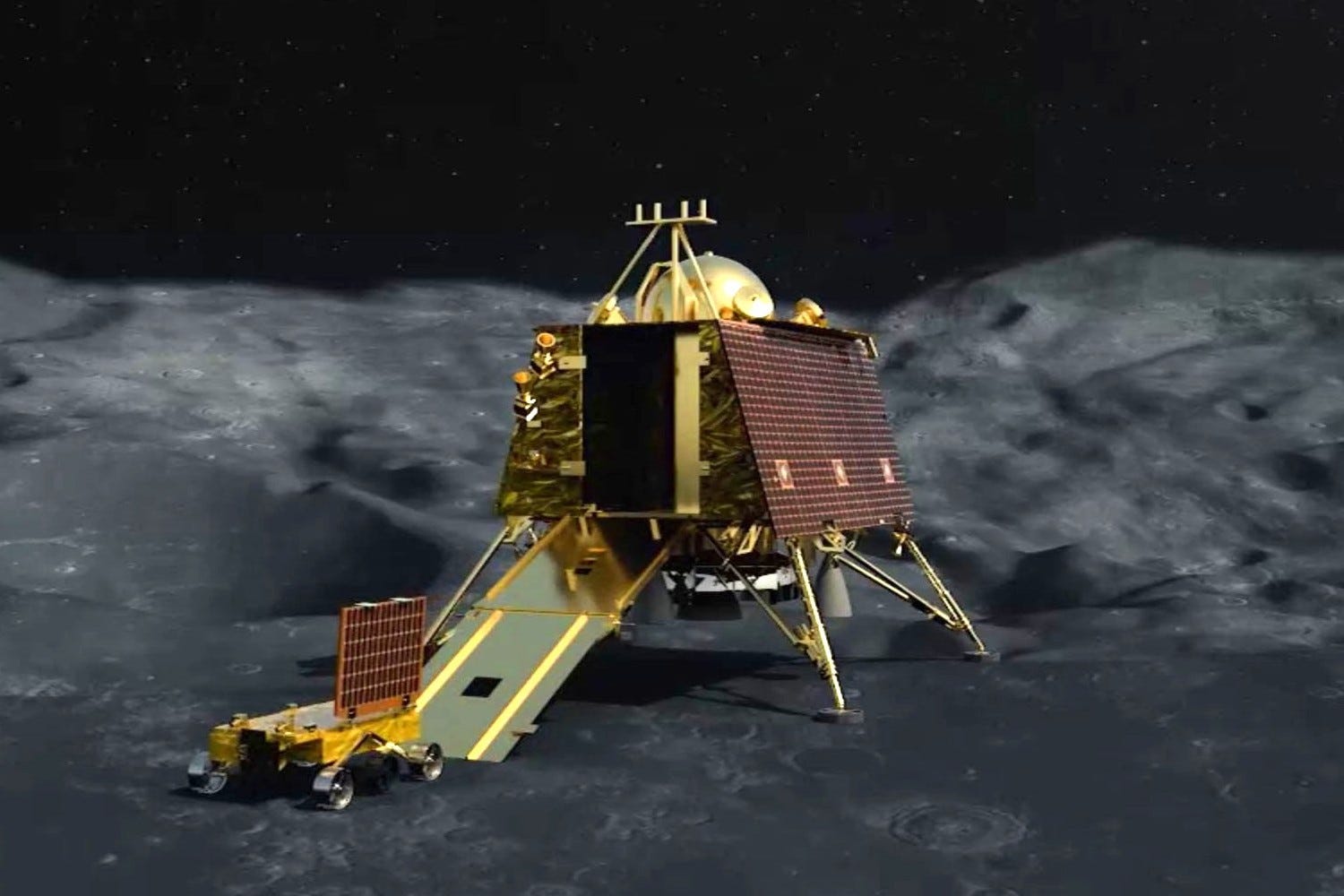
After the dust had settled, panels on one side of Vikram opened and a six-wheeled rover called Pragyaan (the word for "wisdom" in Sanskrit, the ancient language of India) rolled out of the lander's belly down a ramp and on to the lunar surface. The rover will now roam around the rocks and craters on the Moon's surface for two weeks, taking pictures, conducting experiments on the lunar rocks and looking for the presence of water ice. If Pragyaan detects significant quantities of ice, this will point the way for future crewed missions to establish a base in the region. This is because astronauts would be able to use the water to extract oxygen for breathing and to produce fuel—propellant for spacecraft headed to Mars and other distant destinations.
Vikram and Pragyaan are carrying scientific instruments which will help analyse the regolith (the loose particles amassed over billions of years that blanket the bedrock), the atmosphere above the lunar surface and any tectonic activity below.
Chandrayaan-3 (the name means “moon craft” in Sanskrit) took off from Sriharikota in southern India on 14th July. It took much longer to reach the Moon than the Apollo missions of the 1960s and 70s. This is because the spacecraft uses much less powerful rockets, gaining speed instead from repeated orbits of the Earth before setting out on its lunar journey.
On 5th August, ISRO successfully placed the Chandrayaan-3 spacecraft into orbit around the Moon. This operation, called lunar-orbit insertion (LOI), was carried out from the ISRO Telemetry, Tracking and Command Network (ISTRAC) located in Bengaluru. After a series of orbits, Vikram separated from the propulsion module to begin the next phase of the mission on 17th August.


pics
Without in any way limiting Q-files Ltd’s exclusive rights under copyright, any use of this publication to “train” generative artificial intelligence (AI) technologies to generate text is expressly prohibited. Q-files Ltd reserves all rights to license use of this work for generative AI training and development of machine learning language models.