
Q-news

CITE
We have made every effort to follow citation style rules, but there may be some minor differences. If in doubt, please refer to the appropriate citation style manual.
Morocco declares three days of mourning following a devastating earthquake. (2024). In Q-files Encyclopedia, , Q-news. Retrieved from
https://www.q-files.com/news/morocco-declares-three-days-of-mourning-following-a-devastating-earthquake
"Morocco declares three days of mourning following a devastating earthquake." , Q-news, Q-files Encyclopedia, 7 May. 2024.
https://www.q-files.com/news/morocco-declares-three-days-of-mourning-following-a-devastating-earthquake.
Accessed 13 Sep. 2026.
Morocco declares three days of mourning following a devastating earthquake 2024. , Q-news. Retrieved 13 September 2026, from
https://www.q-files.com/news/morocco-declares-three-days-of-mourning-following-a-devastating-earthquake
, Q-news, s.v. "Morocco declares three days of mourning following a devastating earthquake," accessed September 13, 2026.
https://www.q-files.com/news/morocco-declares-three-days-of-mourning-following-a-devastating-earthquake


Morocco declares three days of mourning following a devastating earthquake
A devastating earthquake has struck Morocco. The 6.8-magnitude quake happened at just after 23:10 local time on Friday 8th September. Its epicentre was in a remote cluster of villages near the town of Ighil in the Atlas Mountains,
72 kilometres (45 miles) south of Marrakech. Witnesses said the shaking lasted for about
20 seconds. Measuring VIII (Severe) on the Mercalli Scale, the quake was Morocco’s deadliest since 1960, when an earthquake destroyed Agadir killing more than 12,000 people. The official death toll of Friday's quake is 2901 people killed and 5530 people injured. It is feared, however, that the overall death toll will rise as rescue teams reach remote villages in the mountains. Buildings were shaken on the northern coast of Morocco, while tremors were felt as far away as the cities of Huelva and Jaen in southern Spain.
13th September 2023


The World Health Organization said more than 300,000 people were affected in Marrakech and surrounding areas. The worst of the damage, however, is not in Marrakech itself, but in the towns and villages clustered in the peaks of Al Haouz region to the south, closer to the earthquake’s epicentre. Most of the traditional mud-brick houses in, for example, Majat, Asni, Tansghart, Tafeghaghte, Adassil and Imlil were flattened. In the village of Amizmiz, rescue workers picked through rubble with their bare hands looking for survivors. Villagers are relying on emergency aid for water and food, but the rescue has been made more difficult by blocked roads, the loss of electricity and failed telephone networks.

The basic structure of the village houses increased the risk of fatalities during an earthquake. The mud-brick walls do not have the flexibility those of a more modern building have, meaning that they crumble easily when the earth beneath them shakes during a quake. The walls carry the weight of the roofs, which then immediately cave in.
In the heart of the old city of Marrakech, some houses and parts of the city walls collapsed, while a mosque minaret fell in Jemaa al-Fnaa Square. Other mosques reported extensive damage. Many residents stayed outdoors overnight for fear of aftershocks. They slept on roundabouts, in car parks and in a public square.

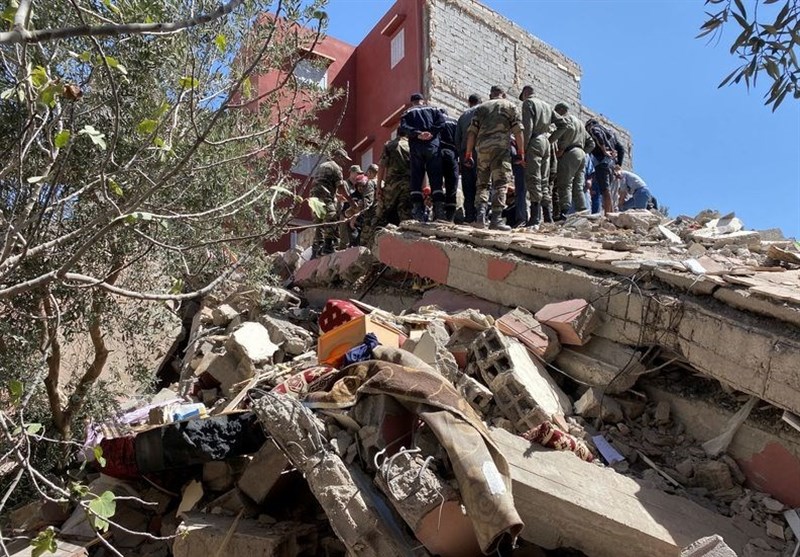
The Moroccan government did not formally ask for foreign assistance, but has accepted aid from Qatar, Spain, United Arab Emirates and the UK. Spain has deployed 86 rescuers and eight search dogs to help in the search and rescue of survivors. Algeria, which broke off ties with Morocco in 2021 after tensions over the long-running Western Sahara conflict, said it would open its airspace for humanitarian and medical flights. Meanwhile, the Moroccan armed forces have set up rescue teams to provide affected areas with clean drinking water, food supplies, tents and blankets.
Morocco lies close to the boundary between the African and Eurasian tectonic plate, known as the Azores–Gibraltar Transform Fault. Most of the earthquakes that occur in the country are caused by movements along that plate boundary. The greatest risk of quakes is in the Atlas Mountains, which run across north of Morocco. The range was formed by two tectonic plates colliding over the past 66 million years, causing the land to buckle and rise. As the two great slabs slowly grind against one another, the rocks break apart creating long cracks called faults.

pics
Without in any way limiting Q-files Ltd’s exclusive rights under copyright, any use of this publication to “train” generative artificial intelligence (AI) technologies to generate text is expressly prohibited. Q-files Ltd reserves all rights to license use of this work for generative AI training and development of machine learning language models.