
Government

CITE
We have made every effort to follow citation style rules, but there may be some minor differences. If in doubt, please refer to the appropriate citation style manual.
International organizations. (2026). In Q-files Encyclopedia, Geography, Government. Retrieved from
https://www.q-files.com/geography/government/international-organizations
"International organizations." Geography, Government, Q-files Encyclopedia, 29 May. 2026.
https://www.q-files.com/geography/government/international-organizations.
Accessed 13 Sep. 2026.
International organizations 2026. Geography, Government. Retrieved 13 September 2026, from
https://www.q-files.com/geography/government/international-organizations
Geography, Government, s.v. "International organizations," accessed September 13, 2026.
https://www.q-files.com/geography/government/international-organizations


International organizations
Many countries belong to one or more international organizations. They are established by treaty, an agreement made between states. The agreement sets out laws that the members agree to follow. Members of international organizations agree to work together, aiming to create a peaceful and prosperous group. Nearly all the countries of the world are members of the United Nations.


United Nations
The United Nations (UN) was formed to prevent war and to foster good relations between nations. Set up in October 1945, at the end of World War II, the UN today is a worldwide organization with 193 member countries, as of 2025. Every member has a seat (and a vote) on the General Assembly.
A body of selected countries forms the UN Security Council, together with five permanent members, USA, UK, France, Russia and China. The Security Council takes decisions at times of crisis. Each of the five permanent members may veto a UN resolution (prevent it being carried out). The UN sends troops from different countries to keep the peace between warring groups.

UN agencies
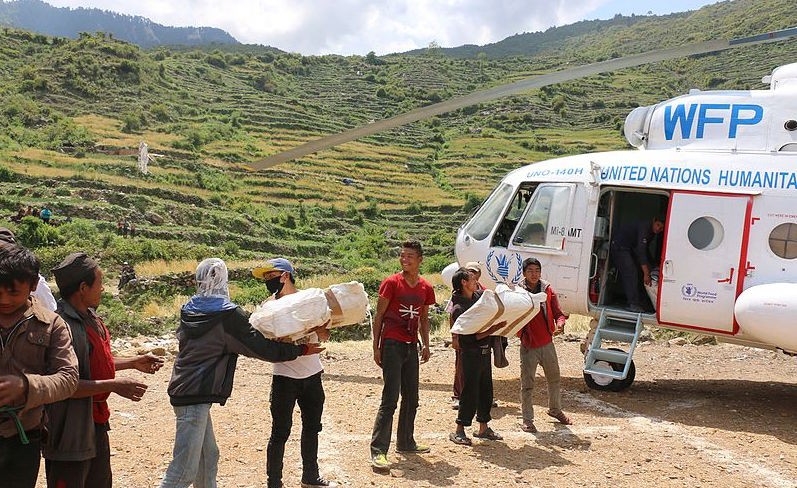
A number of agencies work with the United Nations. They include: the World Bank (which makes loans to developing countries); the International Monetary Fund (IMF, which promotes international monetary co-operation, trade and economic growth); the International Atomic Energy Agency (IAEA, which promotes the peaceful use of nuclear energy); the World Health Organization (WHO, which is concerned with public health); World Food Programme (WFP, which provides food assistance); UNESCO (United Nations Educational, Scientific and Cultural Organization, which promotes international collaboration through educational, scientific and cultural programmes); UNICEF (United Nations Children's Fund, which provides humanitarian assistance to children and mothers in developing countries).


European Union
The countries of Europe have their own governments, but a number are members of the European Union (EU). The European Union is an economic and political union of 27 member states. Its origins were in the European Coal and Steel Community (ECSC) and the European Economic Community (EEC), which was formed by Germany, France, Italy, Belgium, the Netherlands and Luxemburg in 1958 (following the signing of the Treaty of Rome in 1957). Since then, a number of states have joined and one, the UK, has left.
The Maastricht Treaty established the European Union under its current name in 1993. The European Parliament is elected every five years by citizens of every EU country. The EU is run by the Commission, a body that is accountable to the Council of Ministers.
The EU has developed a single market through new laws that apply to all member states. Passport controls have been abolished in what is known as the Schengen Area. The EU's aims include ensuring the free movement of people, goods and services. There are common policies on trade, agriculture and fisheries. A monetary union, the Eurozone, to which 18 member countries belong, was established in 1999.
Other international organizations
Other major international organizations include the North Atlantic Treaty Organization (NATO), the Arab League and the African Union (AU). NATO was formed in 1949 to defend the West against possible attack from the then Soviet Union during the Cold War, a period of tension that lasted until 1989. The Arab League was formed in 1945 to promote co-operation between Arab countries. The AU provides a means for African countries to discuss their political and economic goals.


Commonwealth of Nations
The Commonwealth of Nations, often called simply "the Commonwealth", is a political association of 56 member states. Most of them are territories of the former British Empire (Mozambique and
Rwanda, along with Gabon and Togo which both joined in June 2022, are the exceptions). The Commonwealth was originally created as the British Commonwealth of Nations in 1926. The current Commonwealth was established following the London Declaration in 1949, which proclaimed all member states "free and equal". The word "British" was also dropped from the title of the Commonwealth, to reflect the fact that the Empire was in the process of being dismantled.
Member states are united by English language, history, shared values of democracy, human rights and the rule of law. These values are reaffirmed ever four years when the Commonwealth Games, a sporting event similar in format to the Olympic Games, are held.


The Head of the Commonwealth is, since the death of Queen Elizabeth II in September 2022, King Charles III. He is the head of state of 15 member states ("Commonwealth realms"), while 36 other members are republics and five others have their own monarchs. The chief institutions of the organization are the Commonwealth Secretariat, which deals with matters between governments, and the Commonwealth Foundation, which focuses on relations between member states which do not involve governments.

Consultant: Lloyd Jenkins
pics

Without in any way limiting Q-files Ltd’s exclusive rights under copyright, any use of this publication to “train” generative artificial intelligence (AI) technologies to generate text is expressly prohibited. Q-files Ltd reserves all rights to license use of this work for generative AI training and development of machine learning language models.