
Q-news

CITE
We have made every effort to follow citation style rules, but there may be some minor differences. If in doubt, please refer to the appropriate citation style manual.
The first mission to collect rock samples from the far side of the Moon, lifts off. (2024). In Q-files Encyclopedia, , Q-news. Retrieved from
https://www.q-files.com/news/the-first-mission-to-collect-rock-samples-from-the-far-side-of-the-moon-lifts-off
"The first mission to collect rock samples from the far side of the Moon, lifts off." , Q-news, Q-files Encyclopedia, 20 Dec. 2024.
https://www.q-files.com/news/the-first-mission-to-collect-rock-samples-from-the-far-side-of-the-moon-lifts-off.
Accessed 1 Nov. 2026.
The first mission to collect rock samples from the far side of the Moon, lifts off 2024. , Q-news. Retrieved 1 November 2026, from
https://www.q-files.com/news/the-first-mission-to-collect-rock-samples-from-the-far-side-of-the-moon-lifts-off
, Q-news, s.v. "The first mission to collect rock samples from the far side of the Moon, lifts off," accessed November 1, 2026.
https://www.q-files.com/news/the-first-mission-to-collect-rock-samples-from-the-far-side-of-the-moon-lifts-off


The first mission to collect rock samples from the far side of the Moon, lifts off
China has launched a space probe to collect rock samples from the far side of the Moon. If the Chang'e 6 mission is successful, it would be the first time this feat will have been accomplished. The 53-day mission includes an ascent from the Moon’s far side on the return leg, something that has never been attempted before. Since the first Chang’e mission in 2007, China has made great technological leaps forward in lunar exploration. Many experts see this mission, named after the Chinese Moon goddess Chang'e, as the latest episode in a "space race" between China and the USA to build bases on the Moon in the 2030s, and from there, lift off to Mars.
Updated 7th August 2024

Mission

The probe was launched by a Long March 5 rocket on 3rd May 2024 17:27 local time from Wenchang Satellite Launch Centre on Hainan Island. With no direct line of sight with the Earth, Chang’e 6 relied on a relay satellite, Queqiao 2, to communicate with the Earth.
The Chang'e 6 lander landed on the Moon on 1st June. After the completion of sample collection (and the placement of the sample on the ascender), the ascender successfully took off from atop the lander portion of the probe on 3rd June. The ascender docked with the Chang'e 6 orbiter on 6th June and transferred the sample container to the returner on the same day. The lander collected approximately 2 kilograms (4.4 lb) of lunar material including surface soil and rocks (using a scoop) and subsurface samples (using a drill). The hole left by the sampling was in the shape of the character zhong (中) which is the initial character of the name for China in Mandarin Chinese: Zhongguo.
The returner (re-entry capsule) landed in the Inner Mongolia region of China on 25th June 2024.

Landing site
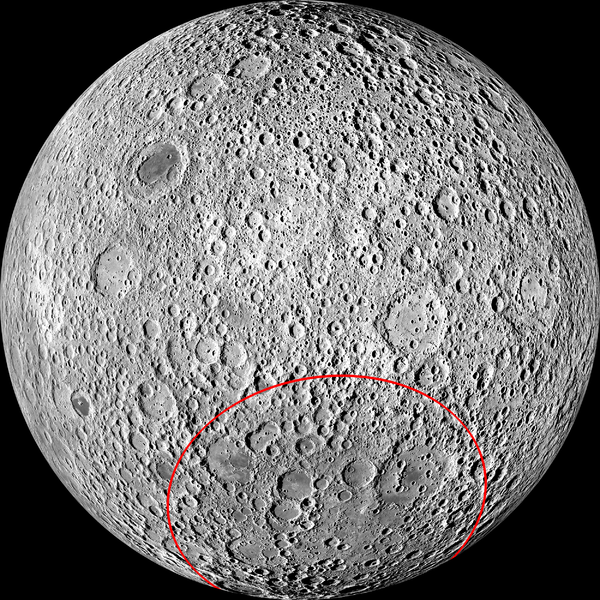
The preceding Chang'e 5 mission returned 1.73 kilograms (3.8 lb) of material from the northern hemisphere of the near side of the Moon in 2020. The Chang'e 6 mission will instead attempt to land and return material from the southern hemisphere of the far side of the Moon. This is sometimes described as the "dark side", not because it does not catch the Sun's rays (it does), but because we cannot see it from Earth. The reason for this is that the Moon takes the same amount of time (about a month) to spin on its axis as it does to orbit Earth.
The far side of the Moon has a thicker, older crust than the near side, with more craters. These are less covered by ancient lava flows than the near side, meaning that there is a reasonable chance that any samples collected may include material from the lunar mantle (the layer beneath its crust) that was blasted to the surface by meteorite impacts more than 4 billion years ago. This will give scientists more detailed information about the Moon's composition.
The Chang'e 6 spacecraft is set to land on the northeastern side of the South Pole–Aitken (SPA) basin. This is the largest and oldest impact crater in the Solar System.
Chang'e 6 space probe

Chang'e 6 was built as a copy of Chang'e 5. If that earlier mission had failed, Chang'e 6 would have been a back-up to it. The probe consists of four modules:

Lander This performed a soft landing on the lunar surface after separating from the Orbiter. Fitted with a drill and a scooping device, it collected about 2 kilograms (4.4 lb) of lunar soil and rock from 2 metres (6.6 feet) below the surface and placed them in the attached Ascender. Also attached to the lander was a small lunar rover.
Ascender The Ascender, or ascent vehicle, was attached to the top of the Lander. After take-off, it made a fully autonomous rendezvous and docking in lunar orbit with the Orbiter where the samples were robotically transferred into an attached sample-return capsule (the Returner) for their delivery to Earth.
Orbiter After it received the samples from the Ascender, the Orbiter (the Returner still attached) left lunar orbit. It will spend between four and five days flying back to Earth orbit, releasing the Returner just before arrival.
Returner The Returner re-enters and descends to the Earth's surface, landing in Chinese territory. Surveillance drones spot the Returner capsule before it touches down, and recovery vehicles locate the capsule shortly afterwards.
Future missions

Ever since India’s Chandrayaan-1 probe discovered the likely existence of ice in the Moon's south pole craters in 2009, scientists from China as well as the US, India and Russia, have wanted to know more about the Moon's potential water reserves. If it is readily available to use, missions to Mars become much more achievable (the water can be converted to rocket fuel), as does establishing crewed bases on the Moon (oxygen for people to breathe can also be extracted from the water).
The launch of Chang'e 6 marks the first of three uncrewed missions to the Moon planned by China this decade. Chang'e 7, expected to launch in 2026, will search the lunar south pole for water. The mission will include an orbiter, a lander and a mini-flying probe. Chang'e 8, scheduled for 2028, will attempt to establish the technical feasibility of building a lunar base, the International Lunar Research Station. This will including testing 3D printing technologies. A future crewed exploration of the Moon is planned for 2029–30.


pics
Without in any way limiting Q-files Ltd’s exclusive rights under copyright, any use of this publication to “train” generative artificial intelligence (AI) technologies to generate text is expressly prohibited. Q-files Ltd reserves all rights to license use of this work for generative AI training and development of machine learning language models.