
Materials

CITE
We have made every effort to follow citation style rules, but there may be some minor differences. If in doubt, please refer to the appropriate citation style manual.
Paper. (2026). In Q-files Encyclopedia, Science, Materials. Retrieved from
https://www.q-files.com/science/materials/paper
"Paper." Science, Materials, Q-files Encyclopedia, 10 Mar. 2026.
https://www.q-files.com/science/materials/paper.
Accessed 13 Sep. 2026.
Paper 2026. Science, Materials. Retrieved 13 September 2026, from
https://www.q-files.com/science/materials/paper
Science, Materials, s.v. "Paper," accessed September 13, 2026.
https://www.q-files.com/science/materials/paper


Paper
Paper is usually made from wood pulp. This mashed-up wood contains fibres (strands) of cellulose. Cellulose is the substance that makes up the cell walls of most plants and is very strong. To make paper, the cellulose fibres are moistened then pressed together into thin sheets. When dried, the sheets are flexible but strong. Sometimes paper is made from the cellulose fibres of other plants, such as cotton or grasses. Paper is produced in a range of thicknesses and colours, while different coatings can make it shiny or waterproof.
Uses of paper
The most common use of paper is for writing and printing on. We write and draw on paper in exercise books, sketch pads and diaries. Large sheets of paper can have words and pictures printed on them by machines, then be folded, cut and bound (by gluing or stapling) into books, magazines and newspapers. Sometimes the words and images printed on paper can make it valuable: banknotes, cheques, tickets and vouchers are all usually made of paper.
Paper is also frequently used in packaging (boxes, envelopes, bags, wrapping paper) and in household products (toilet paper, tissues, cat litter, teabags, sandpaper). Wallpaper may line the walls of your house, or insulating paper filling may fill the cavities between its walls to help prevent heat escaping. Paper can be used to construct products, either as the sole material, as in paper lampshades or papier mâché bangles, or mixed with other materials, such as plastics, to construct strong but lightweight objects such as bicycle helmets or boat hulls.
A history of papermaking
Before the invention of paper, writing was done on tablets made of bamboo or ivory, or on paper-like materials such as silk, papyrus, made from the papyrus plant, or vellum, made from animal skin. Papermaking first developed in China, using plant fibres, such as from mulberry trees, mixed with rags. The oldest piece of paper known dates from China in the 2nd century BC. At this time, paper was mostly used for wrapping and packing. It was not until 400 to 500 years later that paper became widely used for writing in China. The knowledge of how to prepare paper spread very slowly from China, first to Japan in about AD 600, then to the Middle East around 750. From there, the craft of papermaking travelled to Europe by about 1100.

From trees to paper
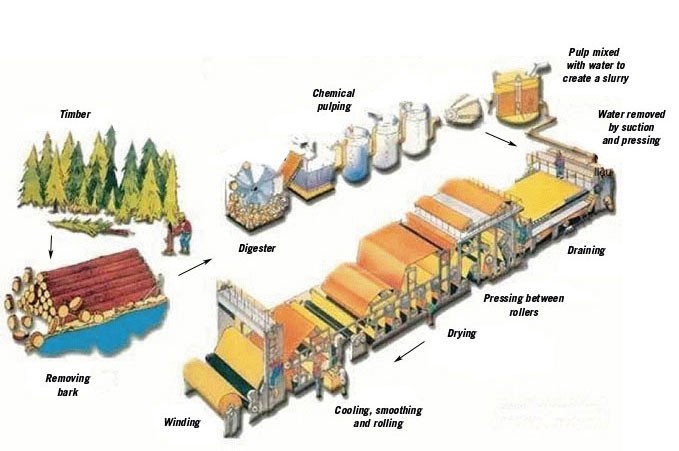
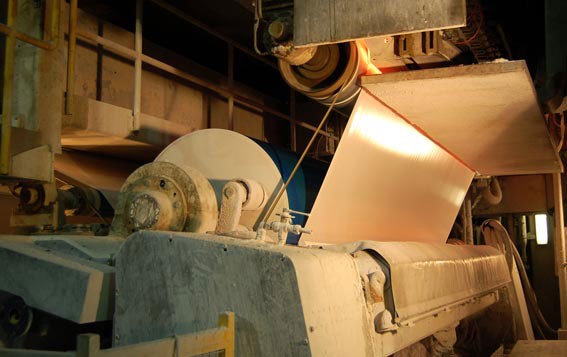
After a tree is cut down, it is transported to a pulp mill. Machines remove the tree’s bark and chop the wood into chips. The chips are fed into a digester, which soaks them in pulping chemicals that separate the cellulose fibres from the rest of the wood. The resulting pulp is transferred to a paper mill. Here the pulp is mixed with water and other chemicals (such as sizing, to make it water-resistant) to create a liquid mash or slurry. A machine spreads the slurry on to a huge screen, where it is pressed and dried. The paper sheet is wound on to giant rolls.

Recycled paper
Worldwide, about 10% of paper is made from recycled paper rather than newly felled trees. Recycled paper is produced from paper mill waste, as well as old magazines, newspapers, packaging, office paper and telephone directories. This used paper is mixed with water and chemicals to break it down into a slurry of cellulose fibres. This is cleaned, de-inked and bleached before being pressed and dried. Paper can be recycled up to seven times before the cellulose fibres become too broken to be re-used. Recycled paper cannot be used for high-quality products such as writing paper, but it is commonly used for newspapers, packaging, tissues, insulation, nappies and animal bedding.
Deforestation
and waste
In North America and northern Europe, two of the world's major paper-producing regions, sustainable forestry is widely practised: at least one new tree is planted for every tree cut down. However, in poorer regions such as East Asia and South America, the paper industry is contributing to deforestation through poor forest management. When measured by weight, about one-third of the world’s waste is paper. Recycling paper uses about the same amount of energy as making paper from felled trees, but the process creates less pollution, as well as reducing waste and saving trees.

Consultant: Mike Goldsmith
pics
Without in any way limiting Q-files Ltd’s exclusive rights under copyright, any use of this publication to “train” generative artificial intelligence (AI) technologies to generate text is expressly prohibited. Q-files Ltd reserves all rights to license use of this work for generative AI training and development of machine learning language models.