
Media and communications
Television
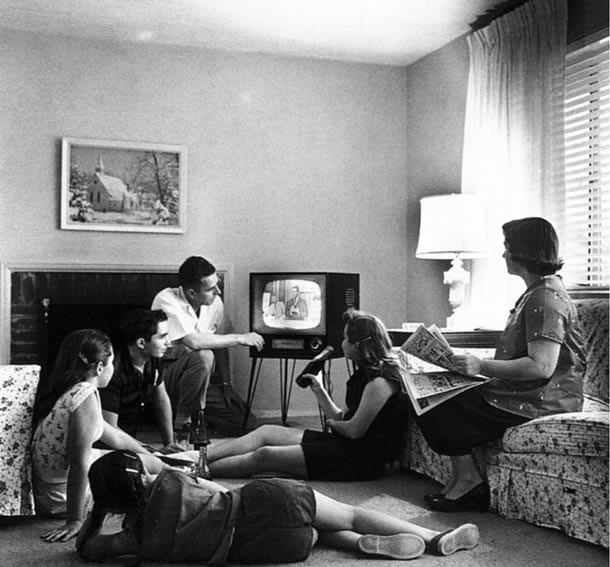
The first fully electronic television system was developed in the 1920s and 30s in the USA by Russian-American inventor Vladimir Zworykin (1888–1982). Television first became popular in the 1950s as TV sets became affordable. Now TV is the most important source of entertainment and information in the world. People can access television programmes not only through aerials in their homes, but also via satellite, cable and the internet.
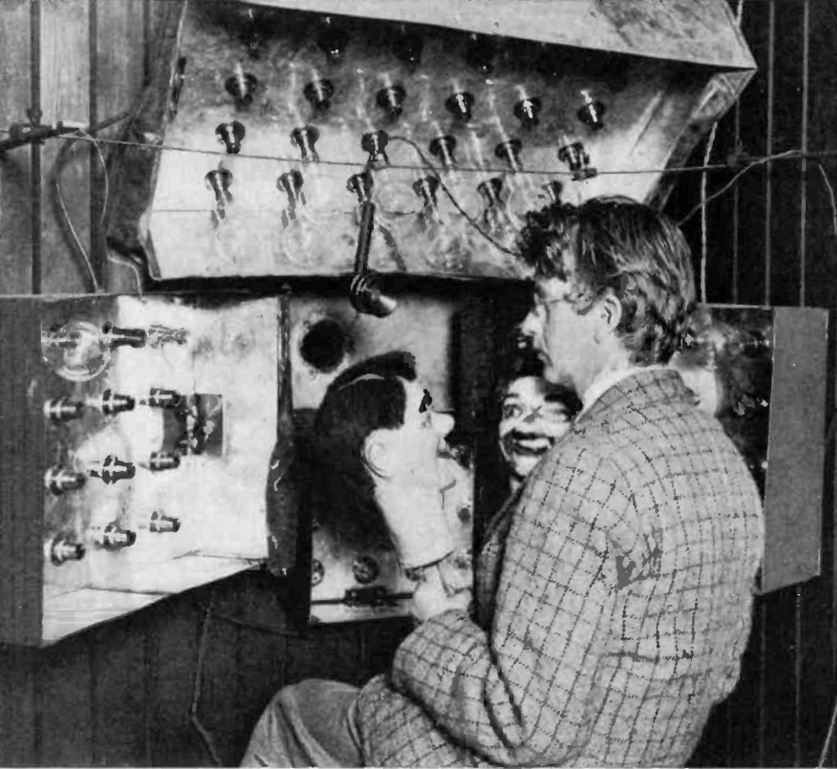
John Logie Baird
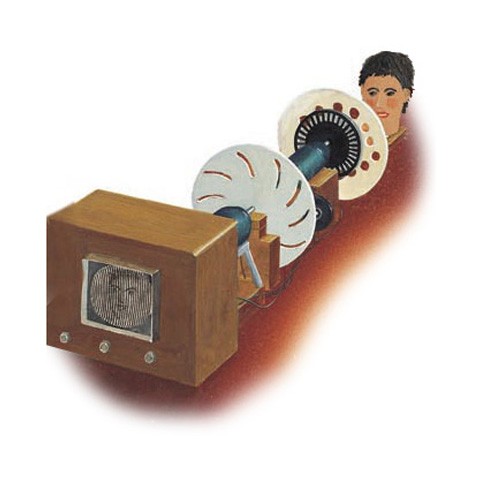
The first electrically transmitted TV pictures were the work of Scottish inventor John Logie Baird (1888–1946), who built his first TV system in 1925. His camera used a spinning disc pierced with holes and an electric "eye". The eye recorded the brightness of different parts of the image—the head of a ventriloquist’s dummy, called "Stooky Bill"—and transmitted what it scanned on to a screen. The result was a 30-line vertically scanned image, transmitted at a rate of five pictures per second. The first person to appear on television was William Taynton, an office worker.
On 26th January 1926, Baird gave the first public demonstration of television, incorporating an improved scan rate of 12.5 pictures per second, in London. He demonstrated the world's first colour transmission in July 1928. The BBC began to broadcast television programmes using the Baird system in 1929.
Baird's television system, based on electro-mechanical principles, was, however, replaced by the superior electronic television system developed by Vladimir Zworykin in 1937.

How television works
Television works using electronics: the control of the flow of electrons through an electric circuit. The broadcasting station transmits (sends out) TV signals on radio waves (terrestrial or satellite) or by cable which are turned back into sounds and pictures by TV receivers, or sets. Some programmes, especially news and sport, are broadcast live: they are transmitted as they happen. But many TV programmes are recorded for broadcasting at a later date.
Programmes can also be broadcast live or recorded via the internet using what is called "streaming" technology. They can then be watched on laptops, tablets or smartphones.
A simple TV system needs a TV camera at the scene, a way of transmitting the images, and a receiver where the images appear. The camera shoots the changing scene 24, 25 or 30 times a second. As it does so, charge-coupled devices (CCDs) collect light on millions of tiny squares, called pixels. Each pixel measures the brightness and colour of that light (made up of red, blue or green) in digital form, and so creates a signal.


TV receiver
The TV receiver, or set, receives signals via an aerial, satellite dish or fibre-optic cable. It builds each frame of the moving picture line by line using the signal originally created by the camera. The frames are displayed in quick succession on a screen, which creates the illusion of smooth movement because our brains merge the frames together. In older televisions, the picture is created by a cathode-ray tube, but modern flat-screen TVs use liquid crystal display (LCDs) or plasma display panels (PDPs).
Cathode-ray tube
The cathode-ray tube in a receiver has a narrow neck (1) and a flat base that forms the screen (2). At the back of the tube are three guns (3) that fire beams of electrons (for red, green and blue light) at the screen. Electromagnets (4) make the beams scan quickly across the screen line by line, while the TV signal controls their strength. Where the beams hit a special coating on the inside of the screen, it gives off light (5). Just behind the screen is a plate with holes in it, called a shadow mask (6). It ensures that the beams hit the screen only behind filters of their own colour (7). Filters make the light produced by the three beams appear red, blue or green. These add together to form the picture colours.


LCD screens
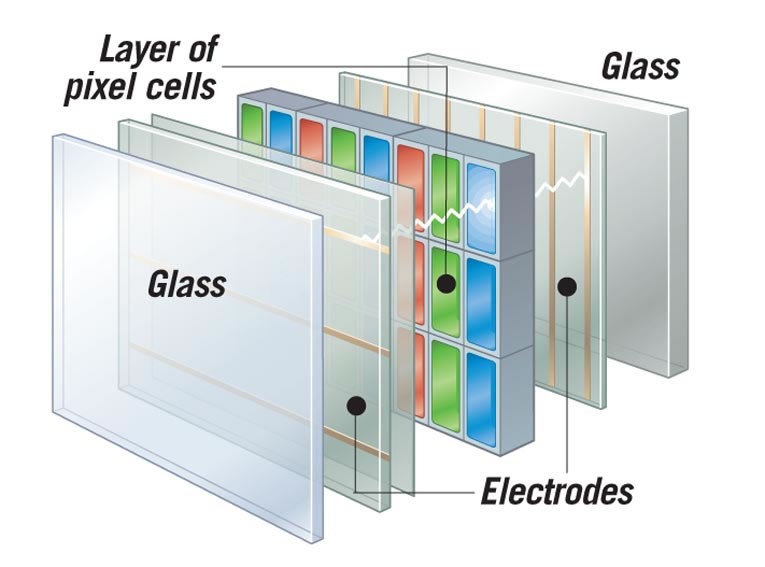
Many flat-screen TV receivers—and computer laptops—use liquid crystal displays (LCDs). An LCD screen contains many thousands of tiny pixels, each made up of red, green and blue elements. White light from a backlight passes through a layer of liquid crystals and various filters to illuminate the pixels. When an electric current is passed through the liquid crystal layer, minute rods act as a kind of camera shutter for the pixels, varying the amount of light that each transmits. The changing pattern of illumination, controlled by the TV signal, produces the moving images.
Plasma screens
In a plasma screen TV, the plasma display panel (PDP) has a layer consisting of many thousands of pixels. An electric current causes a tiny pocket of gas contained inside each cell to heat up and turn it into a state called plasma. This is when the atoms making up the gas lose or gain the number of electrons they each have, and so become electrically charged. For a split second, the plasma gives off energy and illuminates the pixels, each coloured red, blue or green, by varying amounts.
Smart television
A smart TV set has a built-in internet connection. Interactive TV is a popular feature of smart television, which is sometimes also called connected TV. The internet connection allows the viewer to search for and download videos, movies, photos and other content from the world wide web, or from a wide range of cable or satellite TV channels.
Consultant: Chris Oxlade