
Earthquakes
Tsunamis
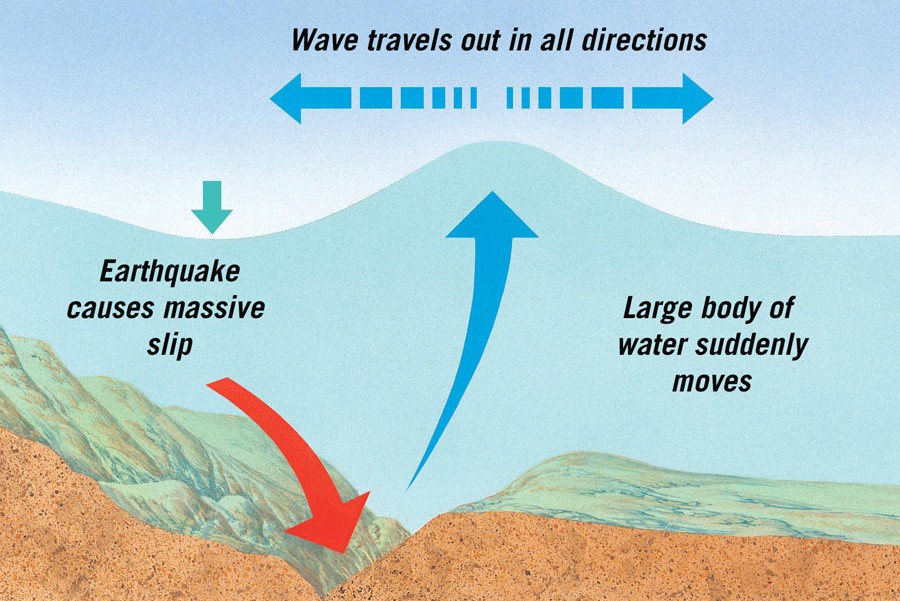
When the epicentre of an earthquake is on the sea bed, a large submarine landslide can result. The sudden movement of the thousands of tonnes of water above it produces a series of fast moving waves, travelling at around 800 km/h (500 mph), called tsunamis (also sometimes known as tidal waves). The wave travels out in all directions at hundreds of kilometres an hour. In deep water, they are small, but as they approach the shallow coastal waters they slow down and build up in height. Some tsunamis are tens of metres high as they crash on to the shore. The waves may last for several hours.

Plate boundary

Tsunami is a Japanese word meaning “harbour wave”. Japan suffers more tsunamis than any other country—on average one every seven years. This is because the islands of Japan lie close to the boundary of two tectonic plates. Here, the Pacific plate is sliding down beneath the Eurasian plate. As it does so, one plate grinds against the other. Occasionally, the two plates "lock" together. Pressure builds up in the rocks underground until they suddenly give, causing an earthquake. If part of the sea bed drops rapidly as a result of the quake, a tsunami results.
Tsunami waves
Tsunami waves are caused by an earthquake under the sea bed, creating a massive landslip (1) as one block of crust moves rapidly in the opposite direction to another. A large body of water in the region of the landslip is caused to move suddenly, causing waves to spread out in all directions.

In the open ocean, tsunami waves are almost unnoticeable, although they travel extremely quickly—up to 800 km/h (500 mph). They have a very long wavelength (the distance between the crests of the waves) of hundreds of kilometres, but they are very shallow—less then a metre high (2).

On reaching shallower water near the shore, the waves grow much bigger. When they finally hit land, they can be 30 metres (100 feet) high (3). The wall of water comes ashore like a violent, onrushing tide. There are normally not just one, but several waves coming ashore seconds, minutes, or sometimes hours, apart.
The Indian Ocean tsunami
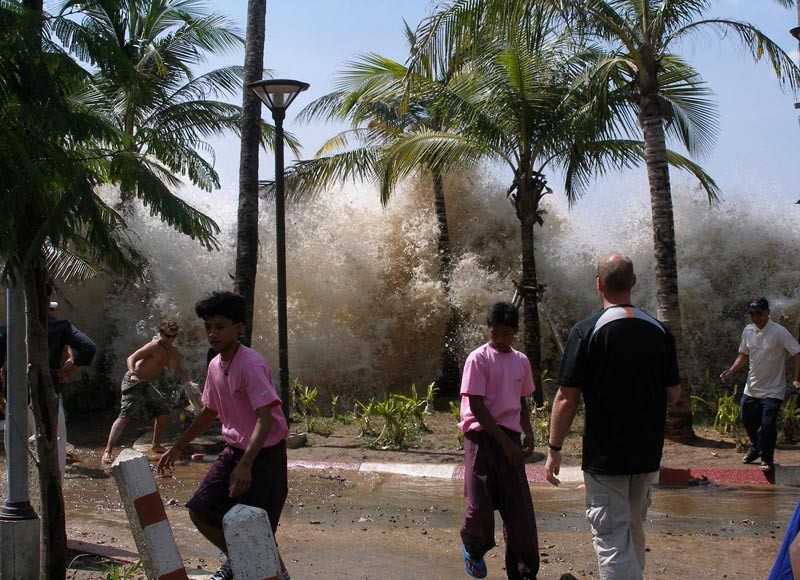
On 26th December 2004, one of the most powerful earthquakes ever recorded took place off the coast of Indonesia. The sudden movement of the sea bed triggered a tsunami, a massive wave that surged ashore in Indonesia, Thailand, Sri Lanka, India and other countries bordering the Indian Ocean. Waves of up to 30 metres (100 feet) high caused enormous devastation and claimed the lives of more than 283,000 people.

An enormous earthquake on the ocean floor caused a large block of the sea bed, estimated at 1200 kilometres (750 miles) long, to slip down about 15 metres (50 feet). This sudden movement under the water created a wave that moved rapidly outwards. As it approached the shallow waters near land, the tsunami increased in height, reaching a massive 30 metres (100 feet) high when it finally crashed ashore. As the wave approached, water along the coast was sucked back. When the tsunami hit, it surged ashore with unstoppable force—far more than any ordinary large wave. Rapid flooding of coastal areas resulted.
The Indian Ocean tsunami affected 18 countries. The worst hit were Sri Lanka, Indonesia and Thailand, but its effects were felt as far away as Alaska. Waves ripped through towns and villages along the coasts of countries in southern and Southeast Asia virtually without warning. The devastation in many stricken areas was total. Buildings were destroyed, roads and bridges swept away and farmland completely ruined.
The epicentre of the Indian Ocean tsunami—the point on the Earth’s surface directly above the earthquake—was close to the Indonesian island of Sumatra. The earthquake registered 9.0 on the Magnitude Scale (a measurement of the size of the
quake). It was the largest earthquake the world had seen for over 40 years.


Megatsunamis
A megatsunami is an extremely large wave created when a landslide caused either by an earthquake or by loose rock crashing into a body of water below. A meteorite impact or a volcanic eruption can also cause a megatsunami. Waves produced by a megatsunami can be hundreds of metres high—far higher than in an ordinary tsunami. Examples of modern megatsunamis include the one associated with the 1883 eruption of Krakatoa and one caused by a landslide near Tracy Arm, a fjord in southeastern Alaska in August 2025, in which a wave around 500 metres (1640 feet) was created.
Consultant: Ian Fairchild