
Africa

CITE
We have made every effort to follow citation style rules, but there may be some minor differences. If in doubt, please refer to the appropriate citation style manual.
South African wars. (2026). In Q-files Encyclopedia, History, Africa. Retrieved from
https://www.q-files.com/history/africa/south-african-wars
"South African wars." History, Africa, Q-files Encyclopedia, 20 Mar. 2026.
https://www.q-files.com/history/africa/south-african-wars.
Accessed 6 Aug. 2026.
South African wars 2026. History, Africa. Retrieved 6 August 2026, from
https://www.q-files.com/history/africa/south-african-wars
History, Africa, s.v. "South African wars," accessed August 6, 2026.
https://www.q-files.com/history/africa/south-african-wars


South African wars
While the Cape Colony was changing hands between European rulers, the northern and eastern lands, inhabited by Bantu-speaking peoples, were going through turbulent times. In the late 18th century, Bantu chiefdoms and clans began to form defensive alliances. This was mainly in response to efforts by slave traders—the Portuguese from Mozambique, the Griqua and the European settlers from Cape Colony—to round up black Africans to work as slave labour on their farms.


Shaka
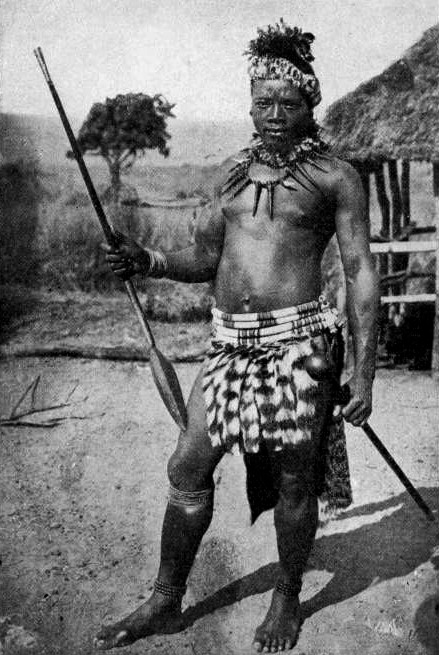
One chiefdom became more powerful than all the others. In 1818, Nguni tribes under Shaka, son of the chief of a Zulu clan, established a kingdom between the Tugela and Pongola rivers. The Zulu people had prospered from their contacts with the Portuguese. Not only had they been enriched from selling ivory from elephant tusks to the Europeans, they were also benefiting from the new high-yielding crop that the Portuguese had introduced to them, maize. Shaka took control of his army and, by 1825, had conquered neighbouring clans to create a fearsome new warrior state, stoutly defended by fortified settlements called amakhanda.
Mfecane
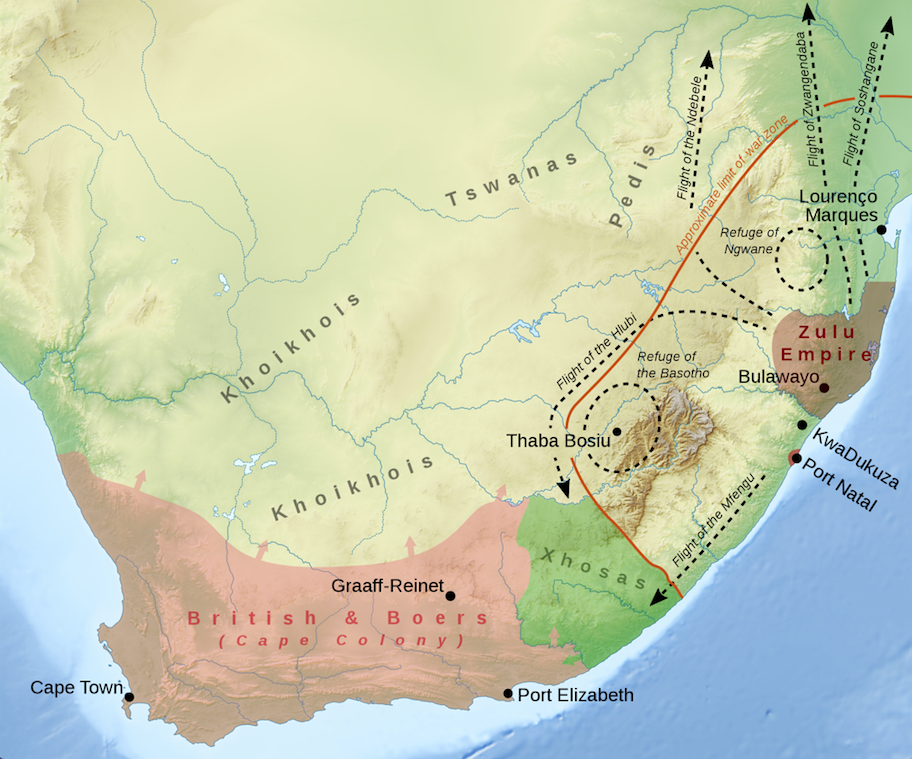
The rise of the Zulu Empire under Shaka forced other peoples, including the Soshangane, Zwangendaba, Ndebele and Ngwane, to flee. Some, like the Xhosa, were caught between the Zulu warriors and the advancing Boers or British forces to the west. As clans living in the path of Shaka's armies quickly moved away to find new homelands, they themselves attacked their own neighbours. This resulted in waves of migration across vast areas of southern Africa and beyond. Sotho speakers know this period as the difaqane ("forced migration"), while Zulu speakers call it the mfecane ("crushing"). This period of turmoil lasted until about 1840, long after the death of Shaka at the hands of his half-brothers Dingane and Umhlangana in 1828.
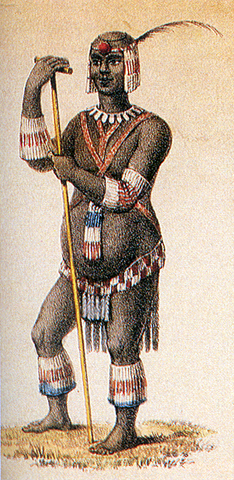
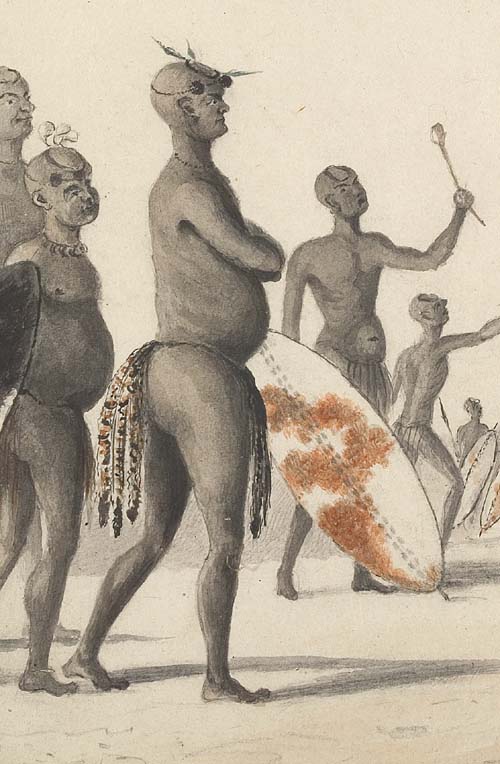
Around 1821, the Zulu general Mzilikazi defied Shaka and set up his own kingdom. Mzilikazi and his followers, called the Ndebele (or Matebele), founded a state northwest of where Pretoria stands today. But the arrival of Boer settlers in 1837 (see Great Trek, below) forced them to migrate once more, moving north of the River Limpopo to an area now known as Matabeleland, in present-day southern Zimbabwe. In doing so, they drove the region's inhabitants, the Shona, northwards. The tension between the two peoples has continued to this day in Zimbabwe.
Great Trek
Trekboers had been travelling northeastwards from Cape Town in small numbers for many decades, but in the 1830s the trickle became a flood. Known as the Great Trek, the mass movement was triggered by Boer resentment at British rule in the Cape Colony—in particular, the insistence that church services be held in English and the ruling that the Boers give up their slaves following the abolition of slavery throughout the British Empire in 1833.

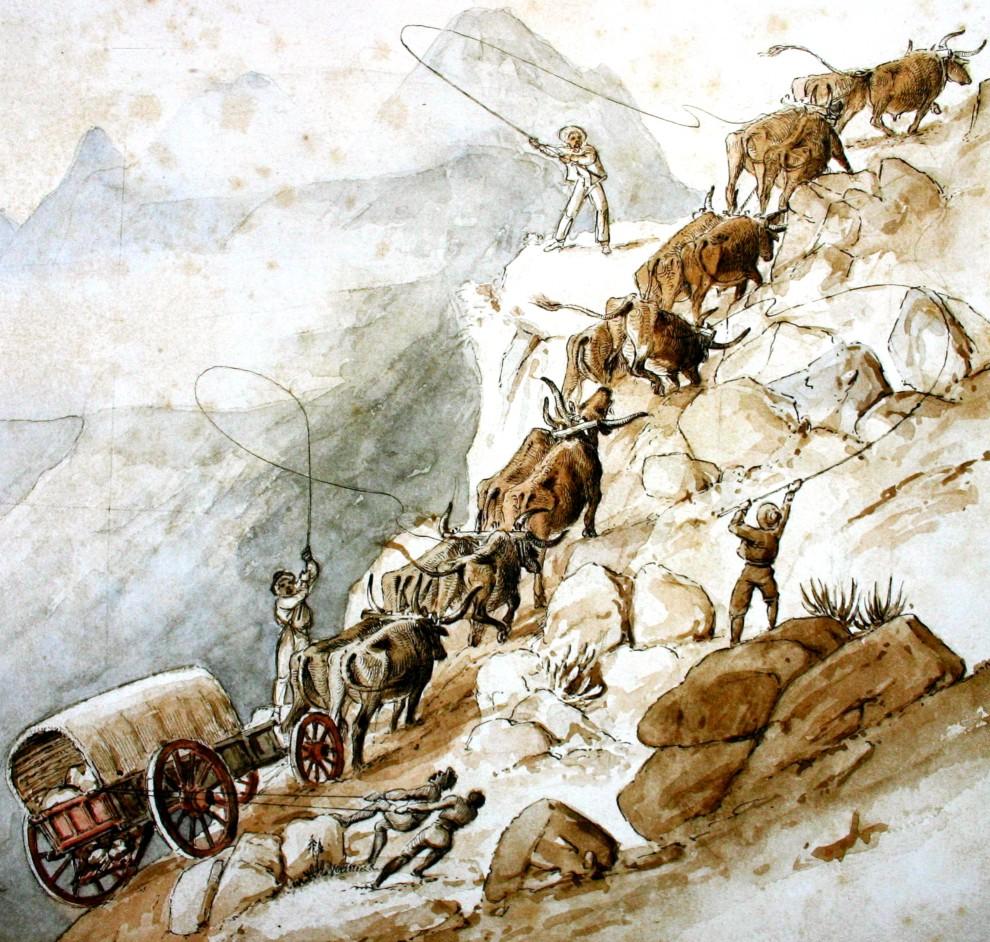
From 1835 onwards, groups of Boers, together with their Khoikhoi and black servants, set off for the interior in search of their own lands—and independence. Crossing the Orange River, the Cape Colony's northern frontier, these Boers, or Voortrekkers ("pioneers") as they were known, discovered vast areas of apparently uninhabited grazing land to the north and east: the Highveld. They were unaware that these pasturelands had been recently abandoned by their former Bantu occupants as a result of the mfecane. As the Boers pushed further northeastwards over the Vaal River into the Transvaal, they came across lands still occupied by Bantu clans and chiefdoms.

The killing of the Boer leader Piet Retief by the Zulu king Dingane triggered a war between the Zulus and the Boers. The Boers' superior weapons gave them easy victory. At the Battle of Blood River, fought at the Ncome River in Natal on 16th December 1838, several thousand Zulus died, reportedly causing the Ncome's waters to run red.
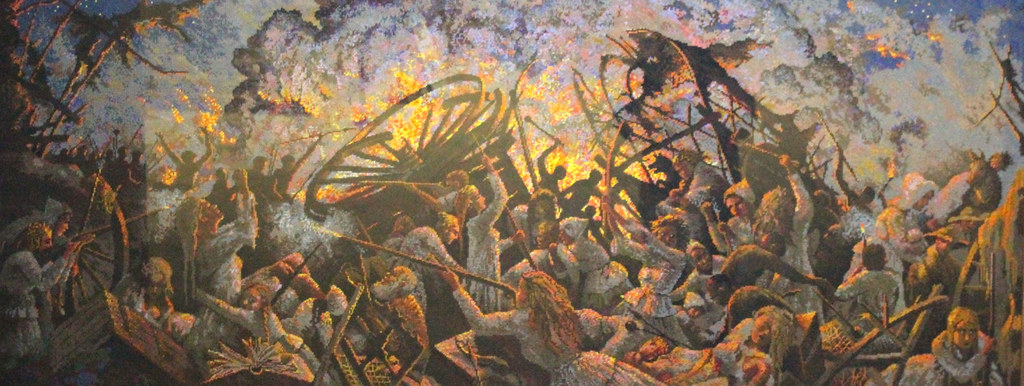
The Boers' triumph under Andries Pretorius led to a civil war within the Zulu nation. King Dingane's half-brother, Mpande, even formed an alliance with the Boers to overthrow the king. After Dingane's death, Mpande was proclaimed king of the Zulus.
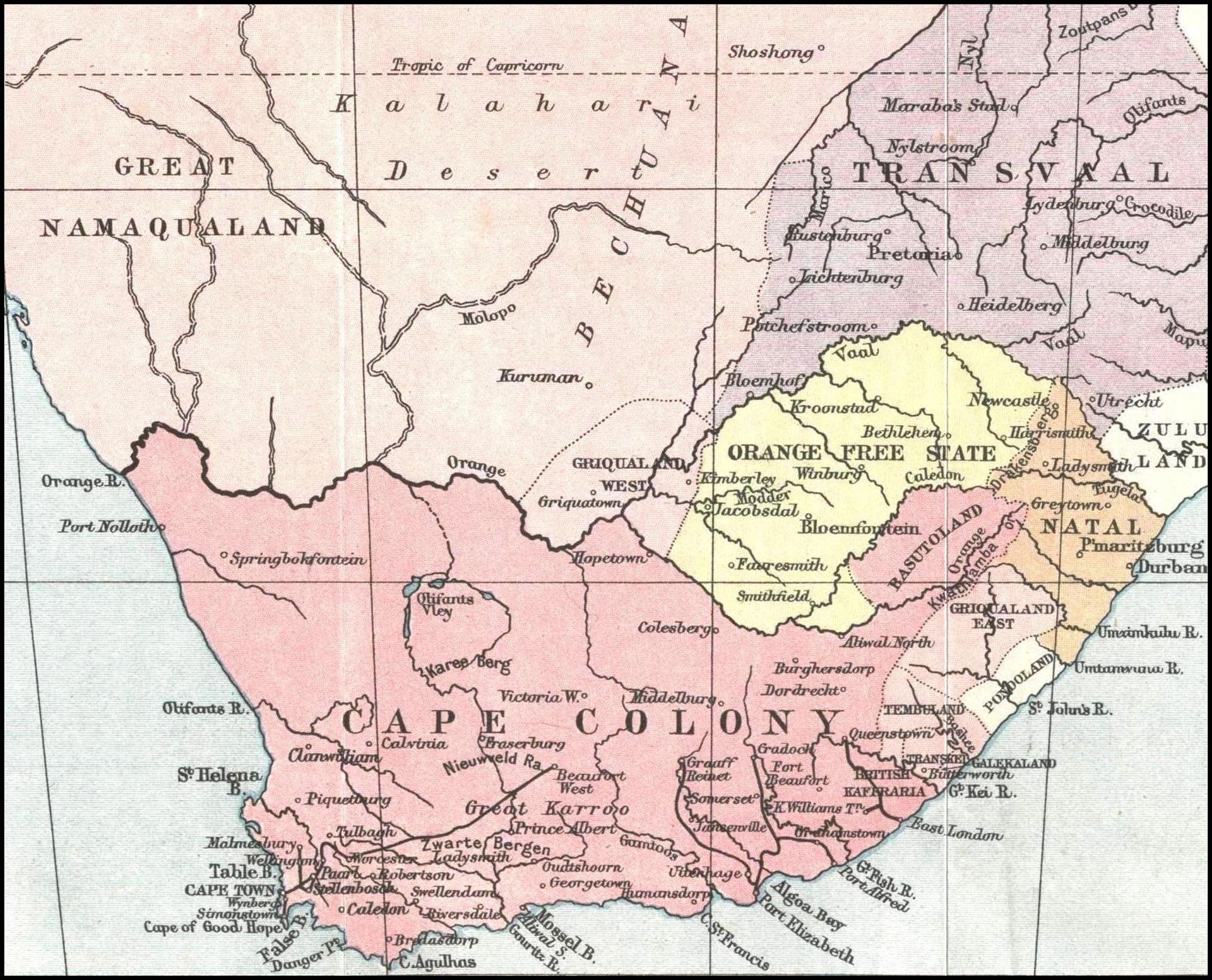
By the early 1840s, the Boer Voortrekkers had occupied much of the Transvaal. Under their leaders Andries Hendrik Potgieter, Andries Pretorius, Jan Mocke and others, they defeated all the remaining weaker African chiefdoms. Two Boer republics emerged in the 1850s. The first, the Transvaal, also known as the South African Republic, was formally recognized by Britain with the signing of the Sand River Convention on 17th January 1852. The second, the land between the Orange and Vaal rivers (previously claimed by the British as the Orange River Sovereignty), became Boer territory in 1854 as the Orange Free State.

Natal
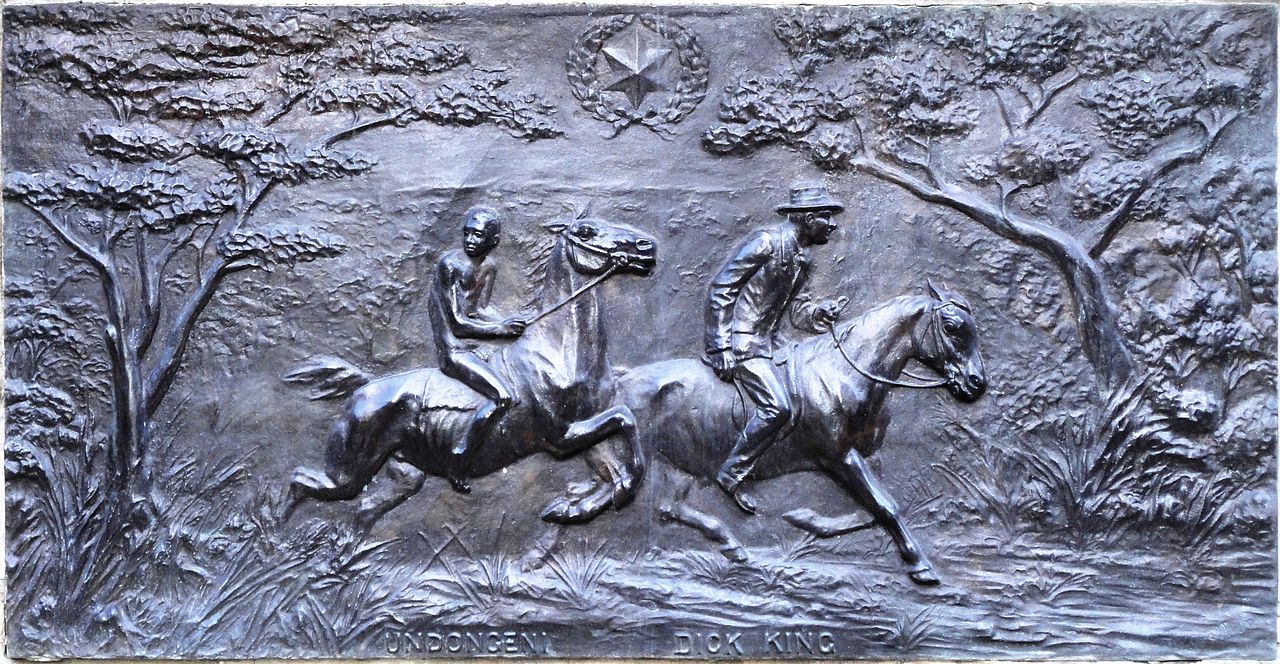
Following their victory over the Zulus at Blood River, the Boers had also attempted to establish another republic, called Natalia, with its capital at Pietermaritzburg in 1839. But, just a short distance away, the British had already founded their own settlement, Port Natal, on the northern shore of the Bay of Natal (it would later become the port of Durban, named after Benjamin D'Urban, a governor of the Cape Colony). The two groups of European settlers were set on a collision course. At the Battle of Congella in 1842 the Boers, now in alliance with the Zulus, besieged Port Natal, but the British held out to drive them out.
The Natalia Republic was annexed by the British in 1843 and proclaimed a British colony, called, simply, Natal. Between 1849 and 1851, thousands of settlers arrived from Britain to live there. But they soon faced a labour shortage on the farms and plantations they established—men of the local Zulu warrior nation refused to work on them. So the colonists looked elsewhere to other parts of the British Empire. In 1860 the first identured labourers (contracted workers) arrived from India. Over the next 50 years, 150,000 more Indian servants and labourers would come to Natal, as well as many free "passenger Indians". Among their number was, in 1893, the lawyer and social activist Mahatma Gandhi.
Basotho
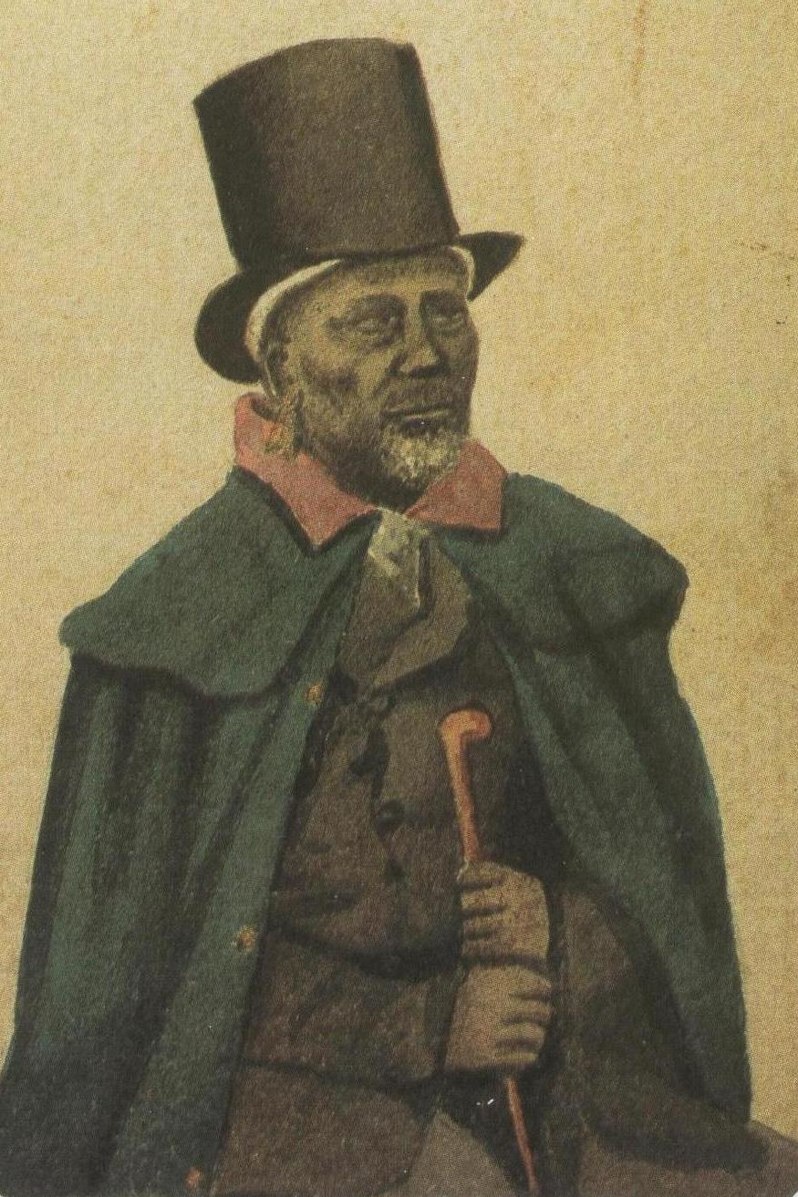
The Sotho (or Basotho) people, inhabitants of the valleys and foothills of the Drakensberg, had, under their king Moshoeshoe I, managed to resist the Zulu onslaught in the 1830s and 40s. They also provided stiff resistance to the Boer advance. In a series of wars fought over a dozen years Moshoeshoe held out, despite being forced to cede territory to the Boers by the 1866 Treaty of Thaba Bosiu. What was left of his kingdom became a British protectorate, named Basutoland, in 1868. Now known as Lesotho, it remains to this day an independent nation within South Africa's borders.

Xhosa Wars
In the Eastern Cape, the series of wars between the white settlers—first the Boers, later the British—and the Xhosa continued on through the mid-19th century. Conflicts were often triggered by accusations of cattle raiding or petty thefts by the Xhosa. The British took control of Xhosa lands east of the Great Fish River as far as the Great Kei River, calling their new territory British Kaffraria. The Xhosa were forced to resort to desperate measures. Between 1856 and 1858, they killed many of their own cattle and destroyed their crops in the belief that this would cause their ancestors to rise from the dead and destroy the white invaders. But as a tragic consequence thousands of Xhosa starved to death and many of the survivors were forced into labour in the Cape Colony.
Diamonds

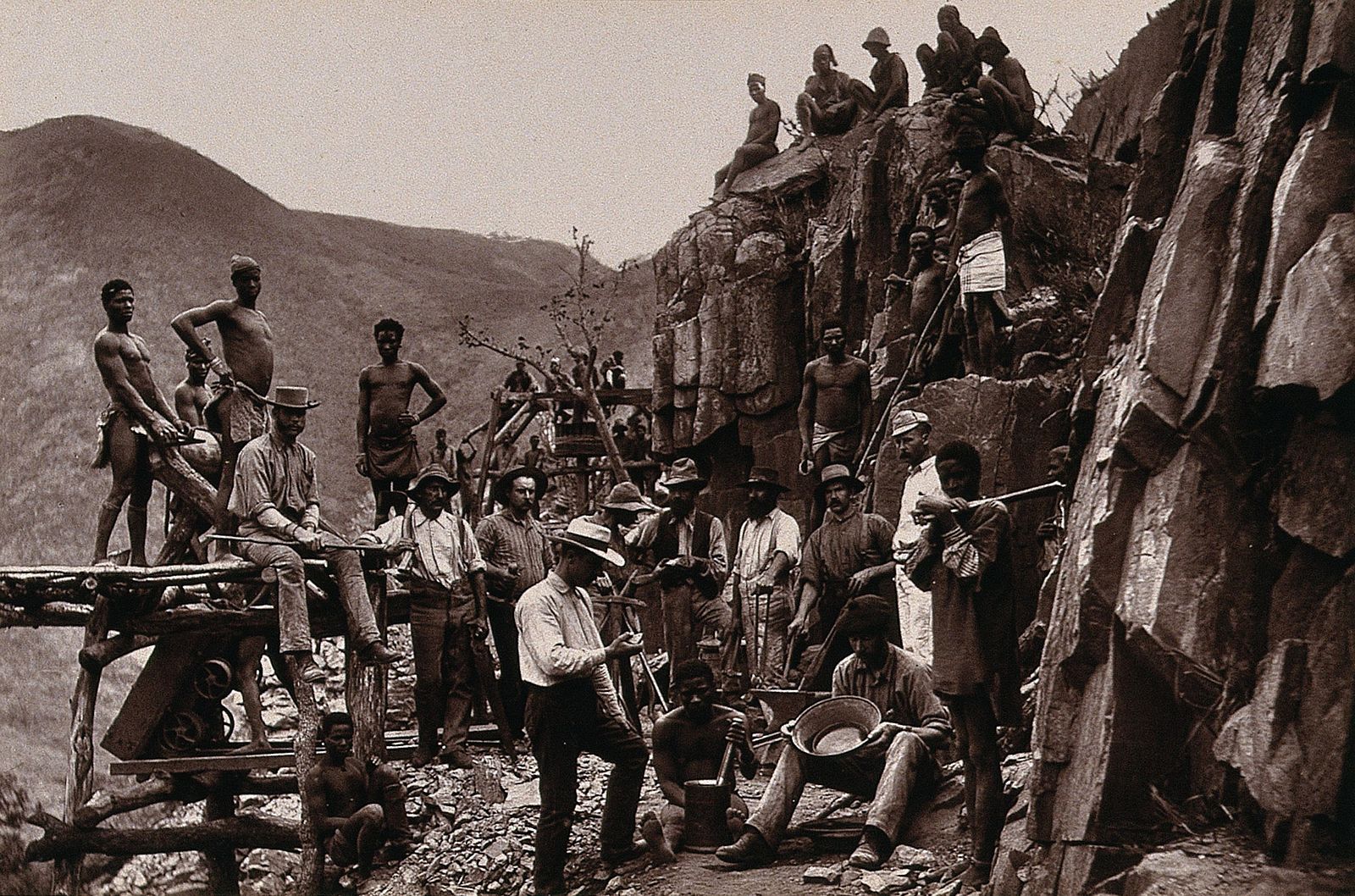
The first discoveries of diamonds were made in 1867 in the sediments of the Orange River. Two years later, gem-quality diamonds were found in a hard rock called kimberlite, named after the nearby town of Kimberley. The "diamond zone", which was on land occupied by the Griqua, was also claimed by the Orange Free State, the Transvaal Republic and the southern Tswana chiefdoms. The British granted rights to Nicolaas Waterboer, leader of the Griqua, but persuaded him to request their protection against his Boer rivals. In 1871 the area became a separate colony of the British Empire named Griqualand West (some Griqua had earlier trekked eastwards across the Drakensberg mountains to found another homeland, Griqualand East, in 1861). The Griqua never received any share of the wealth generated by the Kimberley diamond mines.

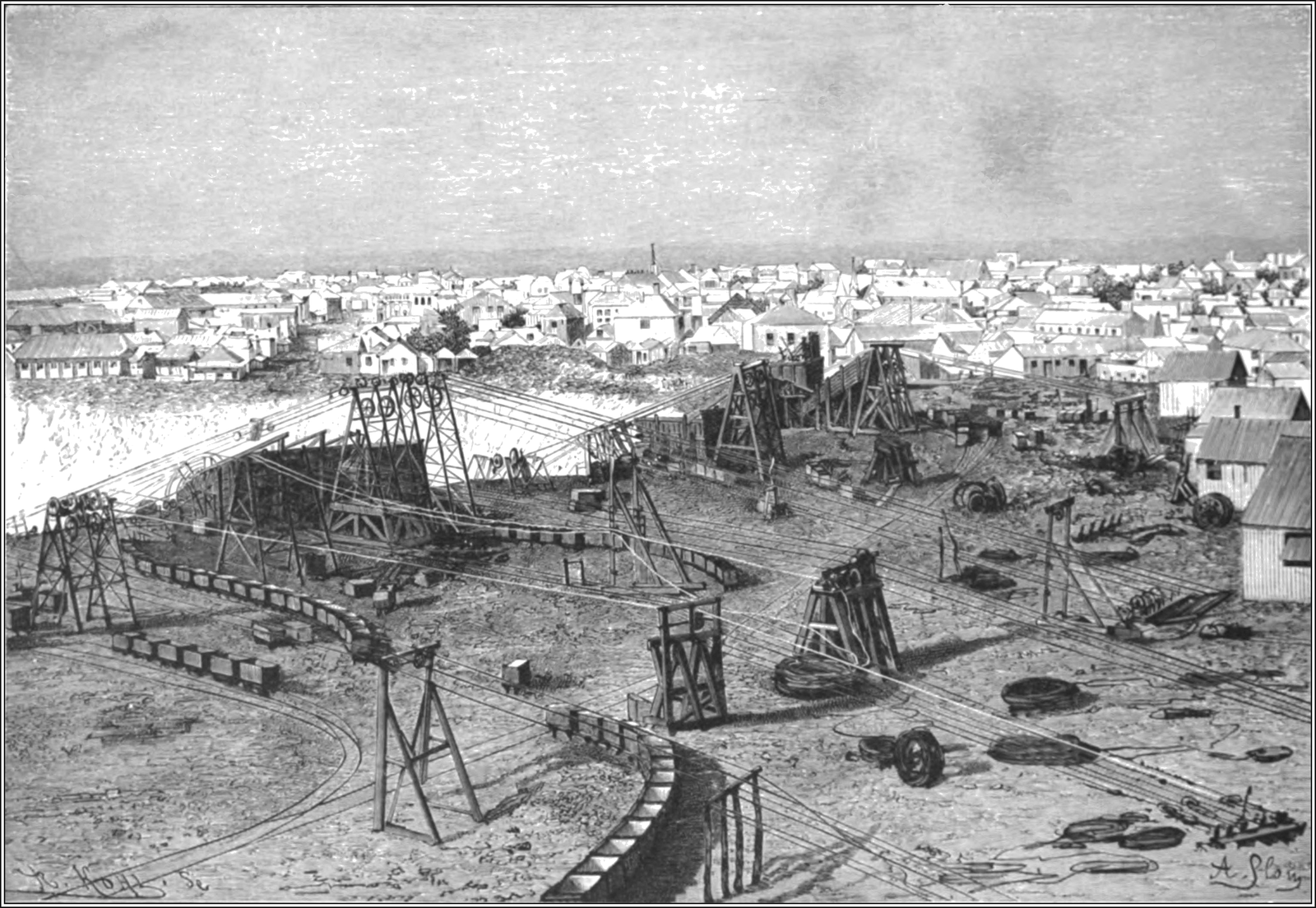
With the arrival of European and black African miners, the Cape Colony's population rapidly increased. The diggers were gradually bought out by big mining companies. De Beers Consolidated Mines, a company co-founded in Kimberley by British businessman Cecil Rhodes in 1888, became the sole producer in 1889.
Confederation
The Cape Colony achieved self-governing status within the British Empire in 1872. Now the Cape Colony governors intensified their efforts to bring all the other states of southern Africa into a confederation under their rule. To this end, the Transvaal Republic, along with Griqualand East and West, was annexed in 1877.

The British also renewed their attempts to secure black Africans' labour for their farms, plantations and now their diamond mines. Their superior firepower gave them victory in the ninth and final Xhosa War of 1877–79, resulting in British annexation of all remaining Xhosa territory.
The still-powerful Zulu kingdom remained a major obstacle to British plans, however. Following an ultimatum—with which the Zulu king Cetshwayo could not comply—British troops invaded Zululand in January 1879. They were faced by a Zulu force of some 20,000 warriors armed mainly with iron spears and cow-hide shields. In the Battle of Isandlwana, the British, despite having modern rifles and field guns, were overwhelmed, losing 1300 from their column of 1800 men. But a British garrison successfully defended the mission of Rorke's Drift against the Zulu onslaught, and, with the arrival of reinforcements, eventually triumphed in July. Zululand was annexed in 1887 and sugar plantations were established on former Zulu lands.

First Boer War
Boer resentment against rule by the British turned into open rebellion in the Transvaal in 1880. Following Boer attacks on occupying British troops, the first Anglo-Boer War broke out. Successful guerrilla warfare tactics and a decisive Boer victory at the Battle of Majuba Hill on 27th February 1881 saw the British government suing for peace at the Pretoria Convention. The Transvaal regained its independence as the Zuid-Afrikaansche Republiek (South African Republic), or ZAR. Paul Kruger, one of the leaders of the Boer uprising, became the republic's president in 1883.


Second Boer War
The discovery in February 1886 of gold at a Langlaagte farm in the Transvaal brought instability to the newly-independent republic. The city of Johannesburg, lying above the main Witwatersrand gold seam, emerged and grew very rapidly as immigrants flooded in to work the new goldfields. Tens of thousands of uitlanders (immigrants), both black and white—including many British miners—now lived in the ZAR.
After Cecil Rhodes became prime minister of the Cape Colony in 1890, the British sought to regain control of the Transvaal and the enormous wealth from its goldmines. In 1895, a column of soldiers under Captain Jameson invaded the ZAR with the intention of triggering an uprising on the Witwatersrand. The plan was foiled and the invaders were captured, but the Jameson Raid alerted the Boer government to the dangers of a British attack. To bolster his defences, President Kruger formed an alliance with the neighbouring Boer republic of Orange Free State against the Cape Colony.


Tensions rose again in 1899 when the British demanded voting rights for the 60,000 British people now living on the Witwatersrand. Kruger rejected the demand and called for the withdrawal of British troops from the ZAR's borders. The British refused and Kruger declared war. The British had far greater numbers—500,000 troops to 87,000 Boer men—but the Boers had much greater familiarity with the local terrain. After a brutal war, the British eventually emerged victorious. By the Treaty of Vereeniging which ended the conflict in 1902, the two independent Boer republics were finally absorbed into the British Empire as the Transvaal Colony and the Orange River Colony. The war had claimed the lives of 22,000 British soldiers and 7000 Boer fighters. More than 27,000 Boer women and children perished in British concentration camps.
Consultant:Philip Parker
pics


Without in any way limiting Q-files Ltd’s exclusive rights under copyright, any use of this publication to “train” generative artificial intelligence (AI) technologies to generate text is expressly prohibited. Q-files Ltd reserves all rights to license use of this work for generative AI training and development of machine learning language models.