
Q-news

CITE
We have made every effort to follow citation style rules, but there may be some minor differences. If in doubt, please refer to the appropriate citation style manual.
Australia suffers its worse mouse plague for decades. (2022). In Q-files Encyclopedia, , Q-news. Retrieved from
https://www.q-files.com/news/australia-suffers-its-worse-mouse-plague-for-decades
"Australia suffers its worse mouse plague for decades." , Q-news, Q-files Encyclopedia, 10 Feb. 2022.
https://www.q-files.com/news/australia-suffers-its-worse-mouse-plague-for-decades.
Accessed 13 Sep. 2026.
Australia suffers its worse mouse plague for decades 2022. , Q-news. Retrieved 13 September 2026, from
https://www.q-files.com/news/australia-suffers-its-worse-mouse-plague-for-decades
, Q-news, s.v. "Australia suffers its worse mouse plague for decades," accessed September 13, 2026.
https://www.q-files.com/news/australia-suffers-its-worse-mouse-plague-for-decades


Australia suffers its worse mouse plague for decades
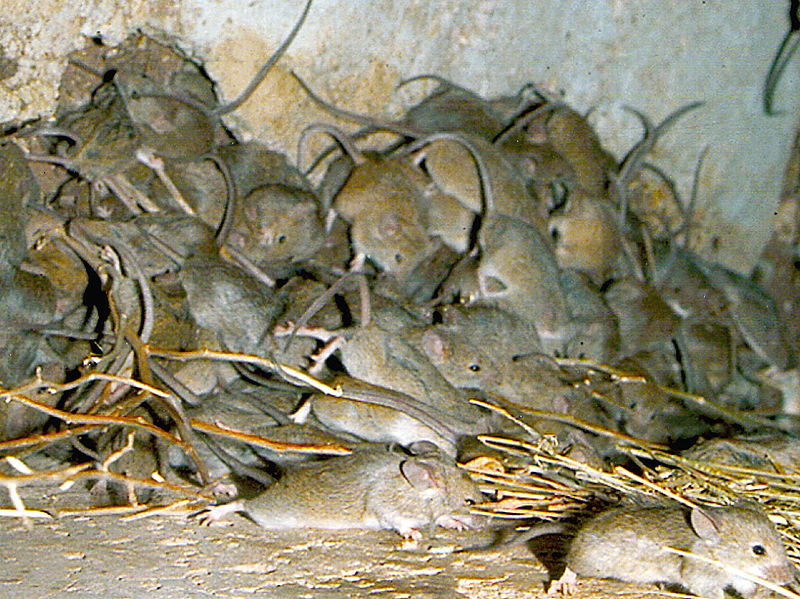
Swarms of mice are infesting rural parts of New South Wales, Australia, in what has been described as the worst plague in memory. A bumper harvest, following prolonged rainfall that ended a long period of devastating bushfires and drought, has massively boosted the populations of wild house mice. With plenty of grain to feed on and fewer predators about (decimated by the effects of drought), the rodents have been wreaking havoc for many months, especially on farms. While New South Wales has seen the largest numbers, parts of Queensland, Victoria and South Australia have also been overrun, and there is no sign of the plague ending soon. After a fairly mild and wet summer, vegetation is continuing to grow into the winter months of June and July. This means large numbers of mice will survive through to the spring and be ready to multiply once more.
25th June 2021


Mouse plagues have come and gone in parts of Australia ever since wild house mice were introduced by British colonists at the end of the 18th century. The rodents multiplied rapidly in the favourable climate. Plagues usually occur in the grain-growing regions of southern and eastern Australia around every four years.
Water conservation and sustainable farming methods—such as reducing tilling to a minimum to conserve soils—have benefited the environment, but also resulted in a significant increase in shelter and extra food sources for mice foraging in the fields.
The infestation of millions of mice has caused damage to homes, where they chew through walls, ceilings, furniture and electric wiring. Some home-owners setting traps say they have caught 500 to 600 mice per night. The stench of urine and of dead mice has been widely reported. Mice have also been seen in supermarkets, prisons, schools and hospitals—even, in a handful of cases, biting patients in their beds. The plague of mice, which has destroyed crops and grain, has hit farmers particularly badly, however. They also face the spiralling costs of pest control.
An invasion of Sydney or other large cities is, thankfully, not likely to happen. Mice seldom travel further than 100 metres from their nests to forage for food at night.

You can see more pictures of the mouse plague, along with video footage showing hundreds of mice inside the Wellington Correctional Centre prison in New South Wales, on the BBC News website here.
Farmers are attempting to tackle the problem by using zinc phosphide as bait. Some of the wheat crop is coated with the poison. When a mouse eats it, gas is released into its digestive system causing the animal to die quickly. Zinc phosphide's toxicity decreases to zero over the course of just 24 hours, so the danger of other animals having exposure to the poison is minimized. It could still be a danger to pets, however.

The use of a more powerful poison, bromadiolone (described as “napalm for mice”), has been rejected over fears for wildlife. Because it remains in the mouse's body tissues for months, the poison would also be toxic to any wild animals that ate the dead or dying mice, including endangered birds such as owls, eagles and parrots. Murray cod, large freshwater fish that live in the rivers of the Murray-Darling basin, have been observed gorging themselves on the thousands of mice that attempt to swim across the Murray River. Also an endangered species, they, too, would have been at heightened risk were bromadiolone to have been introduced.
Genetic bio-control measures have also been developed—although they are more likely to be of use in controlling future plagues. They include releasing genetically modified mice into the wild to spread their altered genes throughout the mice population and cause all newborn female mice to become infertile.
pics
Without in any way limiting Q-files Ltd’s exclusive rights under copyright, any use of this publication to “train” generative artificial intelligence (AI) technologies to generate text is expressly prohibited. Q-files Ltd reserves all rights to license use of this work for generative AI training and development of machine learning language models.