
Astronomy
Observing space
From Earth, we can observe with the naked eye other objects in space: our nearest neighbour, the Moon; our local star, the Sun; five of the other planets of the Solar System; comets and meteors; more distant stars and nebulae and even other galaxies. More can be seen through binoculars or simple telescopes, but to study in detail these objects or other objects that lie millions, or even billions, of light years away, powerful telescopes must be used.


The night sky
A clear, moonless night is the best time to observe space from Earth—as far away from artificial lights as possible. On many nights, the Moon is the brightest and largest object in the night sky. In perfect conditions up to 10,000 stars may be visible to the naked eye. All of them belong to the Milky Way Galaxy. From Earth, our view of one of the Galaxy’s spiral arms looks like a misty band across the sky. This is the “milky way” from which the Galaxy takes its name. Up to five planets (Mercury, Venus, Mars, Jupiter and Saturn) can also be spotted. Every few years might also catch sight of a comet. Meteors (shooting stars) are streaks of light that last usually for less than a second. They are tiny rock fragments from space, called meteoroids, burning up high above Earth.
Reflecting telescopes
There are two kinds of optical telescope: refractors and reflectors. In a refractor, a convex (bulging) lens collects light from the distant object and focuses it. A reflector uses a concave (dish-shaped) mirror to do the same. Most large modern telescopes are reflectors, because large mirrors are easier to manufacture than large lenses.
In a Cassegrain-type reflector, light is focused by two mirrors: a primary and a secondary. The primary mirror is used to collect the light from the object and focus it on to a smaller secondary mirror. From there, the image is reflected on to a light sensor. Larger telescopes are nearly always reflecting telescopes.
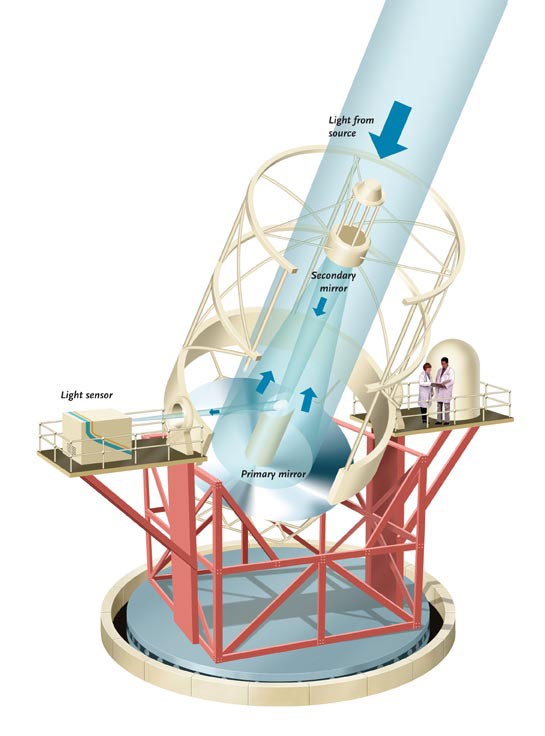

Modern observatories, where telescopes are housed, are built on mountaintops, above the densest, cloudiest parts of the atmosphere, or in the desert, far from the lights from cities (called "light pollution"). Mauna Kea, Hawaii, is one of the best observing mountaintop sites in the world and has many observatories. The Atacama Desert in northern Chile, where it almost never rains, has one of the darkest night skies on Earth.
Detecting radiation
Another type of telescope does not collect light rays at all. It detects radio waves. Others, orbiting Earth, detect gamma, X-rays, ultraviolet or infrared radiation. Planets, stars and galaxies give off some or all of these kinds of radiation. Large radio telescopes look like giant satellite dishes. They are specially designed to collect radio waves. Most can be turned to face any part of the sky.
Some radio telescopes are built in large groups, called arrays, and linked electronically. This has the effect of boosting the resolution (sharpness) of the images received. The Very Large Array of radio telescopes in San Augustin, New Mexico, is an example of an array.


Hubble Space Telescope
The Hubble Space Telescope orbits around 620 kilometres (380 miles) above Earth. Scientists can point it in any direction (except near or at the Sun, or Earth) and receive pictures of distant objects that are clearer than those taken from most Earth-based telescopes. This is because these telescopes suffer from polluted air, clouds and atmospheric disturbances.
James Webb Space Telescope

The James Webb Space Telescope (JWST) orbits the Sun around 1.5 million kilometres (940,000 miles) from Earth, at a point (L2 Lagrange point) where it is stationary when viewed from Earth. Launched on 25th December 2021, the JWST has a primary mirror measuring 6.5 metres (21.6 feet) at its widest point. It is made up of 18 hexagonal mirror segments covered in a thin layer of gold. The JWST is mainly used to detect infrared radiation from the most distant galaxies in the Universe, providing images that will help scientists understand how they formed and evolved. It also focuses on exoplanets.

Consultant: Mike Goldsmith