
Construction
Tunnels
A tunnel is an underground passageway which is dug, blasted or bored out of the ground. A tunnel is needed, for example, when a road, railway or canal has to pass under an obstacle such as a river or mountain. The first tunnels were built in ancient times: they were sewers (channels to carry off drainage water and waste) and aqueducts (channels to carry water from springs to supply cities). In more recent times, railways in cities are built underground in a network of tunnels to prevent congestion at street level. Sewers are still built as underground networks of tunnels and pipes.


Ancient tunnels
The Babylonians, Greeks and Romans all built tunnels in ancient times. In the 6th century BC, the Greek engineer Eupalinos built a tunnel just over a kilometre long on the island of Samos for an aqueduct, a channel to supply the capital city with fresh water. It was designed to prevent the water supply being easily cut off by an enemy.
Early construction techniques
Early tunnels were held up by timber frames while they were being built. They were then lined with bricks or stone to make them stronger. Soft rock could be dug out using hand tools, such as saws and hand drills. Harder rock was excavated using a method called fire quenching. The rock was heated so that it expanded, before being quickly drenched with cold water, which caused the rock to shrink again and so crack apart.

Gunpowder was first used in tunnelling in the early 1600s. Explosions broke up the rock more effectively, but until the slow-burning fuse was invented in 1831, it was very dangerous.

Drilling and blasting
The drill-and-blast method for building tunnels is still used today. Explosives such as dynamite, invented in 1867 by Swedish chemist Alfred Nobel (1833–96, after whom the Nobel Prize is named), are used. They are placed in holes in carefully designed patterns so that when detonated, they blast an opening of the required size and shape. Bolts and support arches are laid in the new tunnel walls to hold it up as it is constructed. By repeating these steps, the tunnel is gradually constructed.
The Laerdal Tunnel in Norway, the world's longest road tunnel, was constructed using this method in 1995–2000. It is 24.5 kilometres (15 miles) long.

Cut-and-cover
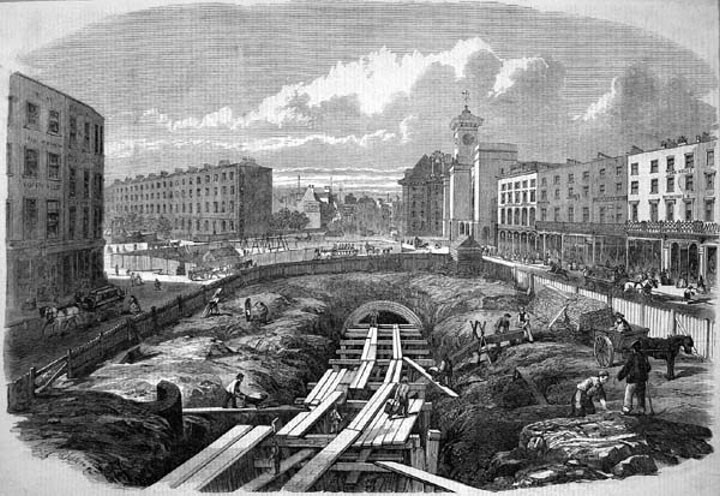
A simple method of building a tunnel is called cut-and-cover. A channel or trench is dug in the ground, the tunnel is constructed in the trench and then a roof is built over it. This method is only suitable for building shallow tunnels in areas where the ground above the construction site can be completely cleared. Early underground railway networks were built using cut-and-cover techniques, including the London Underground’s Metropolitan Line in 1863, and the Paris Metro’s Line 12 in 1910.


Brunel’s tunnelling shield
In 1818 French-born engineer Marc Isambard Brunel (1769–1849) invented the tunnelling shield to build the Thames Tunnel under the River Thames in London, England. It was a huge iron structure that had space for 36 workers to stand and dig out the tunnel a few centimetres at a time from openings in the front of the shield. When each worker had dug out their section, the whole structure could be moved forward using jacks. Bricklayers worked behind them to build the tunnel’s brick lining. It was a slow and dangerous process, because parts of the tunnel often collapsed and there were leakages of water and sewer gas. The Thames Tunnel finally opened in 1843.
Boring machines
Using a tunnel boring machine (TBM), or a mole, is usually the most efficient way to build a tunnel today. It is relatively quick and does not disturb the ground above. Modern machines are based on an American machine designed in 1954 called Mittry’s Mole. It was the first successful design for a rotary excavator, a machine with a rotating head that was able to move forward and cut through the rock at the same time.


A tunnel boring machine is shaped like a large telescope. The rear part grips the sides while the front part, the cutter head, pushes forwards and bores a hole into the rock using a rotating wheel covered in sharp picks. The excavated rock is removed through the cutter head and transported out of the tunnel by conveyor belts. As it does so, concrete segments are fitted to the sides of the tunnel.

Immersed tube
An immersed tube (or immersed tunnel) is a kind of undersea tunnel made up of segments constructed elsewhere. They are then sealed at either end and floated to the tunnel site where they are sunk into place and linked together. Immersed tubes, which may be round, oval or rectangular in cross-section, are commonly used for road and rail crossings of rivers, estuaries and sea channels. The main advantage of immersed tubes is that they are cheaper and safer to construct than bored tunnels.


The first tunnel constructed with this method was a sewer laid in Boston, Massachusetts in 1893. The first to carry traffic was the Michigan Central Railway Tunnel constructed in 1910 under the Detroit River. The world's longest immersed tube tunnel is the 6.7-kilometre-long (4.2-mile) tunnel portion of the Hong Kong–Zhuhai–Macau Bridge, completed in 2018. It will be surpassed by the Fehmarn Belt Fixed Link connecting Denmark and Germany which will be 17.6 kilometres (11 miles) long. Construction started in January 2021 and is due to be completed in 2028.
Consultant: Mike Goldsmith