
Myths and legends

CITE
We have made every effort to follow citation style rules, but there may be some minor differences. If in doubt, please refer to the appropriate citation style manual.
King Arthur. (2026). In Q-files Encyclopedia, Culture, Myths and legends. Retrieved from
https://www.q-files.com/culture/myths-and-legends/king-arthur
"King Arthur." Culture, Myths and legends, Q-files Encyclopedia, 13 May. 2026.
https://www.q-files.com/culture/myths-and-legends/king-arthur.
Accessed 22 Sep. 2026.
King Arthur 2026. Culture, Myths and legends. Retrieved 22 September 2026, from
https://www.q-files.com/culture/myths-and-legends/king-arthur
Culture, Myths and legends, s.v. "King Arthur," accessed September 22, 2026.
https://www.q-files.com/culture/myths-and-legends/king-arthur


King Arthur
King Arthur was a legendary ruler of Britain. Tales of his life and deeds are known as Arthurian legends. They tell the story of a great king who brought peace to a war-torn land. The original legends may have been based on a real person who lived in the 5th or 6th centuries AD, but no one knows who he was. The medieval king who appears in the best-known legends was created centuries later. The most detailed account of King Arthur’s life was written by Geoffrey of Monmouth, who lived between about 1100 and 1155. His History of the Kings of Britain drew upon Welsh folklore, but Arthur, the conquering hero, was largely a fictional character made up by Geoffrey. French writer Chrétien de Troyes wrote poems about Arthur between 1155 and 1185. He introduced the character Sir Lancelot as well as the quest for the Holy Grail. A work by Sir Thomas Malory (died 1471), Le Morte D'Arthur (The Death of Arthur), became the best-known account of the legendary king. Modern versions are mostly based on Malory's story.
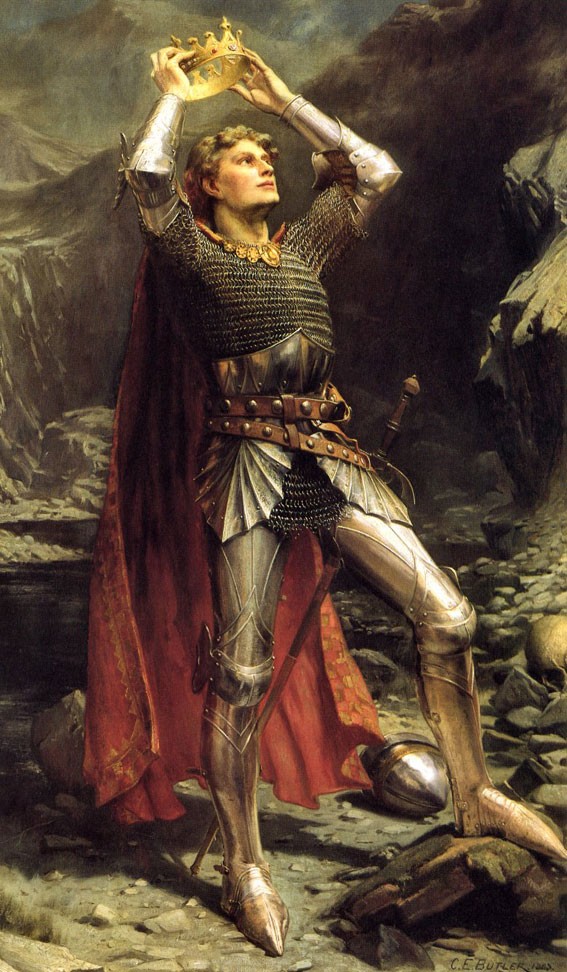

Was there a real Arthur?
Some scholars have suggested that “King Arthur” may have been based on a Celtic ruler called Artorius, who defended his people from the Anglo-Saxon invaders after the Romans left Britain in AD 410. According to some accounts, Artorius fought a number of battles against the Saxons between 500 and 537. Another researcher claims that a British king named Riothamus, who led a British army against France in about 460, may have been the source of the Arthur legend.
The Celts mixed stories of Arthur the great warrior with those of much older mythical figures, such as Gwydion, a Welsh priest-king. Some myths even claim that Arthur was descended from Aeneas, the Trojan hero who was said to be an ancestor of Romulus and Remus, the legendary founders of Rome.
Birth of Arthur
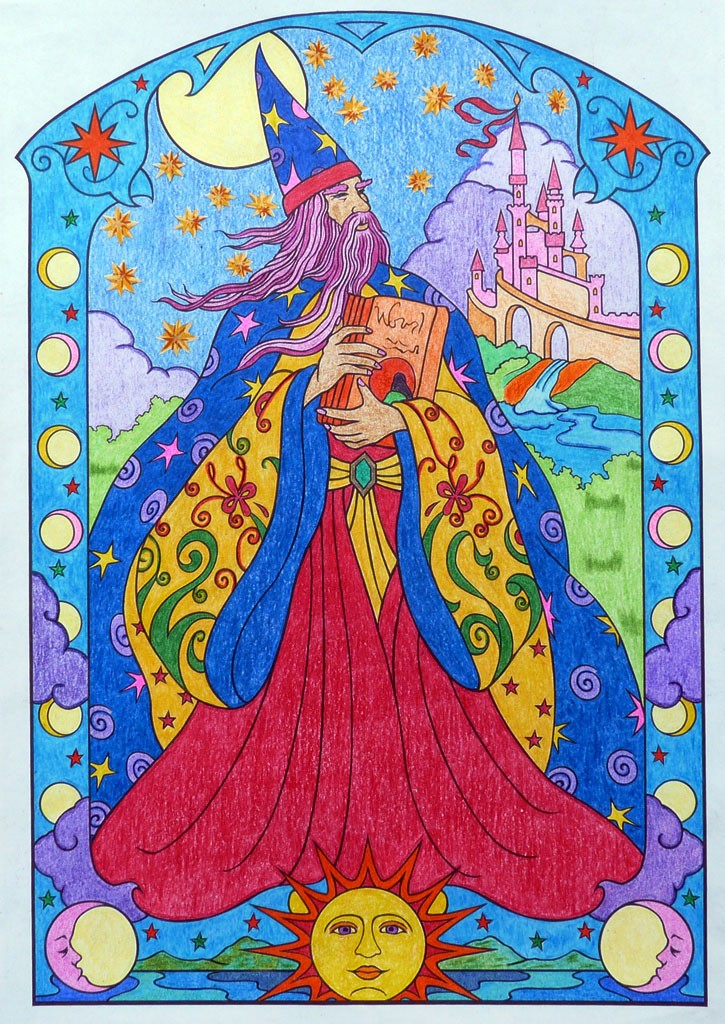
According to Malory, Arthur was the son of a king named Uther Pendragon, who married Igraine, wife of Duke Gorlois of Cornwall. Their child, born at Tintagel Castle in Cornwall, was named Arthur. A wizard called Merlin, who had helped Uther, arranged for a knight named Sir Hector to raise Arthur as his foster-son.

Excalibur
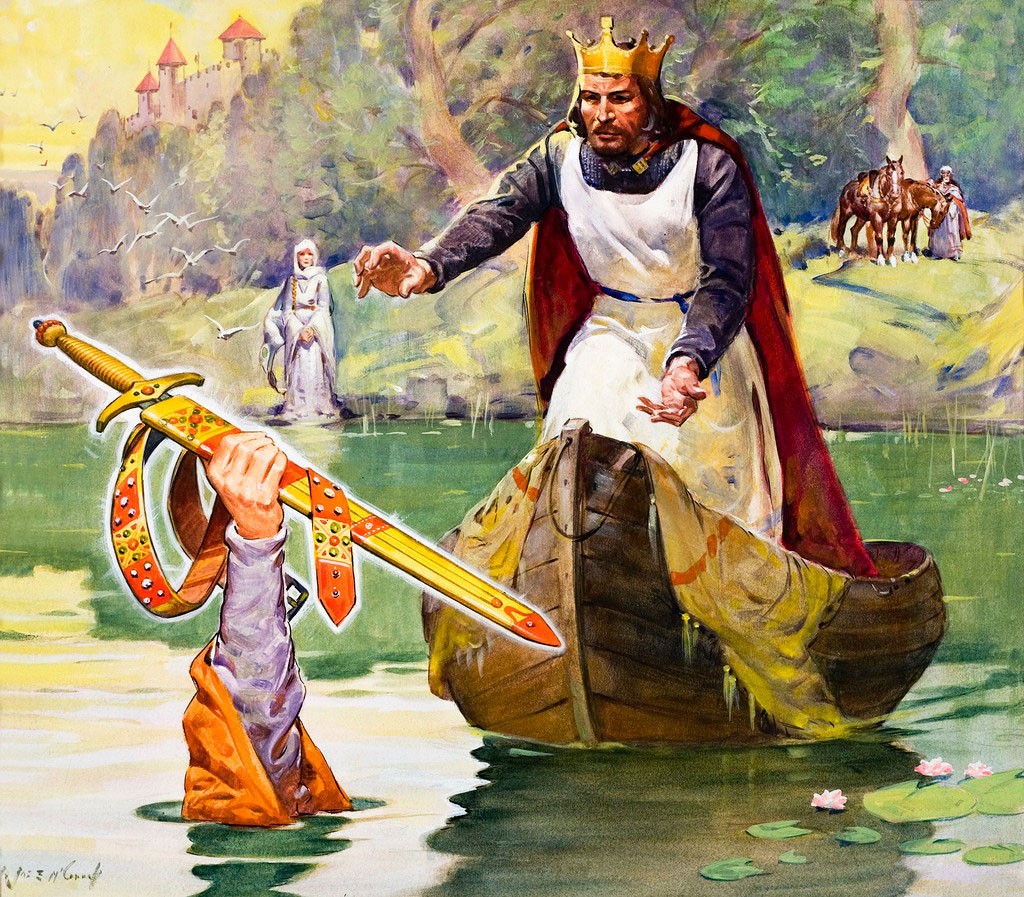
When King Uther died, he left no heir to his throne. It was said that the person who managed to pull a magical sword from a stone into which it was fixed would be the next king. The most powerful knights in the kingdom accepted the challenge, but none succeeded. The young Arthur, however, was able to pull out the sword with ease: thus it was he who was meant to be king of Britain. In some versions of the story, this sword is called Excalibur. Other versions say that Arthur was handed Excalibur by a mysterious figure called the Lady of the Lake.
Merlin then helped Arthur to defeat all those kings and nobles who opposed his kingship.
The Knights of the Round Table
Arthur fell in love with Guinevere, daughter of King Leodegran of Scotland. But Merlin insisted that Arthur had to prove himself in battle before he could marry her. When Arthur later returned in triumph from France, the wedding took place. As a gift, Guinevere's parents gave Arthur a large round table. He and the loyal knights who made up his court would sit around this table it to plan their campaigns and their deeds.
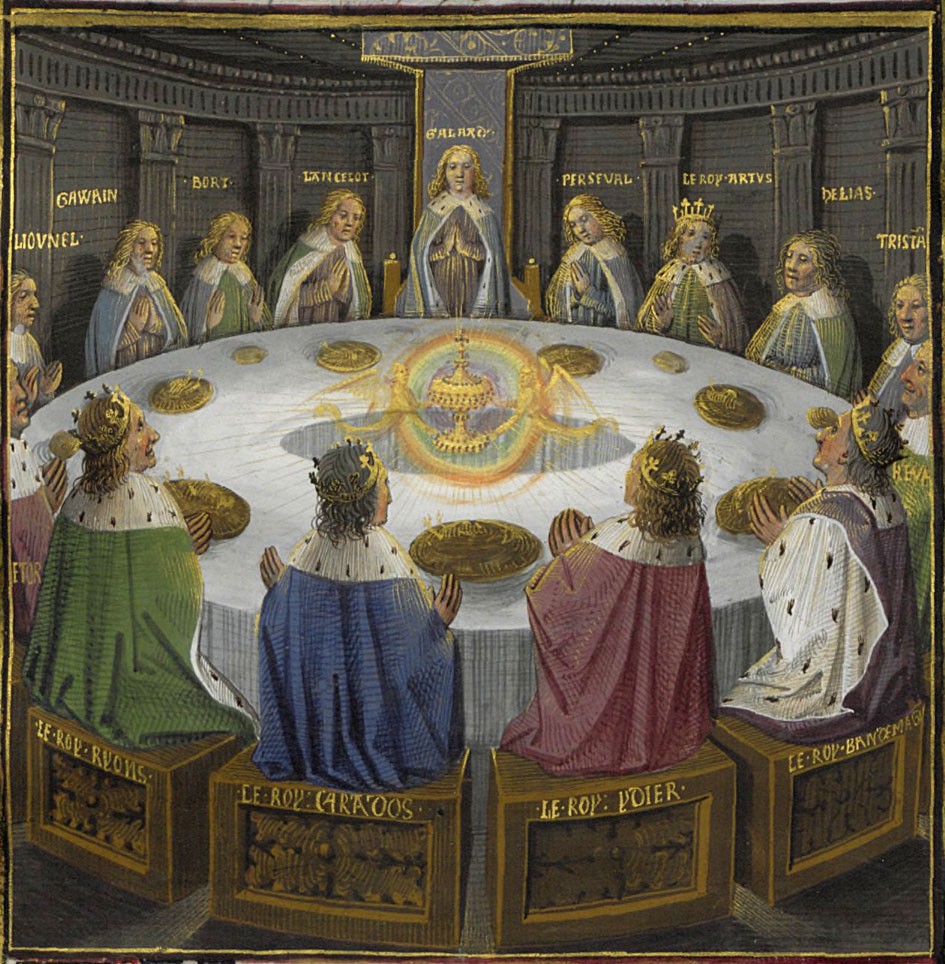
The Round Table became the symbol of the fellowship of the knights who pledged to undertake quests to defeat evil, to help those in danger and to keep the land of Britain free from invaders. Among their quests was the search for the Holy Grail, the sacred cup said to have been used by Jesus Christ at the Last Supper.
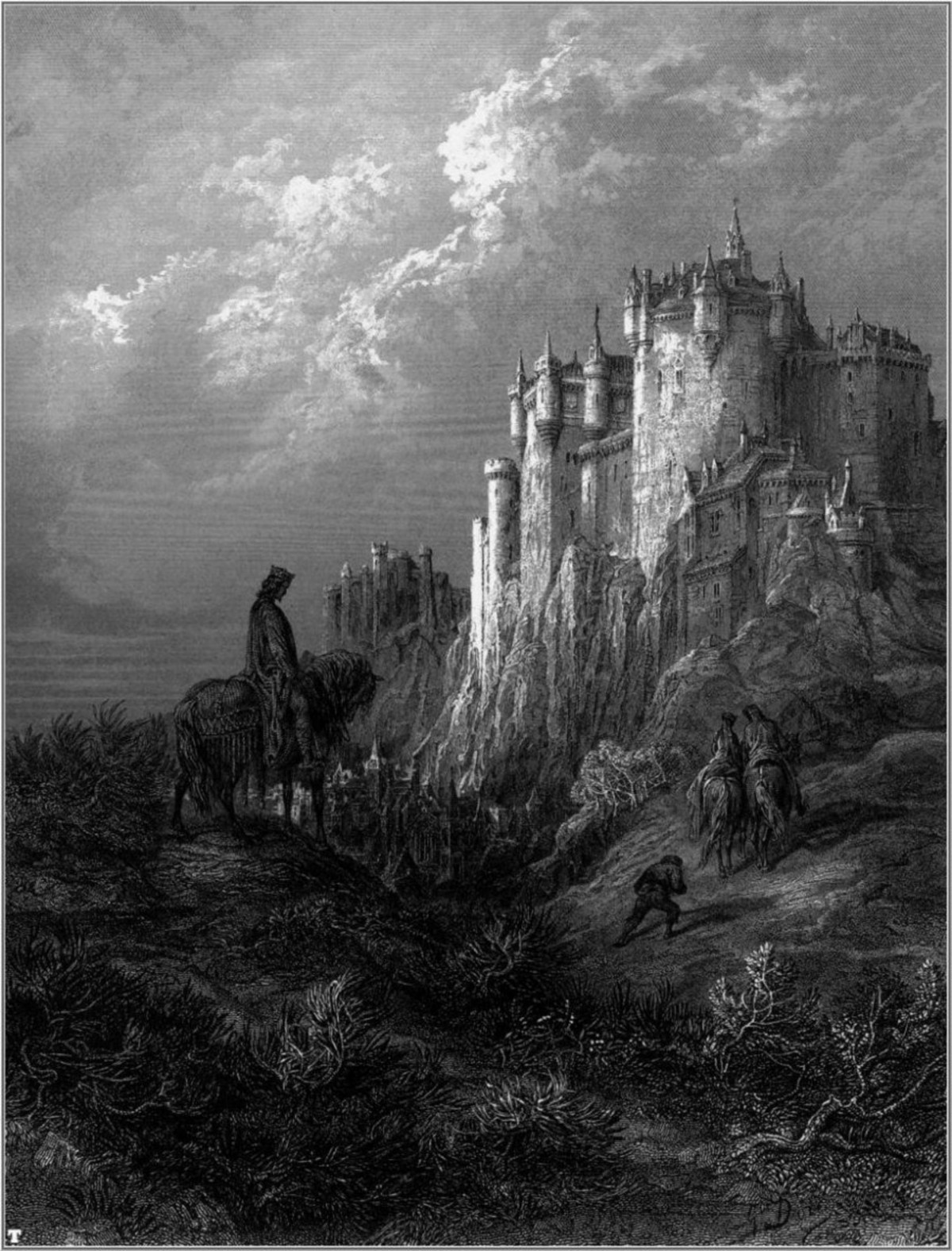
Camelot
Arthur made a place called Camelot his home and court, the headquarters for his knights. The wizard Merlin supervised the building of a magnificent castle, which contained a special hall for the Round Table. The hall also contained statues of the 12 kings who had tried to overthrow Arthur in the past. All had been defeated by him. Each statue had a lighted candle, which, according to Merlin, would stay lit until the Holy Grail was brought to Camelot.
Guinevere and Lancelot
Guinevere was the wife of King Arthur. She was a beautiful and noble queen. But she and Sir Lancelot, one of Arthur's most loyal knights, fell in love. Their attachment grew after he had rescued her following her kidnapping by a rival prince. Mordred, Arthur’s nephew (or, in some accounts, his son by an earlier relationship with his half-sister, Morgause) accused Queen Guinevere of adultery.

Lancelot defended her honour, but the other knights were forced to take sides. Some of them followed Lancelot into exile to France and set up another court, while others remained loyal to Arthur. Several violent battles between Arthur and Lancelot broke out, with groups of knights joining in on each side. Eventually, Guinevere returned to Arthur.
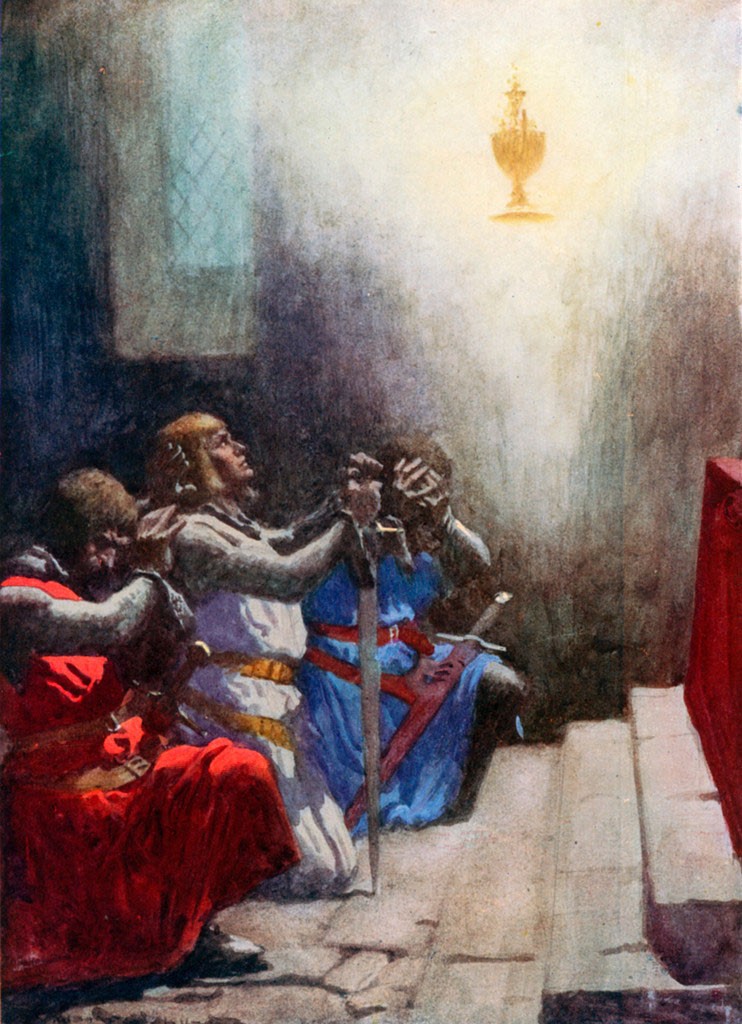
Sir Galahad
According to legend, Galahad was the purest and noblest knight in King Arthur's court. The son of Sir Lancelot and Elaine of Corbenic, Galahad was raised by nuns. When arrived at the Round Table, the young knight sat down in a seat known as the Siege Perilous. It was so-called because only the knight whose destiny it was to find the Holy Grail would be able to occupy this seat safely; everyone else who had sat there in the past was killed instantly. When Galahad remained unharmed, King Arthur and the other knights knew he would succeed in this quest.
After Galahad's arrival at Arthur's court, the knights began their search for the Holy Grail. Galahad set off alone but later joined forces with two other knights, Sir Percival and Sir Bors. Their travels took them to the court of Galahad’s grandfather, King Pelles, known as the Fisher King or the Wounded King. Pelles had been entrusted with guarding the Grail by descendants of Joseph of Arimathea, the man who gave up his own tomb for the burial of Jesus Christ after Jesus’s crucifixion. At Pelles’s court, Galahad was allowed to see the Holy Grail. Having achieved his life's goal, he prayed to be allowed to die.
The death of Arthur
Arthur left Mordred in charge of the kingdom while he went off to fight battles abroad. While the king was away, however, Mordred, who was deeply jealous of the king, plotted to seize Arthur’s kingdom for good and marry Guinevere. The queen locked herself in the Tower of London to avoid marrying him. When Arthur returned and learned of the plot, he vowed to kill Mordred.
The armies of Arthur and Mordred met near Salisbury. The two commanders agreed to make peace, but then a snake in the grass was sighted and someone drew his sword. Immediately, all the knights drew their weapons as well, and, in the chaos, fighting broke out. Arthur killed Mordred, but not before he was fatally wounded himself.

Arthur asked Sir Bedivere, to throw his sword Excalibur into a lake. Bedivere twice failed to follow Arthur's orders, hiding the sword instead. But Arthur knew his friend had disobeyed his wishes and commanded him a third time to cast it away. As he did so, the hand of the Lady of the Lake rose from the water and caught Excalibur.
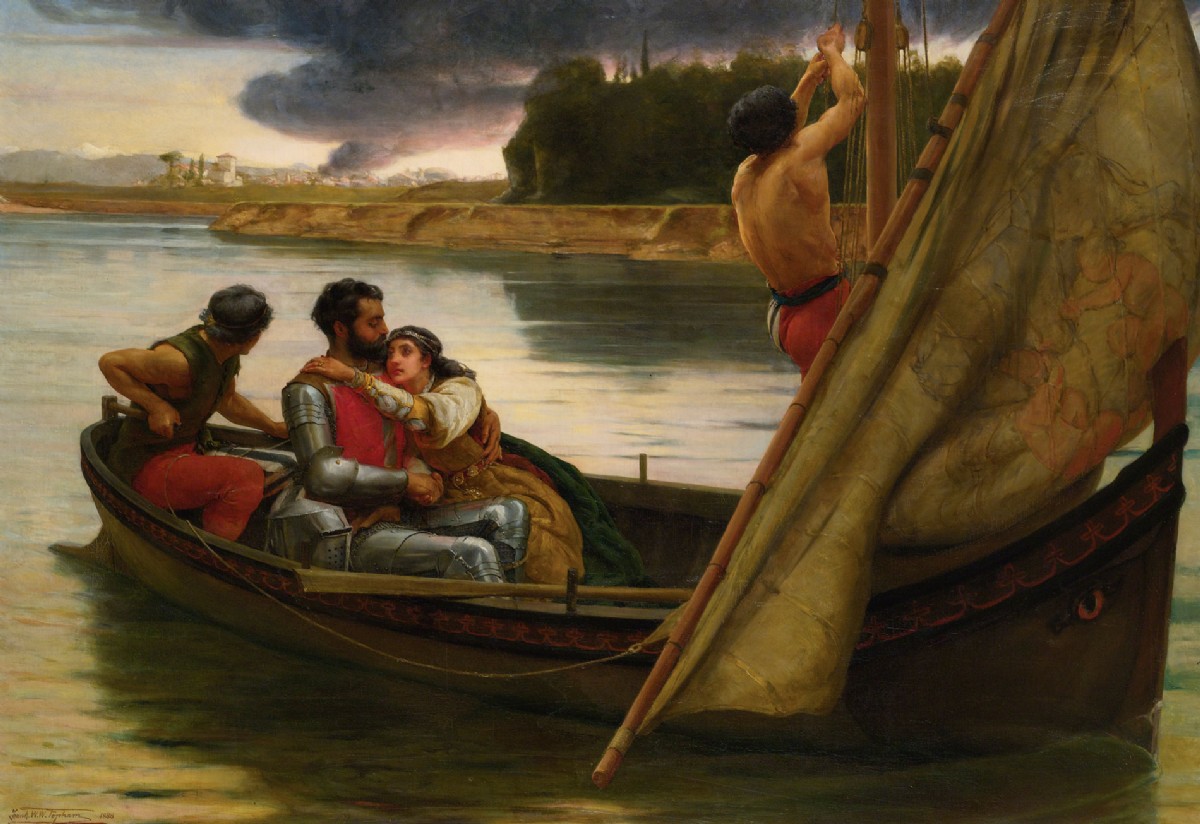
A mysterious barge then appeared. Bedivere placed the ailing Arthur on to the barge, which carried the king away to Avalon, a sacred island. There he would be cared for by the enchantress (magician) Morgan Le Fay until his death. According to legend, he would one day return when Britain had need of him.
Following Arthur’s death, Guinevere, still remorseful after her affair with Lancelot, became a nun and spent the rest of her life praying and helping the poor. When Guinevere died, she was buried beside King Arthur. Lancelot returned to Britain to find that Arthur's court was no more. He served as a monk until he died.
Consultant: Philip Wilkinson
pics
Without in any way limiting Q-files Ltd’s exclusive rights under copyright, any use of this publication to “train” generative artificial intelligence (AI) technologies to generate text is expressly prohibited. Q-files Ltd reserves all rights to license use of this work for generative AI training and development of machine learning language models.