
Myths and legends

CITE
We have made every effort to follow citation style rules, but there may be some minor differences. If in doubt, please refer to the appropriate citation style manual.
Robin Hood. (2026). In Q-files Encyclopedia, Culture, Myths and legends. Retrieved from
https://www.q-files.com/culture/myths-and-legends/robin-hood
"Robin Hood." Culture, Myths and legends, Q-files Encyclopedia, 13 May. 2026.
https://www.q-files.com/culture/myths-and-legends/robin-hood.
Accessed 22 Sep. 2026.
Robin Hood 2026. Culture, Myths and legends. Retrieved 22 September 2026, from
https://www.q-files.com/culture/myths-and-legends/robin-hood
Culture, Myths and legends, s.v. "Robin Hood," accessed September 22, 2026.
https://www.q-files.com/culture/myths-and-legends/robin-hood


Robin Hood
Robin Hood was a legendary English bandit who stole from the rich to help the poor. His name was already well established as a popular legend by the 1300s. It is possible that the Robin Hood legend comes from the old French custom of celebrating May Day. A character called Robin des Bois, or Robin of the Woods, featured at the festival, and this tradition may have crossed over to England—along with a slight name change. In those days, ordinary people were upset about new laws which kept them from hunting freely in forests that were now claimed as the property of kings and barons. The Robin Hood stories reflected this popular discontent. The unrest erupted in the Peasants' Revolt of 1381. Robin was most likely an imaginary figure, although some of the stories may have described the adventures of a real outlaw.

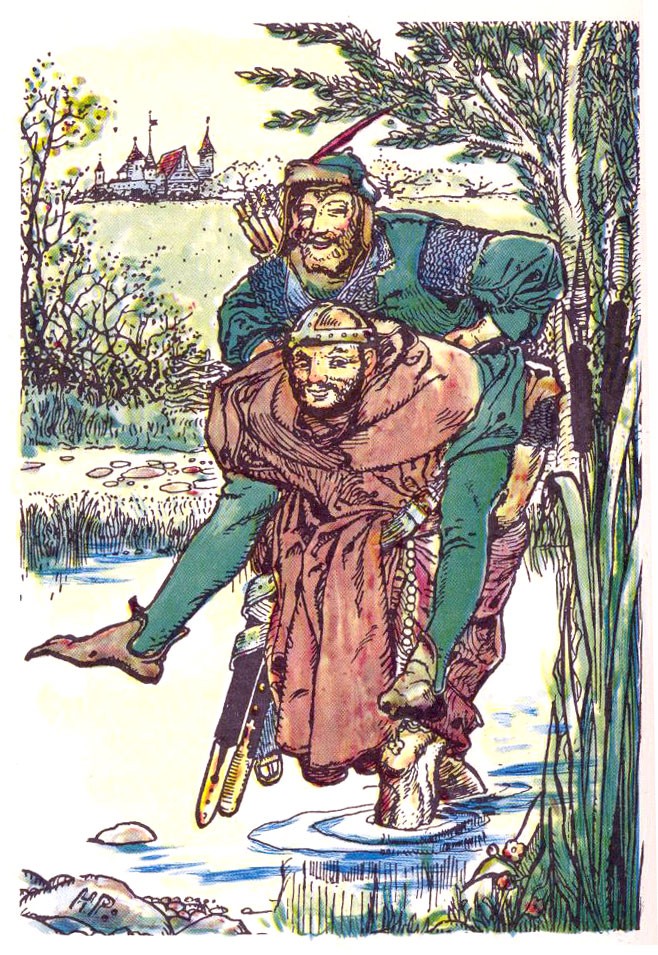
The outlaws of Sherwood Forest
Stories about Robin Hood’s life and adventures first appeared in the late 1400s. Different stories were set in different parts of the country, including the forest of Barnsdale in Yorkshire, near the village of Wentbridge. The most popular location, however, came to be Sherwood Forest in Nottinghamshire, where his chief enemy was the evil Sheriff of Nottingham. Robin's companions, known as the Merry Men, included Little John, Alan-a-Dale, Much the Miller's Son and Will Scarlett. Maid Marian, Robin's sweetheart, and Friar Tuck, both appeared in stories about Robin Hood at a later time.
Sir Guy of Gisbourne
One of the stories about Robin Hood was about Sir Guy of Gisborne (in some versions of the legend, a rival for the affections of Maid Marian). Robin and his comrade Little John had had an argument and John marched off. The Sheriff of Nottingham took John prisoner and had him tied to a tree, to be hanged later. Meanwhile, Robin met Sir Guy of Gisborne, a hired killer who had vowed to slay the leader of the outlaws. Sir Guy, who was wearing a horsehide disguise, agreed to have a shooting contest using a bow and arrows with Robin, which Robin won easily. Both revealed who they were and, in the fight that followed, it was Robin who triumphed over Sir Guy. Robin then put on the knight’s clothes. Disguised as Sir Guy, Robin then persuaded the Sheriff to let him, Robin, kill the unfortunate Little John, who was still tied to the tree. Instead of slaying him, however, Robin untied Little John. Friends once more, the two outlaws drove the outwitted Sheriff and his men from the forest.


The Death of Robin Hood
How did Robin die? According to legend, he was wounded in a fight and fled to a convent. Tricked by one of the nuns, he was left bleeding in a locked room. Robin sounded three faint blasts on his horn. His friends in the forest came to his aid, but they were too late to save him. Robin Hood shot one last arrow, and the outlaws buried him where it landed.
Consultant: Philip Wilkinson
pics
Without in any way limiting Q-files Ltd’s exclusive rights under copyright, any use of this publication to “train” generative artificial intelligence (AI) technologies to generate text is expressly prohibited. Q-files Ltd reserves all rights to license use of this work for generative AI training and development of machine learning language models.