
Myths and legends

CITE
We have made every effort to follow citation style rules, but there may be some minor differences. If in doubt, please refer to the appropriate citation style manual.
Quetzalcoatl. (2026). In Q-files Encyclopedia, Culture, Myths and legends. Retrieved from
https://www.q-files.com/culture/myths-and-legends/quetzalcoatl
"Quetzalcoatl." Culture, Myths and legends, Q-files Encyclopedia, 13 May. 2026.
https://www.q-files.com/culture/myths-and-legends/quetzalcoatl.
Accessed 6 Aug. 2026.
Quetzalcoatl 2026. Culture, Myths and legends. Retrieved 6 August 2026, from
https://www.q-files.com/culture/myths-and-legends/quetzalcoatl
Culture, Myths and legends, s.v. "Quetzalcoatl," accessed August 6, 2026.
https://www.q-files.com/culture/myths-and-legends/quetzalcoatl


Quetzalcoatl
Quetzalcoatl was the legendary ruler of Mesoamerica. Mesoamerica is the name historians give to the region of central and southern Mexico and northern parts of Central America where several great ancient civilizations grew up, beginning thousands of years ago. In the religion of the Aztec Empire, Quetzalcoatl was the god of order and civilization. The name Quetzalcoatl, which means “feathered serpent” in Nahuatl, the language of the Aztecs, combines the magnificent, green-plumed quetzal bird, symbolizing the heavens and the wind, with the coatl (the word for “snake” or “serpent” in Nahuatl), which represents the earth and fertility.
Quetzalcoatl the god
Quetzalcoatl was the chief god to the Aztecs, who ruled central Mexico from about AD 1250. But he dates back many centuries before the time of the Aztec Empire. To the inhabitants of Teotihuacán, a great city that flourished around AD 200, he was probably the god of rain. For the Toltecs, who dominated Mexico from the 800s to the 1100s, Quetzalcoatl was the god of the morning and evening star (which we now know as the planet Venus) and the wind.
People who travelled east from Central Mexico to the land of the Maya, a great civilization that grew up in the Yucatán Peninsula, Guatemala and Belize, took with them legends of this god who became known as Kukulcan to the Maya people.
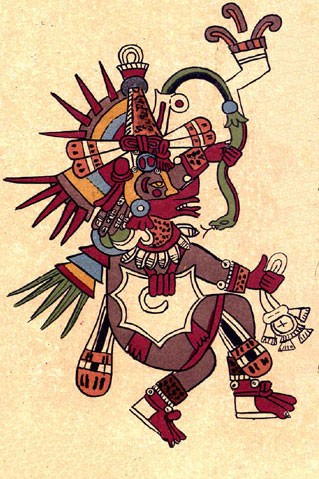
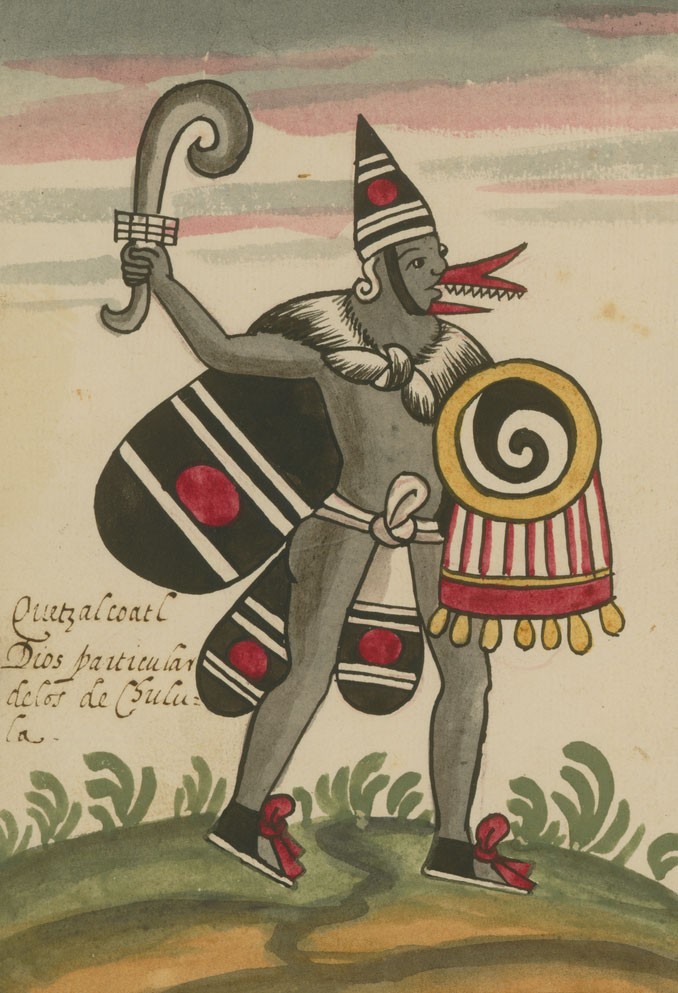
Quetzalcoatl was portrayed in Mesoamerican art as a snake with wings, or simply covered with feathers. He also appeared in human form as a warrior wearing a cone-shaped crown and a pendant, known as the “wind jewel”, made of jade or seashell.


The creation
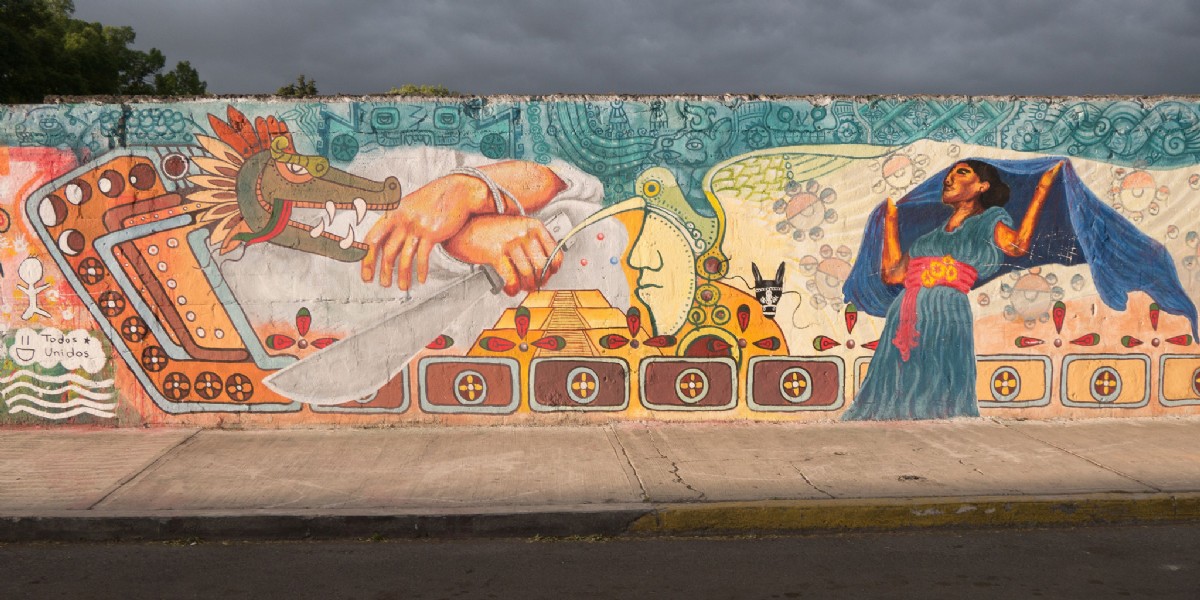
According to an Aztec myth, Quetzalcoatl does battle with another god, Tezcatlipoca, the god of war and night. The struggle between them brings about the creation and destruction of suns and earths—four times over. The sun and earth that survive today are the fifth to be created.
At first there are no people on earth. The inhabitants of earlier worlds have perished, and their bones litter Mictlan, the underworld. Quetzalcoatl journeys to Mictlan to find the bones. He takes them to the earth goddess Cihuacoatl (Snake Woman), who grinds them into flour. Quetzalcoatl mixes the flour with his own blood, giving it life. He then shapes the mixture into human form. He shows the newly created humans how to grow crops, make crafts and understand the stars.
The death of Quetzalcoatl
Quetzalcoatl's fate is brought about by his old enemy, Tezcatlipoca, also the god of power and justice, who demanded bloodier sacrifices from humans than the flowers and butterflies they offered to Quetzalcoatl. Tezcatlipoca tricks Quetzalcoatl into holding a mirror that shows Tezcatlipoca's own terrible face. Horrified, Quetzalcoatl decides to throw himself on to a burning funeral pyre. As his body burns, his heart rises into the heavens to become the planet Venus.


Consultant: Philip Wilkinson
pics
Without in any way limiting Q-files Ltd’s exclusive rights under copyright, any use of this publication to “train” generative artificial intelligence (AI) technologies to generate text is expressly prohibited. Q-files Ltd reserves all rights to license use of this work for generative AI training and development of machine learning language models.