
Myths and legends

CITE
We have made every effort to follow citation style rules, but there may be some minor differences. If in doubt, please refer to the appropriate citation style manual.
Werewolves. (2026). In Q-files Encyclopedia, Culture, Myths and legends. Retrieved from
https://www.q-files.com/culture/myths-and-legends/werewolves
"Werewolves." Culture, Myths and legends, Q-files Encyclopedia, 13 May. 2026.
https://www.q-files.com/culture/myths-and-legends/werewolves.
Accessed 6 Aug. 2026.
Werewolves 2026. Culture, Myths and legends. Retrieved 6 August 2026, from
https://www.q-files.com/culture/myths-and-legends/werewolves
Culture, Myths and legends, s.v. "Werewolves," accessed August 6, 2026.
https://www.q-files.com/culture/myths-and-legends/werewolves


Werewolves
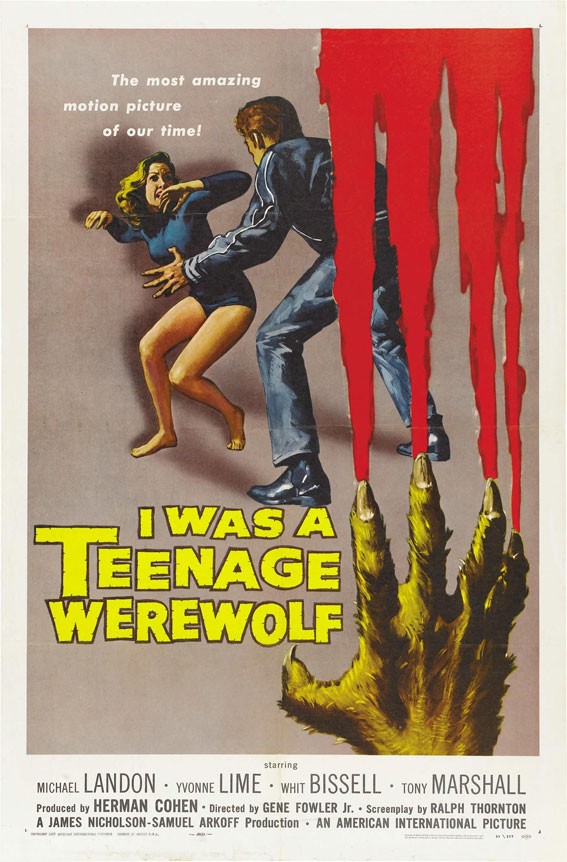
Legends from all over the world tell of men who could turn into wolves and then back into their human form again. They are known as werewolves or man-wolves (wer is the Old English word for "man”). In their animal form, werewolves devoured people, alive or dead—although ordinary wolves seldom attack people. In lands where wolves are unknown, such legends involved different animals instead, such as tigers, bears or even snakes. The European werewolf legend dates from ancient times. For example, the Roman author Ovid wrote in his Metamorphoses about the Greek king named Lycaon, who was turned into a wolf as punishment for serving human flesh to Zeus, the chief of the gods. People who were thought to be werewolves were persecuted from the Middle Ages through to the 18th century. By the 20th century fear was replaced by fascination, as werewolves became popular subjects for horror stories and films.
Becoming a werewolf
During the Middle Ages, belief in werewolves was widespread in Europe. It was feared that any baby born with unusual amounts of hair or a strange birthmark could become a werewolf when they grew up. People could become werewolves voluntarily by worshipping the devil. The bite of a werewolf would also turn someone into a werewolf. It was even rumoured that if you were to drink water from a puddle in a wolf’s footprint you would become a werewolf.
Transformation
The word used to describe the transformation from man into wolf is lycanthropy. It comes from the Greek words lukos (wolf) and anthropos (man).
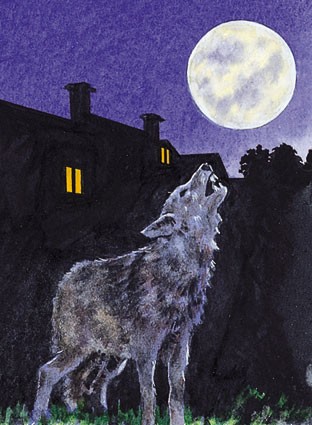
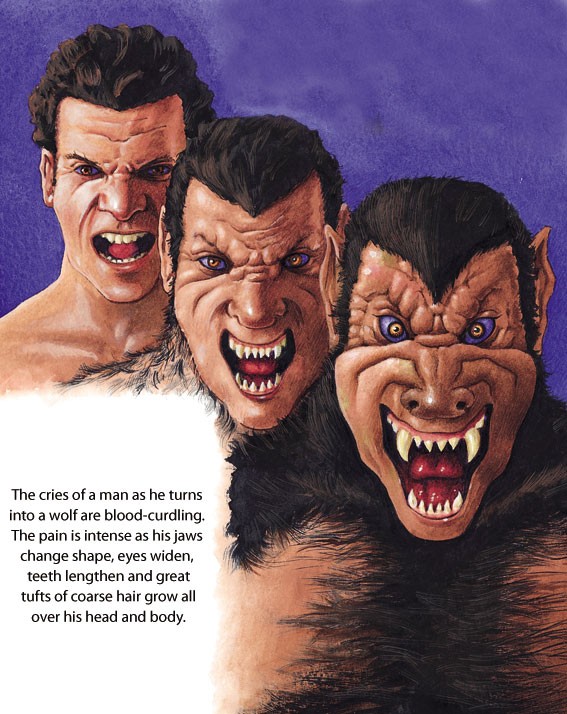
The cries of a man as he turns into a wolf were blood-curdling. The pain was intense as his jaws changed shape, eyes widened, teeth lengthened and great tufts of coarse hair sprouted all over his head and body. The transformation scene was always a dramatic sequence in a horror movie. In some ancient legends, the werewolf took on its animal form at any time—particularly at night. In more recent stories and films, the transformation could only take place on nights when there was a full moon.
Harming a werewolf
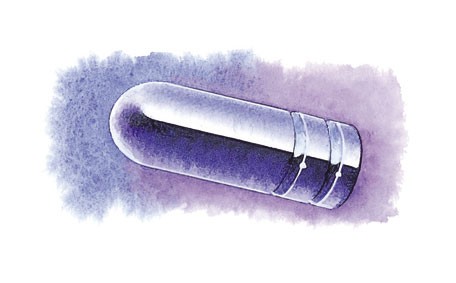
According to folklore, there were various ways to kill a werewolf. If you called the werewolf by its real name, or touched it on the head three times and made the sign of the cross, the beast would change back into a man. In many legends, it was believed that only special weapons made of silver, such as a cane, blade or bullet, could harm a werewolf.
In some legends, any weapon that could injure an ordinary wolf would also harm a werewolf. When it returned to its human form, its wound would remain, thus revealing the creature’s identity as a werewolf.
Consultant: Philip Wilkinson
pics
Without in any way limiting Q-files Ltd’s exclusive rights under copyright, any use of this publication to “train” generative artificial intelligence (AI) technologies to generate text is expressly prohibited. Q-files Ltd reserves all rights to license use of this work for generative AI training and development of machine learning language models.