
Myths and legends

CITE
We have made every effort to follow citation style rules, but there may be some minor differences. If in doubt, please refer to the appropriate citation style manual.
Unicorns. (2026). In Q-files Encyclopedia, Culture, Myths and legends. Retrieved from
https://www.q-files.com/culture/myths-and-legends/unicorns
"Unicorns." Culture, Myths and legends, Q-files Encyclopedia, 13 May. 2026.
https://www.q-files.com/culture/myths-and-legends/unicorns.
Accessed 22 Sep. 2026.
Unicorns 2026. Culture, Myths and legends. Retrieved 22 September 2026, from
https://www.q-files.com/culture/myths-and-legends/unicorns
Culture, Myths and legends, s.v. "Unicorns," accessed September 22, 2026.
https://www.q-files.com/culture/myths-and-legends/unicorns


Unicorns
The word “unicorn” comes from the Latin, meaning "one-horned”. A unicorn is an imaginary beast that has appeared in legends from all over the world, including China, India, the Middle East and Europe. Since the Middle Ages, the unicorn has often been pictured as a horse, usually white, with a single horn growing from its forehead. Some depictions of unicorns may have been modelled on certain real animals, such as the single-horned rhinoceros or the narwhal, a small whale with a single, long, spiralled tusk that looks a little like a horn.


Origins
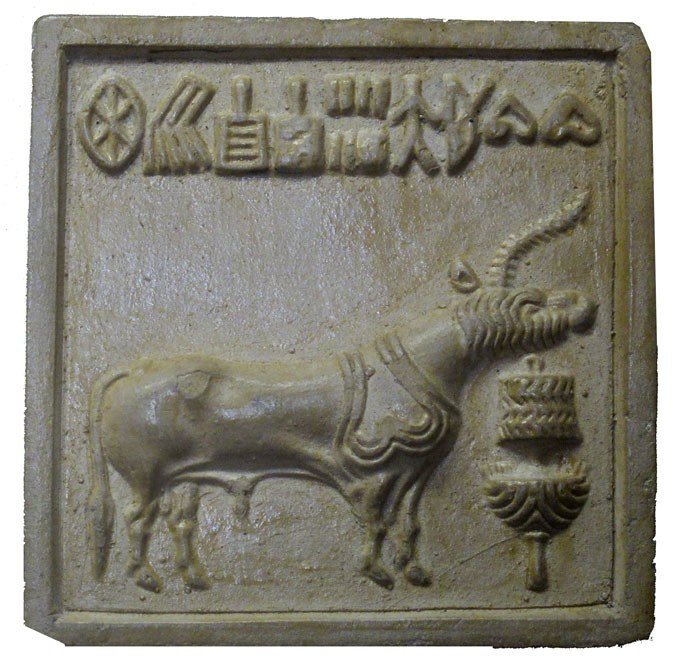
The unicorn in Western legends originates from the Hebrew (Jewish) Bible. During its translation into Greek for the Christian Bible, the Hebrew word for an aurochs, or wild ox, re’em, was mis-translated in some texts as an oryx, a kind of antelope—and in others as an animal thought to exist by some ancient Greek scholars and called a "unicorn". In around 400 BC, the Greek historian Ctesias wrote about a wild beast that was said to have a single horn and fought elephants—he had seen it pictured on ancient seals from the Indus Valley civilization of India. The animal in question was probably a rhinoceros (common in India at the time), though other writers decided that it more closely resembled a horned horse.
Unicorn horn
By the Middle Ages, many Europeans believed that the horse-like unicorn really did exist in some parts of the world. It was thought that any water into which a unicorn's horn had been dipped became safe for people to drink. This led some to think that powdered unicorn horn could somehow protect them against poisons and cure diseases. As a result, the tusks of narwhals were often sold falsely as unicorn horn. Some kings, fearing their enemies might try to poison them, drank from cups that they believed to be made from unicorn horn.

Unicorn legends
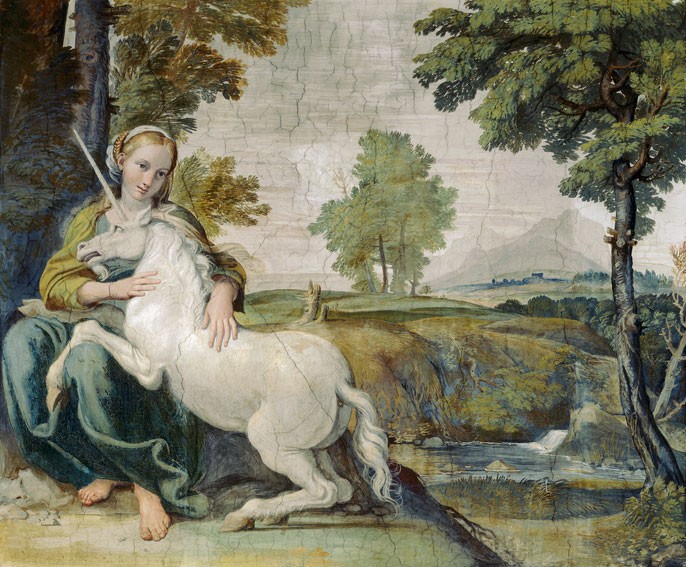
The ancient Greeks associated the unicorn with goddesses such as Artemis, whose chariot was drawn by eight unicorns. In the Middle Ages, the unicorn, a woodland creature, was a symbol of purity and grace. According to legend, one way to capture a unicorn was to send a young girl into the forest. The unicorn would come up to her rest its head in her lap. A hunter, following the girl unseen, could then rush out from his hiding place and catch the animal.
Chinese unicorns
The qilin is a creature from Chinese legend that has sometimes been likened to a unicorn. It has the body of a deer, the head of a lion, a covering of scales and a long, forward-curving horn (or horns). In Chinese legend, the qilin was one of four magical creatures that were regarded as signs of good fortune. The other three were the phoenix, tortoise and dragon. The appearance of a unicorn usually marked the birth or death of a notable person. One was said to have appeared when Confucius, the great philosopher, was born (551 BC).


Consultant: Philip Wilkinson
pics
Without in any way limiting Q-files Ltd’s exclusive rights under copyright, any use of this publication to “train” generative artificial intelligence (AI) technologies to generate text is expressly prohibited. Q-files Ltd reserves all rights to license use of this work for generative AI training and development of machine learning language models.