
Myths and legends

CITE
We have made every effort to follow citation style rules, but there may be some minor differences. If in doubt, please refer to the appropriate citation style manual.
Sinbad the Sailor. (2026). In Q-files Encyclopedia, Culture, Myths and legends. Retrieved from
https://www.q-files.com/culture/myths-and-legends/sinbad-the-sailor
"Sinbad the Sailor." Culture, Myths and legends, Q-files Encyclopedia, 13 May. 2026.
https://www.q-files.com/culture/myths-and-legends/sinbad-the-sailor.
Accessed 6 Aug. 2026.
Sinbad the Sailor 2026. Culture, Myths and legends. Retrieved 6 August 2026, from
https://www.q-files.com/culture/myths-and-legends/sinbad-the-sailor
Culture, Myths and legends, s.v. "Sinbad the Sailor," accessed August 6, 2026.
https://www.q-files.com/culture/myths-and-legends/sinbad-the-sailor


Sinbad the Sailor
Sinbad (sometimes called Sindbad) the Sailor is one of the stories in One Thousand and One Nights, or Arabian Nights, a collection of Persian, Arab, and Indian tales written between the 800s and the 1400s. In fact, the Sinbad tale does not appear in the original versions of the Nights, but was added in the 19th century. A merchant from the city of Baghdad (now capital of Iraq), Sinbad made seven voyages to lands around the Indian Ocean. During his travels, he had great adventures, survived many dangerous episodes—and amassed considerable wealth.

First and second voyage
On Sinbad's first voyage, he visits an island that, unknown to him, turns out to be an enormous whale. When the crew lights a fire, the whale wakes up and dives beneath the waves. Thrown into the ocean, Sinbad is eventually rescued by another ship.
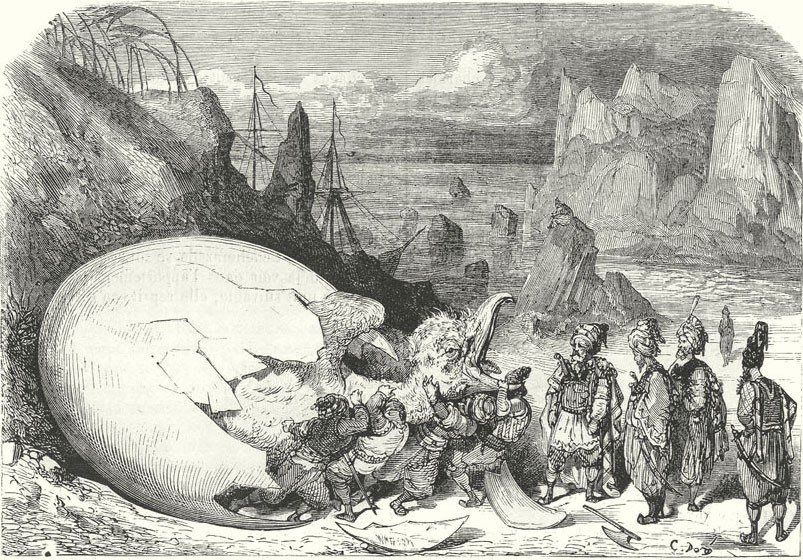
The second voyage takes Sinbad to a desert island, where he discovers an enormous egg. It has been laid by a giant bird called a roc. When the bird appears, it flies off to the Valley of Diamonds with Sinbad tied to its leg with his turban cloth. This time, he is rescued by merchants and he returns to Baghdad along with a booty of diamonds.
Third and fourth voyages
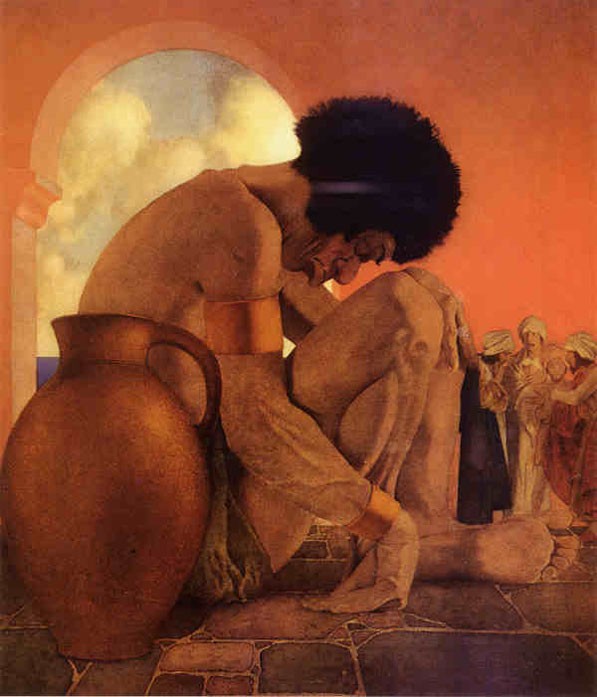
During his third voyage, Sinbad is kidnapped by dwarfs and taken to the home of a man-eating giant. Sinbad manages to escape but is lured to another island by a serpent that tries to swallow him. Once again, Sinbad is saved by a passing ship.
Shipwrecked on his fourth voyage, Sinbad and his crew are captured by cannibals. Our hero escapes (yet again) to a strange kingdom. There he marries the king's daughter. When she dies, Sinbad is buried alive along with her. He succeeds in making his escape, however.
Final voyages
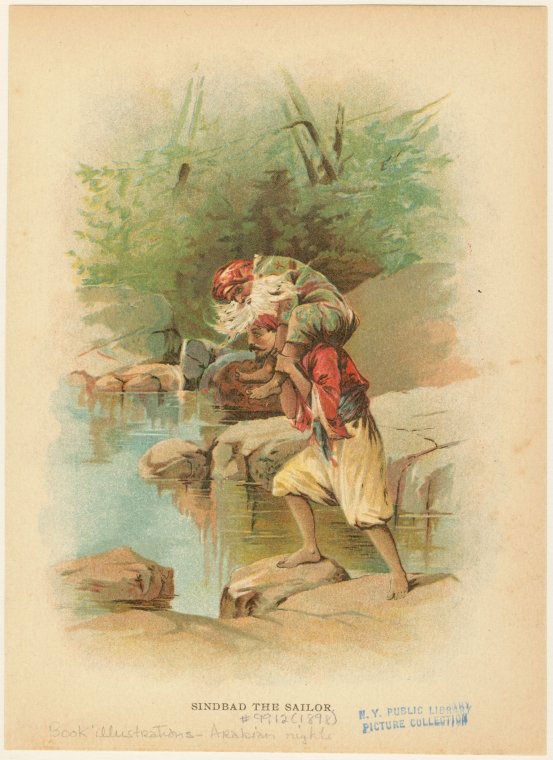
During Sinbad's fifth voyage, his crew find and break open a roc's egg, killing the chick inside. Several angry rocs take their revenge by bombarding Sinbad's ship with huge boulders, sinking it. Washed ashore on an island, Sinbad meets the Old Man of the Sea, who tricks him into carrying him on his shoulders until he dies of exhaustion. Sinbad, in turn, tricks the Old Man into drinking wine, then killing him after he falls off.
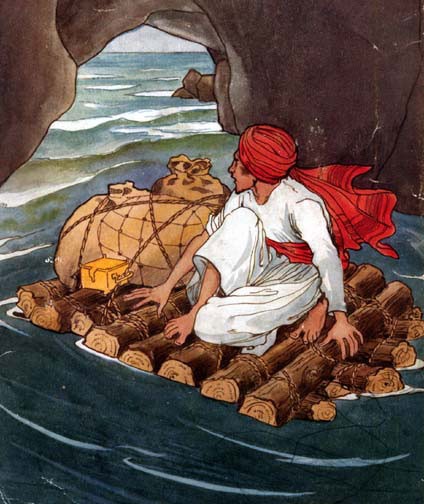
Sinbad's sixth voyage also ends with him being shipwrecked, this time on an island called Serendib. There he rides on a raft along the River of Gems and through a tunnel in a mountain. Waking on the other side, he finds precious stones and a dark-skinned people. He visits their capital city and meets their king.
Sinbad sails back to Serendib on his seventh and final voyage. On the way home he is taken prisoner by pirates, who sell him into slavery. He is bought by a merchant, who puts him to work as an elephant hunter. Sinbad discovers a massive trove of ivory tusks at an “elephants’ graveyard”. Delighted with the haul, the merchant gives Sinbad his freedom, along with enough ivory to make him a wealthy man.
An alternative final voyage
In another version of the seventh voyage, Sinbad is shipwrecked. Once again, he constructs a raft and floats down a river to a great city. Here, a rich merchant gives Sinbad his daughter’s hand in marriage. Once a month, the city’s inhabitants become transformed into birds. One of the bird-people carries Sinbad high into the sky. A burst of fire nearly consumes the bird-men. Blaming Sinbad for putting them in danger, they set him down on a mountaintop. Returning to his new wife, Sinbad decides to sell all his possessions and take her back to his home in Baghdad. His adventures are over.
Consultant: Philip Wilkinson
pics
Without in any way limiting Q-files Ltd’s exclusive rights under copyright, any use of this publication to “train” generative artificial intelligence (AI) technologies to generate text is expressly prohibited. Q-files Ltd reserves all rights to license use of this work for generative AI training and development of machine learning language models.