
Mammals

CITE
We have made every effort to follow citation style rules, but there may be some minor differences. If in doubt, please refer to the appropriate citation style manual.
Elephants. (2026). In Q-files Encyclopedia, Life, Mammals. Retrieved from
https://www.q-files.com/life/mammals/elephants
"Elephants." Life, Mammals, Q-files Encyclopedia, 24 Mar. 2026.
https://www.q-files.com/life/mammals/elephants.
Accessed 13 Sep. 2026.
Elephants 2026. Life, Mammals. Retrieved 13 September 2026, from
https://www.q-files.com/life/mammals/elephants
Life, Mammals, s.v. "Elephants," accessed September 13, 2026.
https://www.q-files.com/life/mammals/elephants


Elephants
The largest land animals in the world, elephants have large ears and long, flexible trunks. There are three species. The African bush elephant lives in grasslands south of the Sahara Desert. The smaller African forest elephant lives in the rainforests of West and Central Africa. Asian elephants are native to the Indian subcontinent, Sri Lanka, Southeast Asia, southern China and Indonesia. Elephants are highly intelligent animals. Females stay in family groups led by the oldest female, while males travel alone or in small bands. Their diet is at least 50% grass, with leaves, bamboo, twigs, bark, roots, and small amounts of fruits, seeds and flowers making up the rest. An elephant's life span, around 70 years, is limited to the time when their last teeth wear out. From then on it is incapable of chewing its food properly and starves to death.


Bush or forest?
The African bush elephant is the largest land animal in the world, and lives in forests, grasslands, woodlands and wetlands across Sub-Saharan Africa. Long thought to be a subspecies, the forest elephant is now recognized as a separate species. It is smaller, has more rounded ears, and thinner, straighter tusks than the bush elephant. It is native to the rainforests of West Africa and the Congo Basin.
African or Asian?

Asian elephants are smaller than the African bush elephant (but larger than the forest elephant) with smaller ears and shorter tusks. The African bush elephant's ears are, on average, at least three times the size of the Asian elephant's. Only the male Asians have tusks that protrude beyond the lips, whereas both male and female African elephant (both species) have long tusks.
The Asian’s trunk has only one "finger" at the tip of its trunk, while both the Africans have two. The Africans' back has a dip in it, while the Asian's back is arched. The Africans have a smooth forehead while the Asian has two humps on its forehead. The neck of the African elephants is almost horizontal whereas in the Asian elephant it is held up at about 45°.
African elephants rarely lie down unless they are sick or wounded; Asian elephants lie down frequently. Asians are also easier to tame than Africans. They are still used in many parts of South Asia for carrying people and heavy loads, such as timber.

Elephant families

An elephant family is ruled by a matriarch (older female), and generally consists of her daughters and their young, as well as 2–3 sisters. Families of 12–20 elephants are quite common in Africa. The young calves are tended not only by their mothers, but also by other females of the herd. When the males reach puberty, they leave the family and either live alone or form loose groupings with other males.
Family bonds are close. Elephants have greeting ceremonies when a "friend" that has been away for some time returns to the group. These involve spinning round, defecating and urinating. They will grieve at the loss of a stillborn baby or another family member. Within minutes of the birth of a baby elephant, the mother and other females trumpet, rumble and scream.


Trunks
An elephant's strong, flexible trunk is actually an extended nose and upper lip, with the two nostrils running through its full length. It has no bones in it, which means that it is very flexible. The trunk is powerful enough to lift logs, but it is also very sensitive. The finger-like lips at the tip of the trunk can pick up very small objects.
Elephants use their trunks to graze on grass or reach up into trees to grasp leaves, fruit or entire branches. Sometimes they wrap their trunks around a tree or branch and shake its food down, or knock the tree down altogether. They then use their trunks to bring the food in their mouths.
To drink, elephants reach down to the ground to suck water up into the trunk (up to 14 litres / 3 gallons at a time) and then squirt it into their mouths. Alternatively, they might spray the water over their bodies during bathing. They also spray dirt and mud, which act as a protective sunscreen to their sensitive skins.


Trunks can also used as snorkels. Elephants are great swimmers and are happy in the water from an early age. When they swim, they poke their trunks out of the water so that they can breathe.

Communication
When meeting, elephants always touch each other with their trunks, as if to say "hello". Sometimes they may even entwine them, like a warm handshake. They also use their trunks while play-wrestling, caressing during courtship and in displays of dominance over other elephants. A raised trunk can be a warning or threat.
Elephants also trumpet through their trunks to make a loud call. Elephants hear and respond to each other's calls from distances as great as 4 kilometres (2.5 miles) away—and nearly 10 kilometres (6 miles) at dusk. Elephants also produce low calls which other elephants "hear" as vibrations in the soles of their feet or when they lower their trunks to the ground.
Tusks
An elephant's tusks—actually long incisor teeth growing from their upper jaws—are used to dig for roots, to rip or peel bark from trees, or to tear vegetation apart. They are also used as weapons in fights between males. The tusks grow at about 17 centimetres (7 inches) each year. One of the elephant's tusks is often used more than the other, revealing whether the individual is either right-tusked or left-tusked.
At the end of a hard day’s work, an elephant can curl its trunk around the end of one of its tusks and give it a well-earned rest.

Migration

Some African bush elephants spend the dry season in sheltered forests, avoiding the heat and foraging for food. When the grasses they feed on wither away, they have to eat whatever they can find—mainly shoots, bark and roots. A group of elephants may demolish much of the forest, overturning trees and eating everything in sight. When the rains return, they can finally leave the forest and migrate towards open grassland.
Elephants and humans
Both Asian and African elephants, but particularly the Asians, have been domesticated by humans. They have been used as working animals, for example, uprooting trees, shifting logs or other heavy loads, as beasts of burden, and for riding on for hunting other animals, going on photo-safaris or getting around generally. Elephants also feature in a number of ceremonies at temples or festivals and sometimes appear in circus acts.
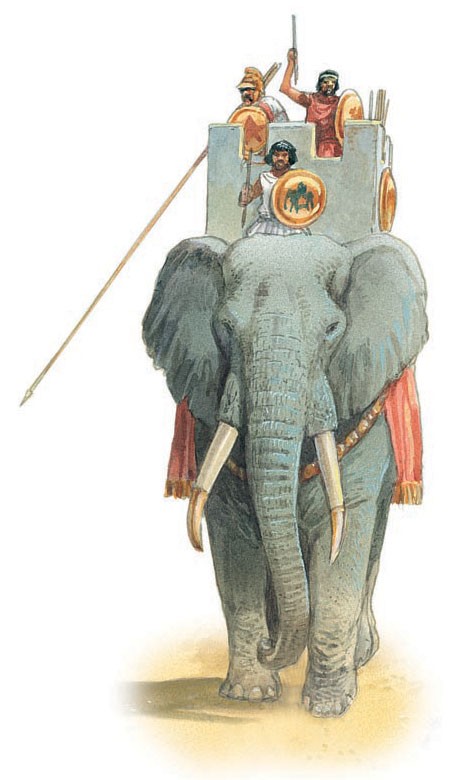
In the past, elephants have even been used in battle. The most famous occasions were when the Carthaginian leader Hannibal led a troop of 37 elephants against the Romans, and by the Persians against Alexander the Great.


Elephants can affect humans in bad ways, too. Raiding elephants can destroy whole fields of crops. They can also damage or demolish whole trees. Humans are also a threat towards elephants: much of their natural habitat has been destroyed, and poachers kill elephants for their tusks, which they sell for their ivory.
Elephants and their environment
Elephants have an effect on their immediate environment in a number of ways. They provide water for other animals by digging water holes in dry riverbeds. They disperse plant seeds when they defecate. Dung is often carried below ground by dung beetles and termites, which spreads the nutrients further. Elephants also provide food for birds by disturbing small reptiles, amphibians or insects whenever they walk through long grass.

By pulling down trees to eat leaves, breaking branches or pulling out roots, elephants create clearings in which new young trees grow. They also make pathways through the landscape that are used by other animals to access areas normally out of reach. Many of these pathways have been used by several generations of elephants.

Consultant: Chris Jarvis
pics




Without in any way limiting Q-files Ltd’s exclusive rights under copyright, any use of this publication to “train” generative artificial intelligence (AI) technologies to generate text is expressly prohibited. Q-files Ltd reserves all rights to license use of this work for generative AI training and development of machine learning language models.