
Myths and legends

CITE
We have made every effort to follow citation style rules, but there may be some minor differences. If in doubt, please refer to the appropriate citation style manual.
Dragons. (2026). In Q-files Encyclopedia, Culture, Myths and legends. Retrieved from
https://www.q-files.com/culture/myths-and-legends/dragons
"Dragons." Culture, Myths and legends, Q-files Encyclopedia, 13 May. 2026.
https://www.q-files.com/culture/myths-and-legends/dragons.
Accessed 6 Aug. 2026.
Dragons 2026. Culture, Myths and legends. Retrieved 6 August 2026, from
https://www.q-files.com/culture/myths-and-legends/dragons
Culture, Myths and legends, s.v. "Dragons," accessed August 6, 2026.
https://www.q-files.com/culture/myths-and-legends/dragons


Dragons
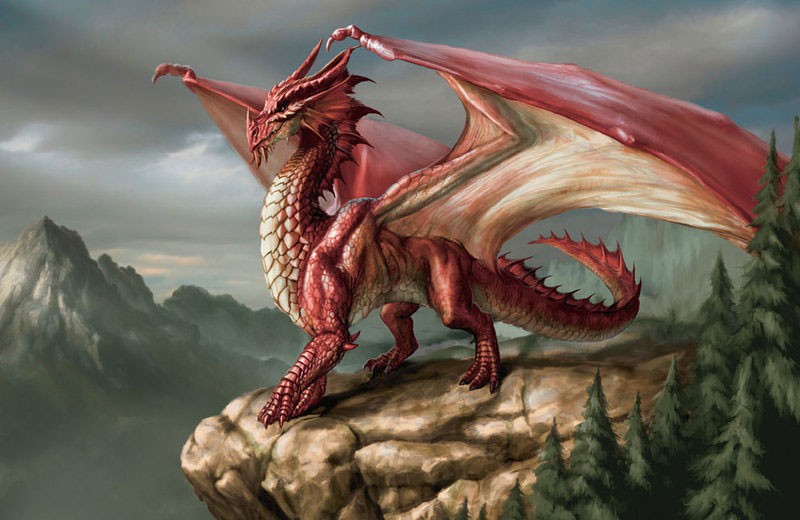
In many myths and legends, dragons are fire-breathing, lizard-like creatures with scaly bodies, bat-like wings, four legs, a spiny back and a long tail with an arrowhead at its tip. Heroes slay them in battles of good over evil. Because of their reputation for fierceness, dragons were seen as symbols of military might by both the Romans and the Celts (to this day the dragon appears on the flag of Wales, a Celtic nation). A dragon is slain by Beowulf, a Norse warrior, in a story dating from Anglo-Saxon times. In Chinese legends, however, dragons are symbols of happiness, good fortune and wealth.
Dragons in the ancient world

In ancient Egyptian mythology, the dragon-like creature Apophis (Apep) was the enemy of Re, the sun god. In ancient Greek mythology, the god Apollo fought Python, a dragon-like serpent that guarded the oracle at Delphi. Dragons are also mentioned in the Bible: the Book of Revelation describes Satan as "a great dragon, flaming red with seven heads and ten horns”.

Fafnir
In Norse mythology—later retold in the German epic, the Nibelungenlied—a young hero Sigurd slays the dragon Fafnir. A giant, Fafnir was son of the dwarf king Hreidmar and brother of Regin. He transformed himself into a dragon to guard his father's hoard of gold and gems on which a curse had been placed. He breathed poison into the nearby land, so the people would be too terrified to go near him. Regin plotted to get the treasure by sending his foster-son, Sigurd, to kill Fafnir. In the dragon’s lair, Sigurd stabbed Fafnir in the shoulder, mortally wounding the dragon. As Fafnir lay dying, he warned Sigurd that any person who possessed the gold would be cursed to die, but Sigurd replied that all men must die one day anyway, so he claimed the gold.

St George and the dragon
In a legend dating from the 11th century, St George (the patron saint of England, Catalonia, Georgia and Romania), saved a princess from a dragon. George (around AD 280–303), the son of Greek Christians from Cappadocia in modern-day Turkey, was a soldier in the Roman army. A dragon had made its nest near a spring which provided water for the city of Sylene (possibly Cyrene in Libya). To collect water, the citizens had first to make an offering to the dragon—a sheep, or, if no sheep could be found, a young woman.
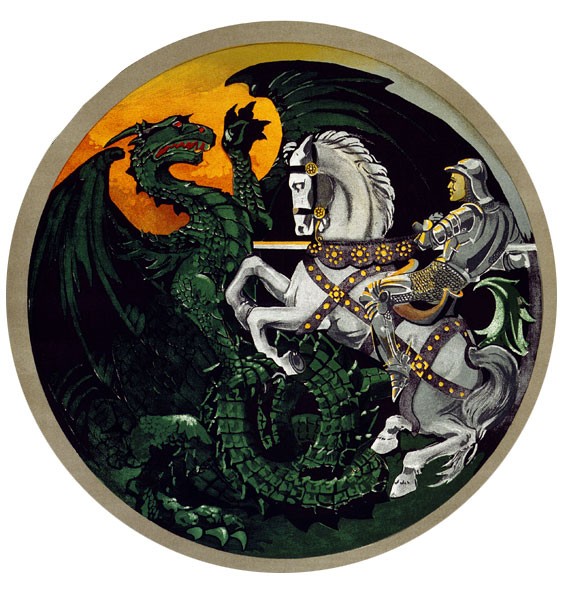
The victim was chosen by drawing lots. One day, the princess turned out to be the unlucky one. The king begged for his daughter’s life to be spared, but to no avail. Just before she was devoured by the dragon, George appeared. Protecting himself with the sign of the Cross, he slew the dragon and rescued the princess.

Chinese dragons
Chinese dragons are legendary creatures in Chinese mythology: they have a completely separate origin to the dragons of Europe and the Middle East. In Chinese culture, dragons are most commonly depicted as snake-like with four legs but no wings. Dragons, known as long in Chinese, are symbols of strength and good luck: outstanding people are often compared to dragons. In the past, emperors of China used the dragon as emblems of their imperial power.
The ancient Chinese described fossil dinosaur bones as dragon bones. The modern Chinese word for a dinosaur is konglong; villagers in central China have long ground up fossilized "dragon bones" for use in traditional medicines, a practice that continues today. Fossils of Mei long (the full name means “sleeping dragon”) have been found in coiled form, with the dinosaur’s tail circling around its body.


Consultant:Philip Wilkinson
pics
Without in any way limiting Q-files Ltd’s exclusive rights under copyright, any use of this publication to “train” generative artificial intelligence (AI) technologies to generate text is expressly prohibited. Q-files Ltd reserves all rights to license use of this work for generative AI training and development of machine learning language models.