
Birds

CITE
We have made every effort to follow citation style rules, but there may be some minor differences. If in doubt, please refer to the appropriate citation style manual.
Emperor penguin. (2026). In Q-files Encyclopedia, Life, Birds. Retrieved from
https://www.q-files.com/life/birds/emperor-penguin
"Emperor penguin." Life, Birds, Q-files Encyclopedia, 9 Apr. 2026.
https://www.q-files.com/life/birds/emperor-penguin.
Accessed 31 Oct. 2026.
Emperor penguin 2026. Life, Birds. Retrieved 31 October 2026, from
https://www.q-files.com/life/birds/emperor-penguin
Life, Birds, s.v. "Emperor penguin," accessed October 31, 2026.
https://www.q-files.com/life/birds/emperor-penguin


Emperor penguin
The emperor penguin is the largest and heaviest species of penguin, growing up to 1.2 metres (4 feet) tall. It is the only species of penguin to breed during the Antarctic winter. The male protects the egg on top of its feet throughout the coldest months of winter while the female goes off to feed. Graceful swimmers, emperors gets about on the ice by sliding on their bellies. The emperor's diet consists chiefly of fish, but also krill and squid. Its tongue has rear-facing barbs on its surface to prevent prey from slipping out when caught. It can stay under water for up to 20 minutes, sometimes diving to depths of 565 metres (1850 feet) seeking food. The emperor penguin's feathers, together with a thick layer of fat under its skin, provide most of the protection it needs from the cold. Muscles hold the feathers erect when on land, trapping a layer of air next to the skin, giving additional insulation.


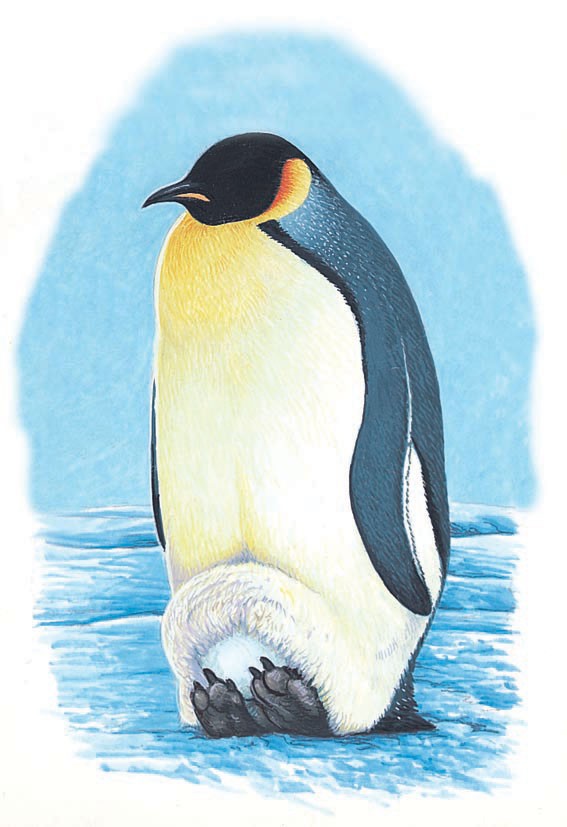
Breeding
Emperor penguins are the only penguins to breed during the Antarctic winter. They mate in May after a long march from the sea to their inland breeding sites. Emperors have only one mate each year, and stay faithful to that mate—but usually only for that year.
Each female lays a single egg, which she passes to the male to care for. The transfer is quite an awkward process. If it is dropped at any point, the chick inside the egg will die, as it cannot withstand the freezing temperature of the ice for more than a few seconds. The egg has a relatively thick shell for this reason. Once the egg is handed over, the female returns to the sea to feed over the winter.
The male balances the egg on top of his feet to keep it off the ice. Here, it is kept warm under a special pouch of skin, called a brood pouch. Males huddle together for warmth, taking turns to stand in the warmest spot at the centre of the group. They stand for more than two months, through bitter winds, fierce snow storms and temperatures as low as -60°C (-75°F)—eating nothing. Emperor penguins are the only species of penguin where just one parent cares for the egg.
When the females return in July, the males pass over the eggs, which are nearly ready to hatch. By this time, the males may have lost up to half of their body weight.

Back to the sea
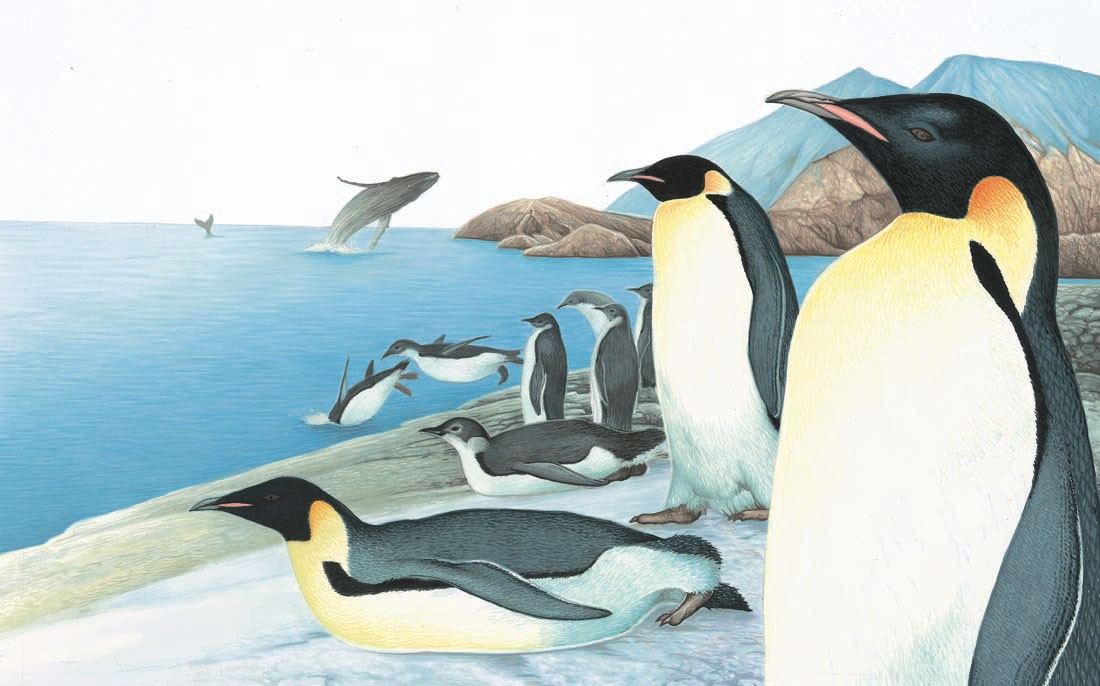
In spring, emperor penguins leave their inland crèches (groups of chicks, protected by adults) and head to the sea to fish. They return with food which they regurgitate (sick up) for their young eat. The young penguins, by now at their full size, grow an adult coat of waterproof feathers. When they are nearly two years old, they finally develop the yellow-orange markings of their parents.

Climate crisis
Emperor penguin chicks are hatched and grow on “fast” ice—sea ice that abuts the Antarctic coast. They remain there for around nine months, during which time they gain their adult coat of waterproof feathers. However, global warming has, since 2016, resulted in record lows in Antarctic sea ice. When the ice breaks up early, entire colonies of emperor penguins can fall into the ocean, leaving the chicks to drown. Even if some escape the water, they will almost certainly freeze to death. Four of the five known emperor penguin breeding sites in the Bellingshausen Sea collapsed in 2022, with the loss of thousands of chicks.
The International Union for Conservation of Nature (IUCN) predicts that the emperor penguin population will halve by the 2080s owing to sea ice loss. It is currently estimated at 595,000 adults, having already fallen by 10% between 2009 and 2018.
Consultant: Chris Jarvis
pics
Without in any way limiting Q-files Ltd’s exclusive rights under copyright, any use of this publication to “train” generative artificial intelligence (AI) technologies to generate text is expressly prohibited. Q-files Ltd reserves all rights to license use of this work for generative AI training and development of machine learning language models.