
Chemistry
Water
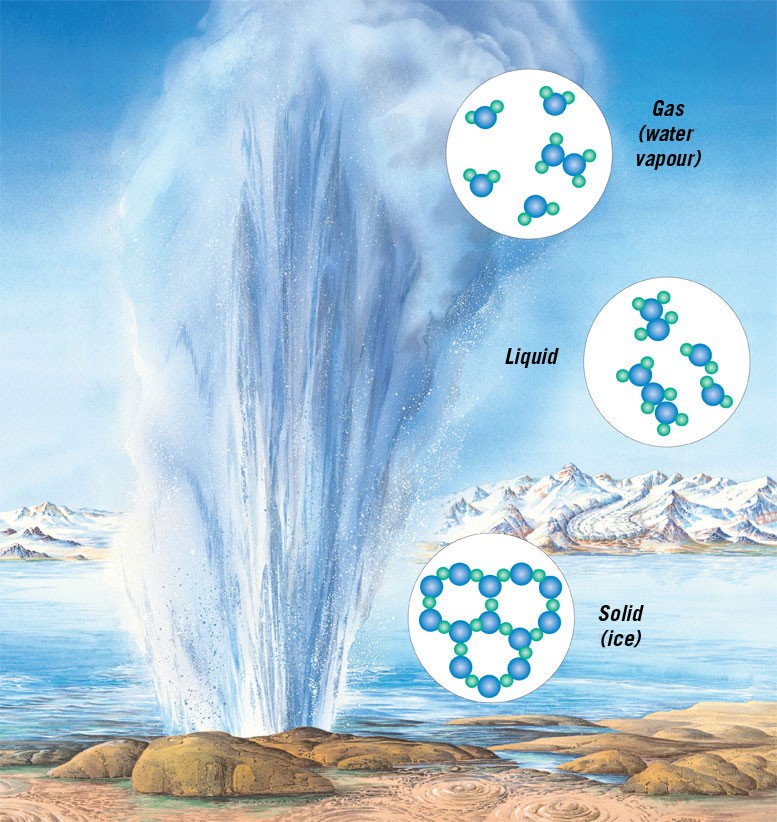
Water is a molecule with the chemical formula H2O. It contains two chemical elements—hydrogen (H) and oxygen (O)—with each atom of oxygen bonded to two hydrogen atoms. Water occurs in nature in three states of matter. As a solid (ice), it makes up, for example, hail, icebergs and glaciers. As liquid water it occurs as raindrops, sea water and fresh water. As a gas, it is water vapour, an invisible component of the air. All known forms of life depend on water. All living things are made up mostly of water: the adult human body is roughly 60% water. Water is fundamental to the way photosynthesis works in plants and plays a vital role in digestion and breathing in animals. It also acts as a solvent for essential nutrients.
Properties of water
Pure water has neither taste nor smell. It is transparent and has a faint blue colour. Water can dissolve a large variety of chemical substances. The boiling point of water, as with all liquids, depends on the surrounding pressure. On the summit of Mt Everest, for example, where air pressure is low, pure water boils at 68°C (154°F), compared to 100°C (212°F) at sea level. Water deep in the oceans, where pressure is extremely high, can reach temperatures of hundreds of degrees near hydrothermal vents and yet still remain liquid.

As it freezes, water expands (about 9%), whereas most other substances shrink. So water occupies a greater volume as both a solid and a gas (about 1700 times) than in its liquid state. Because water expands as it freezes, it becomes less dense, not more. This explains why ice cubes—and massive icebergs—float in liquid water.
Hydrogen bonds
Molecules of water are strongly attracted to one another, because of the hydrogen bonds between them. This gives rise to a property called surface tension, which makes water behave as though it has a stretchy skin on its surface. This "skin" enables some insects, such as pond skaters, to move about on it. Surface tension also makes possible capillary action: the tendency of water to move up a narrow tube against the force of gravity.


Water's strong hydrogen bonds mean that a large amount of heat is required to break them down and so turn liquid water to vapour. This means that the boiling point of water is higher than that of liquids made of molecules with similar masses to water molecules.
Hydrogen bonds are caused by the attraction between the oxygen and hydrogen atoms in different water molecules. They are much weaker than the bonds between the atoms within molecules.
The water cycle
The water cycle is the process in which water continually moves within the hydrosphere, between the Earth's atmosphere and its surface water (oceans, rivers, lakes and wetlands), groundwater (water contained in the soil or in pores or crevices in water-bearing rocks called aquifers) and plants. Water evaporates from the surface of oceans, rivers, lakes and wetlands. Water also evaporates from the leaves, stems and flowers of plants, a process called transpiration. Water vapour in the atmosphere condenses (turns to liquid) and falls back to the ground or directly into bodies of water as precipitation: rain, snow and hail.

Precipitation that falls on to land may soak into the soil and rock pores or crevices. Here it may be stored as groundwater, or it may slowly seep back into the oceans, lakes or rivers. Some precipitation collects on the ground as lakes or icecaps, or flows across the surface in the form of glaciers, streams and rivers, before emptying into the oceans.

Groundwater
Groundwater may be stored inside the tiny pores of certain rocks—known as porous or permeable rocks—or in the spaces between the fragments of rock in gravel, silt or sand. These underground layers where water is stored are known as aquifers. A rock that does not absorb water is called an impermeable or impervious rock. Sometimes an aquifer becomes completely full of water: it is saturated. The level of water inside a saturated aquifer is called the water table.
Groundwater may emerge from the ground naturally at a spring. This is often at the boundary between a permeable rock and an impermeable one: the water cannot sink further into the ground, so it spills out at the surface. The groundwater can also be reached by drilling wells down through permeable rock. In artesian wells, water rises to the surface under its own pressure, rather than by pumping.

Consultant: Mike Goldsmith