
Robotics and AI

CITE
We have made every effort to follow citation style rules, but there may be some minor differences. If in doubt, please refer to the appropriate citation style manual.
Swarm robotics. (2026). In Q-files Encyclopedia, Technology, Robotics and AI. Retrieved from
https://www.q-files.com/technology/robotics-and-ai/swarm-robotics
"Swarm robotics." Technology, Robotics and AI, Q-files Encyclopedia, 13 Mar. 2026.
https://www.q-files.com/technology/robotics-and-ai/swarm-robotics.
Accessed 6 Aug. 2026.
Swarm robotics 2026. Technology, Robotics and AI. Retrieved 6 August 2026, from
https://www.q-files.com/technology/robotics-and-ai/swarm-robotics
Technology, Robotics and AI, s.v. "Swarm robotics," accessed August 6, 2026.
https://www.q-files.com/technology/robotics-and-ai/swarm-robotics


Swarm robotics
Swarm robotics is a technology involving the use of large numbers of mostly small, relatively simple robots, all working together. They imitate the swarming behaviour of social insects (such as ants), a phenomenon known as "swarm intelligence". The object is to build a team of robots able to work together, without the need for external control—in the same way ants do. The individual robots communicate with one another using radio, infrared or ultrasonic signals. One of the most promising applications of swarm robotics is in search and rescue missions. A large number of robots that can share information between them would be able to survey a target area far quicker than any individual robot.

Swarm intelligence


Swarm intelligence is the collective behaviour of a group of living things without a leader. Swarm behaviour is observed in nature when shoals of fish or flocks of birds move together in the same direction, when termites build their towering nests or when ants forage for food. Although there is no one individual in charge, somehow all of the animals work together as a group. The co-ordination emerges spontaneously from interactions between the individuals, and between them and their environment.
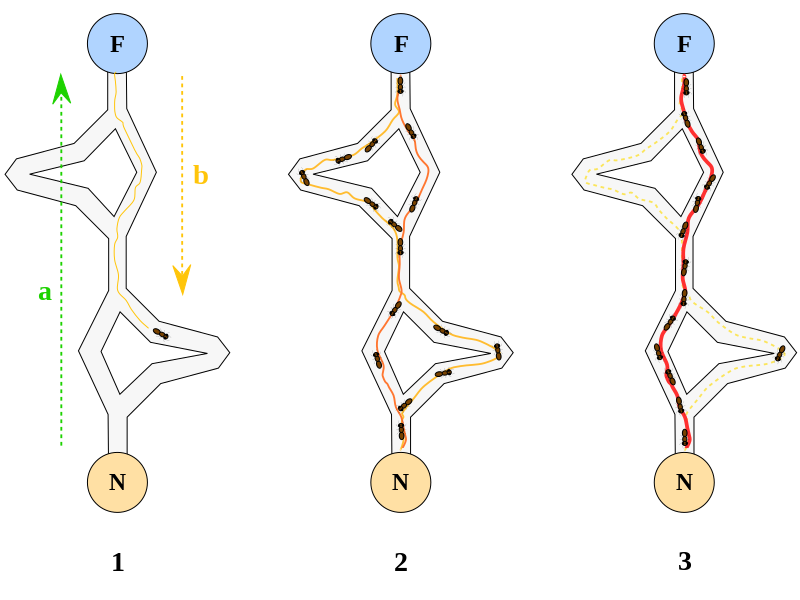
Ants can solve complex problems, such as building elaborate nests or finding the shortest route to a food source, working together as a colony in a way that an individual ant cannot. Despite a lack of a leader, the entire group behaves in a co-ordinated manner. Ants initially wander randomly looking for food. If an individual ant is successful, it brings the food back to the colony and leaves a pheromone trail—a chemical scent—as it goes. If another ant comes across this trail, it will follow it and reinforce it with its own pheromones. The shorter the path, the less time there is for the pheromones to evaporate, and the more frequently the path will be reinforced with more pheromones. In this way, the colony of ants between them find the shortest possible path.

Robot swarms
Scientists create computer algorithms (sets of rules) to try to reproduce swarm intelligence, operating—like ants—without any centralized control. This is a type of artificial intelligence called artificial swarm intelligence. Each individual AI robot in the swarm follows the algorithms to interact with both the other robots in the swarm and the local environment.
Researchers can program, for example, a group of eight quadcopters to form and maintain a pattern in the air on request. But to get hundreds or thousands of quadcopters to do the same thing requires them to work together as a swarm and execute the command autonomously—by themselves.
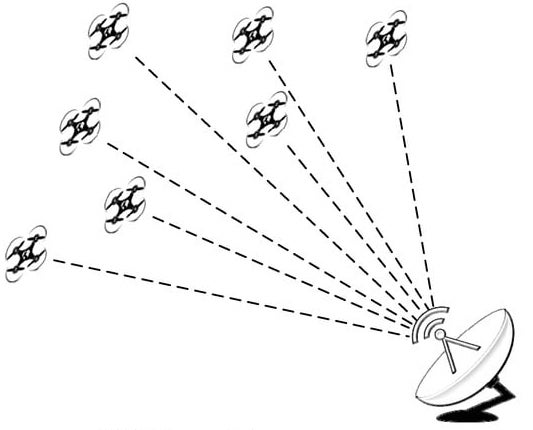
A swarm of robots is a system usually made up of many—tens, hundreds, even thousands—identical robots. No one robot is in charge and the loss of any individual robot will not cause a failure of the system; the swarm will adapt to any losses. The system is also scalable (it can be made larger). Adding robots to the swarm will not change the way the swarm works because each robot interacts only with those around it. They may communicate via radio, ultrasonic or infrared signals.

Drone light shows

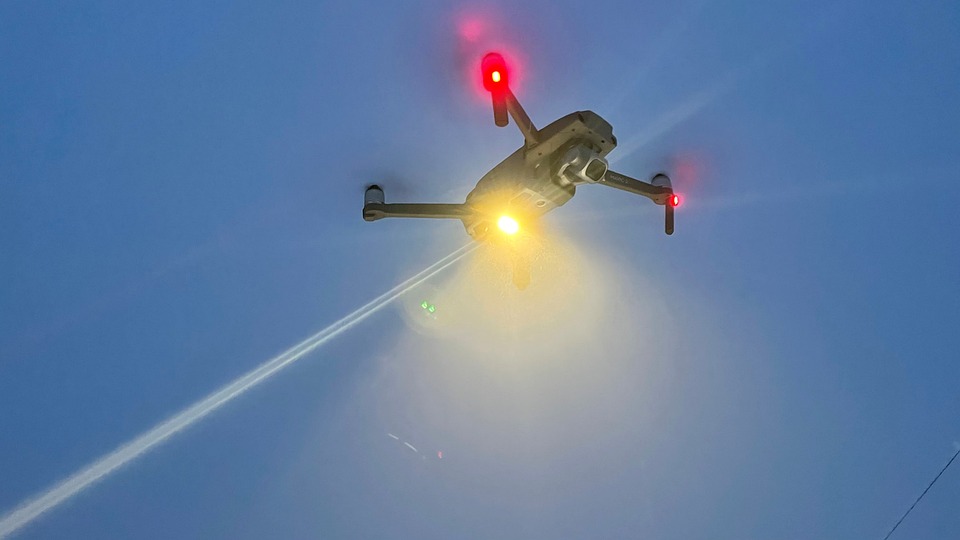
Swarm robotics is described as an "emerging technology", a future technology that is still currently in development. One basic type of swarm robotics may soon be in use, however: drone light shows. The shows use multiple robots—the numbers sometimes run into several thousands—in a co-ordinated sequence. Unmanned aerial vehicles (drones), often quadcopters each fitted with light fixtures consisting of several LEDs, fly in formation to create images against the night sky.
At present, the drones are individually controlled by a computer. This runs a program that turns graphics into flight commands and communicates them to the drones via radio signals. The drones have no ability to "think" for themselves, so are not displaying any swarm intelligence.
In some recent displays, however, experimental swarm technology has been introduced, enabling the drones to communicate with each other to a certain degree. Using GPS and radio frequencies to position themselves, the drones can ensure they maintain their spacing and avoid collisions.


Kilobots
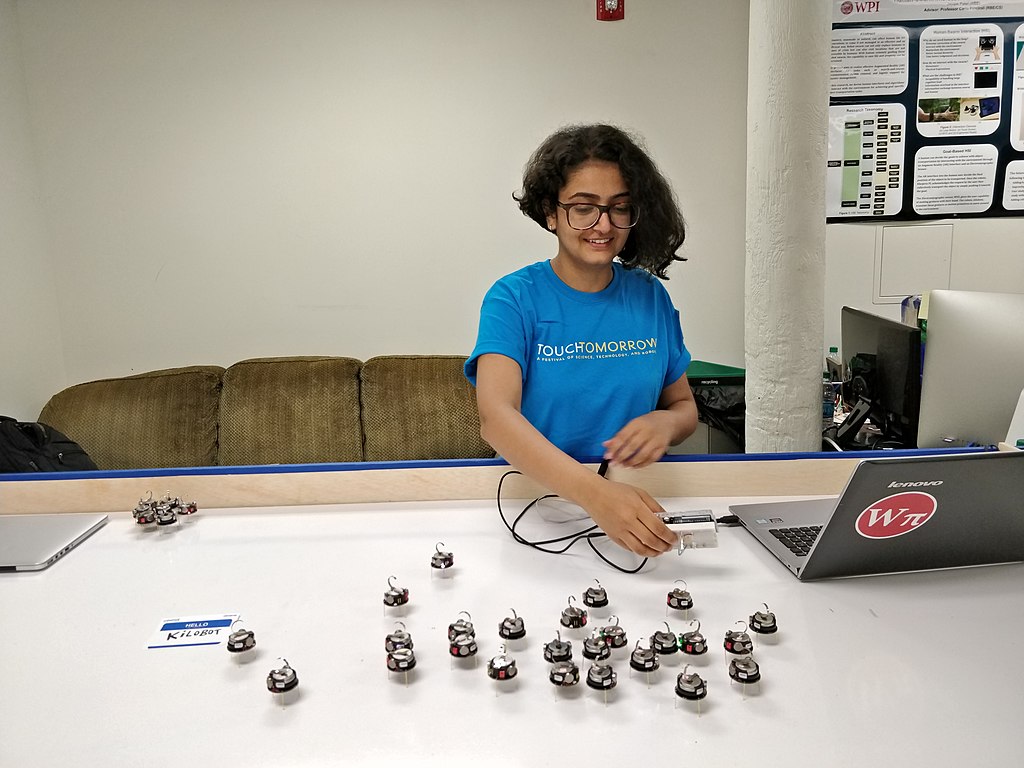
Researchers at Harvard University have created Kilobots, tiny robots measuring just 33 millimetres (1.3 inches) across which are simple in design and cheap to build. Designed to act together in swarms, each robot is fitted with a transmitter, which bounces an infrared signal off the ground to the receiver of another robot beside it. In this way, commands based on a program are passed from robot to robot. A controller can switch on an entire swarm of Kilobots by sending out one signal, rather than manually switching on every robot.
The Kilobots act in groups of up to a thousand, behaving in the same way that swarms of ants do: each works with the whole to perform tasks that could not be carried out by individuals. The robots are used to test algorithms designed for a group of larger, more sophisticated robots carrying out certain tasks. This could help with fine-tuning the behaviour of the group in, for example, finding and rescuing people from collapsed buildings after an earthquake. Other uses of Kilobots include working out the best way of achieving "collective transport"—the movement of a large object, or the component parts making up a large object such as a building, by individual robots working together.
Scientists have discovered that certain individual ants play specific roles in the process of carrying an object—say, an item of food—back to their nest. Some ants create a chain-like pathway that guides the foraging ants there. Other ants are in charge of the process of carrying an object from one place to the next. Kilobots can be used to test the same principle by which, for example, more sophisticated robots can trained to detect and clean up oil spills.

Uses for robot swarms
A team of robots that could work autonomously without a person directing them could be very useful in certain tasks, such as in dangerous environments (for example, search and rescue operations in a disaster zone or a mountainous area), innaccessible regions (for example, exploring uncharted territory on the ocean floor of our own planet), or in places where communication between controller and robot is difficult (for example, building a base on Mars, from where signals take 11 minutes to travel to Earth).
In trials on animals carried out at universities in China and Hong Kong in 2025, swarms of robots each measuring around 2.5 micrometres, have been injected into the sinus cavity and guided to their target—a bacterial infection—by electromagnetism. Here they are heated up using light from an optical fibre. This causes the robots to produce oxygen, which kills the bacteria. Experts believe the microrobotic swarms could be in full use for treating infections in bladders, intestines and sinuses in the 2030s.
One day, swarms of nanobots, microscopic robots whose components are at or near the scale of a nanometer (a billionth of a metre), may even be able to travel through the arteries or veins of the human body. There they would carry out vital medical work, such as early diagnosis of diseases, tissue repair, monitoring infections, and so on.


Swarm robotics has military uses, too. Swarms of robots might form an autonomous army—for example, a fleet of autonomous boats that are able to deter or destroy enemy vessels, or a squadron of drones loaded with explosives mounting a co-ordinated attack from the air.
SWIM
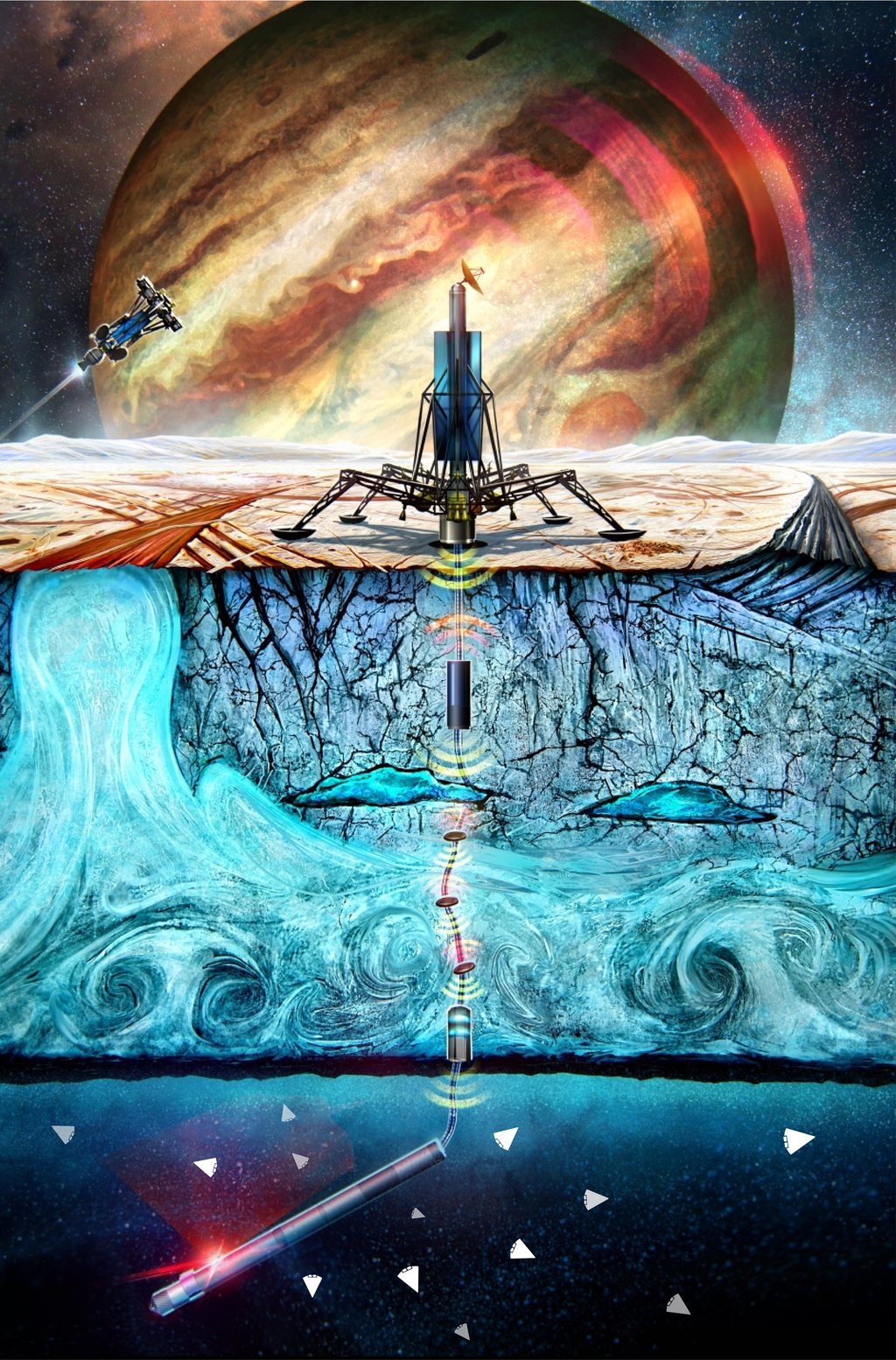
Sensing With Independent Micro-Swimmers (SWIM) is a swarm robotics project in development at NASA’s Jet Propulsion Laboratory. Researchers hope to send dozens of small robots on future space probe missions to certain moons of Jupiter and Saturn. Their aim is to explore the subsurface oceans that, according to evidence gathered from previous space probe missions, exist on Jupiter’s moon Europa, Saturn’s moon Enceladus—and maybe other moons.
The robots would descend through the moon's icy shell packed inside a cryobot (a robot that uses heat to melt the ice enabling it to tunnel down through the thick crust of ice) to search for signs of alien life in the ocean below.

The tiny robots would be released underwater, swimming far from the cryobot mothercraft—but in a co-ordinated manner, using swarm intelligence—to explore the undersea world. Each robot would have its own propulsion, onboard computer and ultrasound communications system, along with sensors for temperature, salinity, pressure and "biomarkers"—signs of life. Streams of data from each robot would be sent back to the cryobot, connected via a communications tether to the surface-based lander. From there, the data would be relayed back to mission controllers on Earth.
Consultant: Mike Goldsmith
pics
Without in any way limiting Q-files Ltd’s exclusive rights under copyright, any use of this publication to “train” generative artificial intelligence (AI) technologies to generate text is expressly prohibited. Q-files Ltd reserves all rights to license use of this work for generative AI training and development of machine learning language models.