
Human body
Kidneys
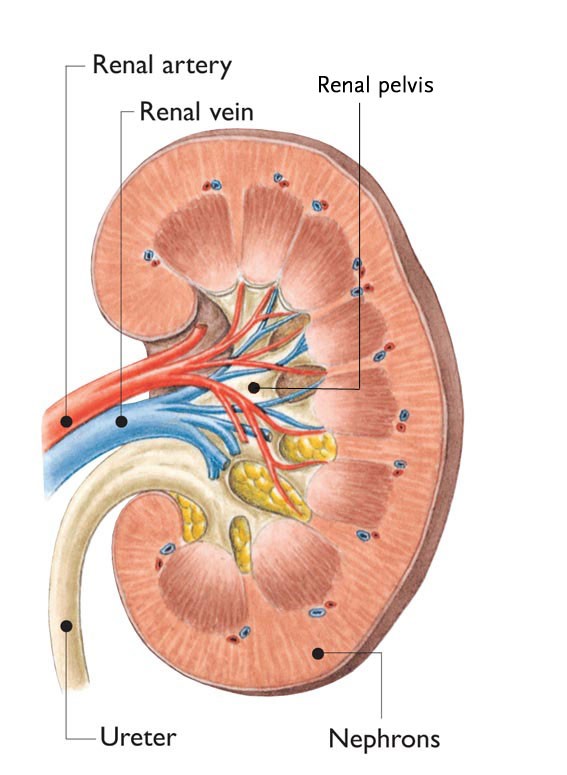
Your two kidneys are bean-shaped, fist-sized organs located in the middle of your back. The kidneys continually filter the blood, removing harmful wastes, such as urea, a substance made in the liver, as well excess water and salts, thus keeping the composition of the blood constant. The wastes, which, along with the excess water and salts make up a solution called urine, are sent to the bladder from where they are passed out of the body. About 99% of the volume of blood is re-absorbed back into the bloodstream after being filtered. The kidneys have an enormous work capacity: they can filter about one quarter of your entire bloodstream in just a minute.
How kidneys work
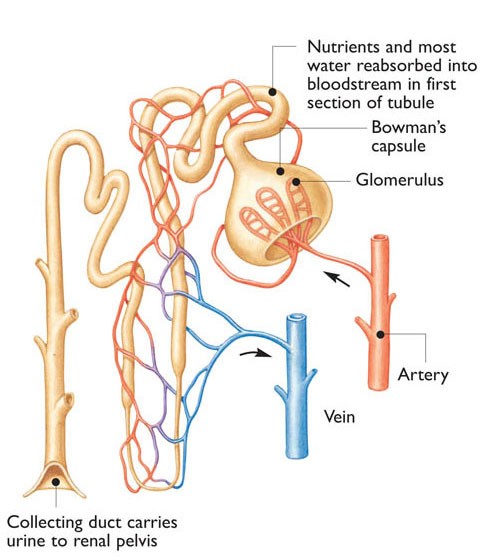
Packed into the outer layers of each kidney are around one million microscopic filtering units called nephrons. In the two kidneys these process over one litre (1.8 pints) of blood each minute to remove unwanted wastes, water and salts, and produce urine. Each nephron consists of two parts: a hollow, cup-shaped Bowman’s capsule that contains a glomerulus, a knot of tiny blood capillaries; and a coiled tubule surrounded by a network of blood capillaries.
Blood arrives in each kidney from the heart through a renal artery. The renal artery subdivides into smaller arteries, which branch repeatedly into capillaries, one of which supplies each glomerulus.
The capillary’s walls act like sieves. Water, salts, wastes and nutrients are forced out of the bloodstream and into Bowman’s capsule and tubule. Because proteins and blood cells are too big to pass through the capillary walls, they remain in the glomerulus. As filtered fluid passes along the first bendy part of the tubule, all nutrients and most of the water and salts are absorbed back into the bloodstream. The remaining waste fluid, called urine, passes along the rest of the tubule.
Urinary system
The urine produced by the kidneys’ nephrons is about 95% water. Dissolved in it are various wastes, mostly urea, a substance made in the liver. Urine flows from the nephrons's tubules into the renal pelvis, the hollow central part of the kidney. Meanwhile, blood cleansed of its wastes leaves the kidneys through the renal veins to continue its journey around the body.
Urine leaves each kidney via a tube called the ureter. Dribbles of urine are pushed down the ureter to a stretchy, storage bag called the bladder. As the bladder fills (it can take up to about 600 millilitres or 1 pint at maximum), its muscular walls stretch and send signals to the brain so you feel a need to urinate or wee.

You then make a conscious decision to relax the sphincter (a muscular ring) at the base of the bladder. The bladder walls then contract to push the urine through the urethra. About 1.5 litres (2.6 pints) of urine are passed every 24 hours, but this varies greatly from person to person.
Consultant: Richard Walker