
Q-news

CITE
We have made every effort to follow citation style rules, but there may be some minor differences. If in doubt, please refer to the appropriate citation style manual.
Earth’s wild land mammals now make up just 2% of the mammal kingdom. (2023). In Q-files Encyclopedia, , Q-news. Retrieved from
https://www.q-files.com/news/earths-wild-land-mammals-now-make-up-just-2-of-the-mammal-kingdom
"Earth’s wild land mammals now make up just 2% of the mammal kingdom." , Q-news, Q-files Encyclopedia, 5 Oct. 2023.
https://www.q-files.com/news/earths-wild-land-mammals-now-make-up-just-2-of-the-mammal-kingdom.
Accessed 31 Oct. 2026.
Earth’s wild land mammals now make up just 2% of the mammal kingdom 2023. , Q-news. Retrieved 31 October 2026, from
https://www.q-files.com/news/earths-wild-land-mammals-now-make-up-just-2-of-the-mammal-kingdom
, Q-news, s.v. "Earth’s wild land mammals now make up just 2% of the mammal kingdom," accessed October 31, 2026.
https://www.q-files.com/news/earths-wild-land-mammals-now-make-up-just-2-of-the-mammal-kingdom


Earth’s wild land mammals now make up just 2% of the mammal kingdom
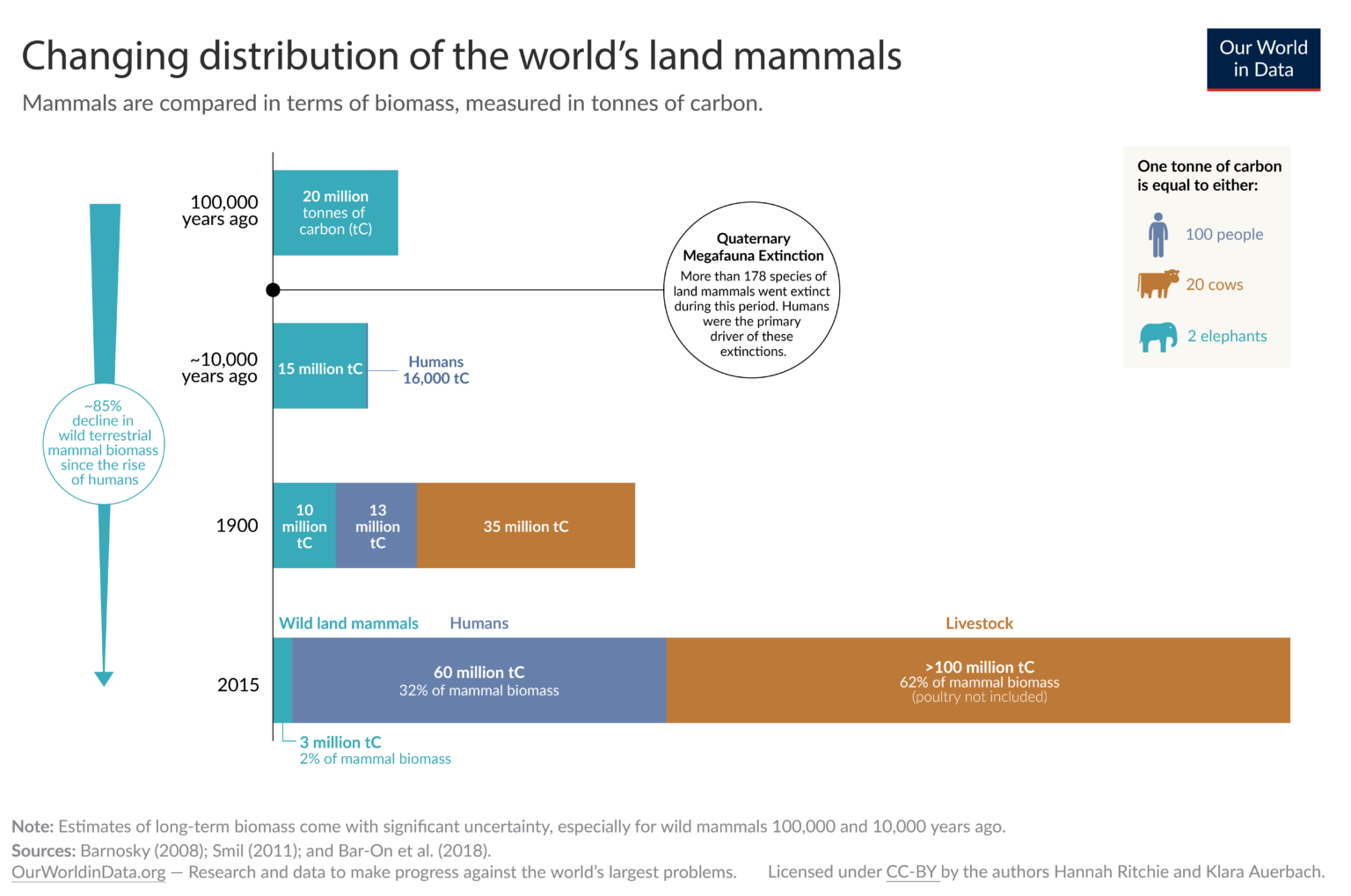
A new study has found that the total weight of Earth’s wild land mammals is now less than 6% of the combined weight of humans living on the planet. Scientists at Israel’s Weizmann Institute of Science calculate that wild land mammals alive today have a total weight of 22 million tonnes, while the total mass of humanity is estimated at around 390 million tonnes. Biomass—the combined weight of animals—is a useful measure that allows us to compare species with very different body sizes. By comparison with wild mammals, domesticated animals are dominant, weighing an estimated 630 million tonnes. Today, wild mammals make up just 2% of the mammal kingdom.
20th March 2023


Domestic mammals
Domesticated mammals, including our pets and livestock such as pigs, sheep and cattle, along with animals that live in human environments—urban rats and mice—are estimated to weigh 630 million tonnes. Cattle weigh 420 million tonnes. Farmed pigs, alone, are reckoned to have a weight double that of all wild land mammals put together.
Domestic dogs have a total weight of around 21 million tonnes—almost the same as the combined biomass of all wild land mammals, while domestic cats have a combined weight of around 2 million tonnes—about double that of all the African savanna elephants and four times that of moose.
Wild mammals
Almost half of the total biomass of wild mammals are made up by even-toed ungulates: hoofed mammals such as hippos, deer, giraffes, camels, llamas, bison and antelopes. Ten species make up 8.8 million tonnes or around 40% of the total mass of all wild land (terrestrial) mammals; they include wild boar, elephants, kangaroos and several kinds of deer. The white-tailed deer, common in North America, has the highest biomass of all, accounting for almost 10% of the total of wild land mammals globally. Like another mammal ranking highly on the list, the wild boar of Europe and Asia, the white-tailed deer has benefited from the human eradication of predators such as wolves.


Marine mammals
The total mass of marine mammals was calculated at around 40 million tonnes, just under twice as much as wild land mammals. Around 60% of this total is accounted for the baleen whales. The fin whale, which has a biomass of 8 million tonnes, ranks highest, while a toothed whale, the sperm whale, comes second with 7 million tonnes.
How were the calculations made?
The distribution and numbers of the vast majority of the planet's wild mammals are poorly known. To overcome this, the team used AI to help them. First they collected data on the global population of 392 land mammal species which make up about 6% of all wild land mammal species, and for which the data could be relied upon to be fairly accurate. The researchers then used the data from half of these species to train a machine learning system (a form of AI) until it could accurately predict the biomass of the other half—that is, come up with predictions that matched figures already known to the scientists. They then fed into the model the information they had for each of about 4400 additional mammal species—habitats, diet, body size etc.—to estimate their biomass and numbers.

Head count
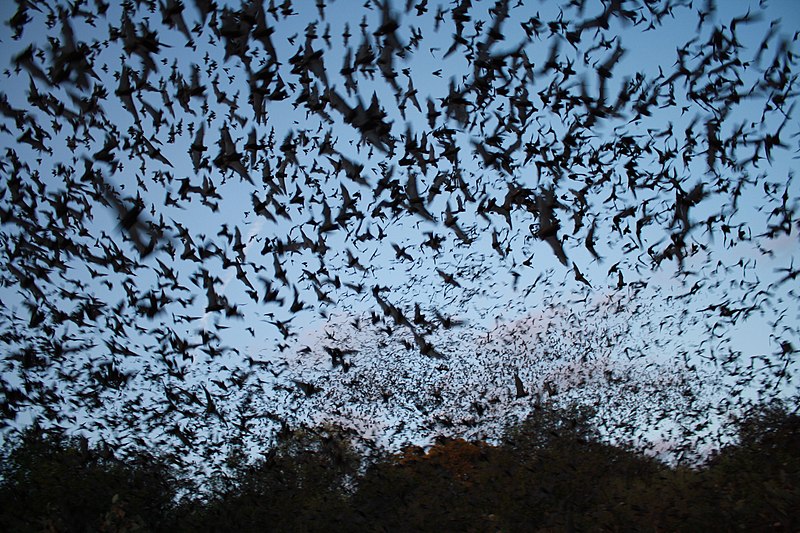
Bats, of which there are around 1200 species (one fifth of all land mammal species), account for two-thirds of all wild mammals by head count—around 56 billion individuals. At about 0.5 million tonnes, they make up just 7% of the biomass of wild land mammals, however. Rodents, the next highest types of wild mammal by numbers, around 25 billion, have a combined weight of 1.1 million tonnes.
Our vanishing wildlife
On the strength of these findings, the idea many of us have of Earth as a planet of vast wildernesses teeming with wild animals is clearly far removed from reality. The natural world and its wild animals are vanishing, as the world's human population, now over 8 billion individuals, continues to grow.
We humans have transformed the mammal kingdom. In the last 100,000 years, with the emergence of Homo sapiens as the planet's dominant species, wild land mammal biomass has declined by an estimated 85%. At the same time, the total amount of mammal biomass—including ourselves and our domesticated animals—has increased enormously.
pics
Without in any way limiting Q-files Ltd’s exclusive rights under copyright, any use of this publication to “train” generative artificial intelligence (AI) technologies to generate text is expressly prohibited. Q-files Ltd reserves all rights to license use of this work for generative AI training and development of machine learning language models.