
Dinosaur species
Dinosaurs
The dinosaurs were reptiles that had legs held upright beneath their bodies, rather than sprawling. They walked on either two legs or all fours. Most kinds had long tails, clawed hands and feet. Many had scaly skins, but some had a covering of feathers. Ranging from about the size of a duck to 75-tonne giants, the dinosaurs inhabited land environments on all continents—including Antarctica—during the Triassic, Jurassic and Cretaceous periods, 252–66 million years ago, together known as the Mesozoic Era. Dinosaurs were divided into two major groups: saurischians (“lizard-hipped”) and ornithischians (“bird-hipped”).

Posture
Dinosaurs stood and walked on straight legs, which were directly beneath their bodies. No other reptiles had straight, upright legs like this. Most reptiles have legs at the sides of their bodies. Modern lizards, such as the Komodo dragon, walk with a sprawling gait: they bend down at the knees.


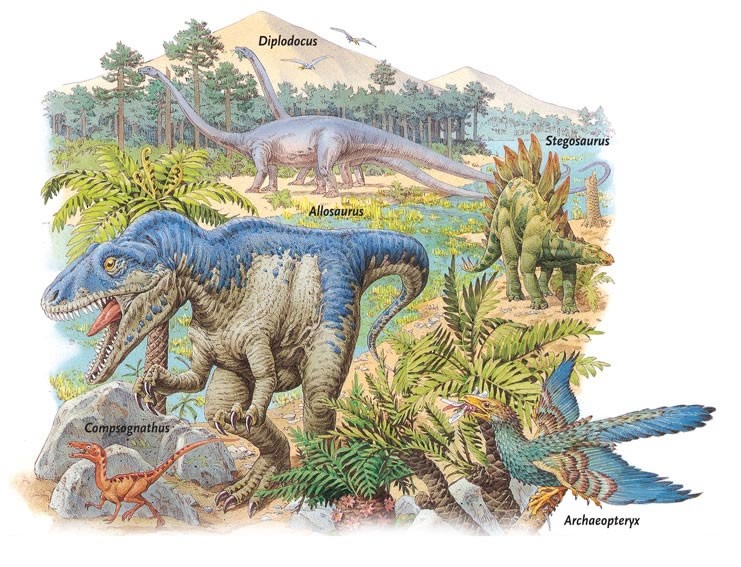
Prehistoric reptiles called thecodonts had partly bent legs, “half-way” between an ordinary reptile and a dinosaur. Thecodonts lived before the dinosaurs. Perhaps some of them changed, or evolved, into the first dinosaurs. Crocodiles can also run in a partly-upright way. By contrast, the dinosaurs had an erect posture. The bone structure of a dinosaur’s limbs was more like that of a mammal’s. It allowed dinosaurs, such as Compsognathus, to walk and run more efficiently—even to sprint on their back legs only.
Two groups
Dinosaurs were divided into two major groups: saurischians (“lizard-hipped”) and ornithischians (“bird-hipped”). The saurischians included the mostly carnivorous, bipedal theropods and the herbivorous sauropodomorphs, many of which went about on four legs. The ornithischians, all plant-eaters, included the ornithopods, the ceratopsians, stegosaurs and ankylosaurs.
Hip bones
The two groups of dinosaurs, ornithischians and saurischians, were distinguished from one another by the shape and positioning of their hip bones. In an ornithischian, the pubic bone slanted backwards, parallel to the ischium. In most saurischians, the pubic bone sloped forwards. This example shows the hip bones of the saurischian Allosaurus, which had a “foot” on the pubic bone characteristic of some predators.


Saurischians
The saurischians were divided into two major sub-groups: the mostly carnivorous (meat-eating), bipedal theropods, and the herbivorous (plant-eating) sauropodomorphs, many of which went about on four legs. The theropods were the first dinosaurs to evolve. Their upright stance gave them the advantage of speed over other reptiles. The group was divided into ceratosaurs and tetanurans. The tetanurans included small raptors (from which the birds evolved), ornithomimids and the huge tyrannosaurs.
Most sauropodomorphs—the prosauropods and the sauropods—had long necks and tails. Prosauropods were once thought to be the bipedal ancestors of sauropods, but they are now considered a separate sub-group.
Ornithischians
The ornithischians, all plant-eaters, were divided into four main sub-groups: ornithopods, ceratopsians, thick-skulled pachycephalosaurians and armoured or plated thyreophorans.
Thyreophoran dinosaurs included two main families: the stegosaurs, which had rows of plates and spines along their backs and tails, and the ankylosaurs, with their armour-plated bodies. The scelidosaurs, a third group, may have been ancestors to both.

The first ornithopods were the hypsilophodonts, small, bipedal herbivores. Later ornithopods included the larger iguanodonts and the hadrosaurs or “duck-bills”. The ceratopsians evolved into large, four-legged dinosaurs distinguished by their horns and neck frills. Pachycephalosaurians were all bipedal herbivores with thick skulls.
Feathered dinosaurs
Well-preserved dinosaur fossils with feather impressions were discovered in Liaoning province, China, in the 1990s. From this evidence, palaeontologists realised that some dinosaurs had not the scaly skins of today’s reptiles, but coats of feathers—much more like their living descendants, the birds. This is especially common among the maniraptor group of theropods from which birds are most likely descended.

The original purpose of having feathers was for insulation—to keep warmth in. This makes it likely that feathered dinosaurs were warm-blooded, like birds and mammals, but unlike other other reptiles. Long feathers on their limbs would have given the very lightest dinosaurs the ability to glide or even fly.
Consultant: Chris Jarvis