
Ocean life
Plankton
Plankton are mostly tiny plants and animals that float or swim in the surface waters of the ocean. Most ocean animals depend on them, either directly or indirectly, for their food. Plant plankton is called phytoplankton; animal plankton is known as zooplankton. Algae, simple, single-celled, plant-like organisms, form a major part of phytoplankton. Unlike land plants, oceanic plants cannot put down roots into the ground. Instead, they drift through the water. They use sunlight and nutrients dissolved in the water to make food by the process of photosynthesis.

Diatoms

Most phytoplankton consists of organisms called diatoms, the commonest types of algae. These are very simple life-forms, no bigger than a tenth of a millimetre in size. Seen under a microscope, however, they have beautifully detailed patterns, giving the nickname "jewels of the sea". Delicate “hairs” or whip-like “oars” help keep them floating at or near the water’s surface as they drift along in the currents. They are each surrounded by a glass exoskeleton made of silica, called a frustule.

Dinoflagellates
Dinoflagellates, kinds of marine phytoplankton, are single-celled protists and are even tinier than diatoms. The name "dinoflagellate" is a combination of the Greek word dinos and the Latin flagellum. Dinos means "whirling" and describes the way in which they twirl through the water. Flagellum means "whip" and refers to their whip-like flagella.
A rapid accumulation of certain dinoflagellates in the sea, known as a "bloom", can result in the water turning a red or brown colour and is known, as a red tide. Because the dinoflagellates are toxic, red tides may cause the deaths of fish, birds, shellfish, mammals and other marine life that feed on them.
Some dinoflagellates also have the natural ability to produce light, called bioluminescence. When the dinoflagellates gather in large numbers, the surface waters of the ocean may glow with a bluish-white light at night.

Zooplankton
Phytoplankton are food for tiny animals called zooplankton. The larvae (young) of fish, as well as tiny relatives of crabs and shrimps, known as copepods, and some amphipods are all kinds of zooplankton. Many protozoans (single-celled protists that prey on other microscopic life) are zooplankton. They include zooflagellates, foraminiferans, radiolarians (see below) and some dinoflagellates.


Zooplankton rise and fall through the water, using the surface currents to carry them along to new grazing areas where they feed on phytoplankton.
They, themselves, arec prey for a wide range of ocean animals. In an attempt to escape attention from their predators, many zooplankton are coloured or patterned in such a way that makes it difficult for them to be detected. Some are even transparent. Fish, squid and baleen whales are major predators of zooplankton. Shoals of small fish throng the surface waters to feed on them. They, in turn, attract larger predators.
Radiolarians

Radiolarians are single-celled zooplankton. Like diatoms, they are encased in glass skeletons made of silica and pierced with holes. They catch prey by extending parts of their body through the holes. When radiolarian shells sink to the ocean floor after the creatures die, they become part of the sediments coating the seabed. Preserved as microfossils, they tell us about oceanic conditions millions of years ago.
Plankton abundance
In some oceans, the amount of plankton in the water peaks in the spring and autumn. Many plankton-eating animals breed or migrate to coincide with these peaks. Plankton is especially abundant in areas where currents or winds stir up nutrients from the sea bed. This is particularly true of the shallower waters of the continental shelf and in cooler waters—for example, the tempestuous southern oceans.

It is in the southern oceans that a kind of zooplankton called krill is found in vast quantities—enough to provide a bountiful food supply for fish, squid and baleen whales. The abundant fish, in turn, attract sea birds, seals and flesh-eating whales. Very large whales, like the blue and sei whales, take in several tonnes of krill every day, using comb-like plates in their mouths, called baleen, to sieve the krill from gulpfuls of water.
Marine snow
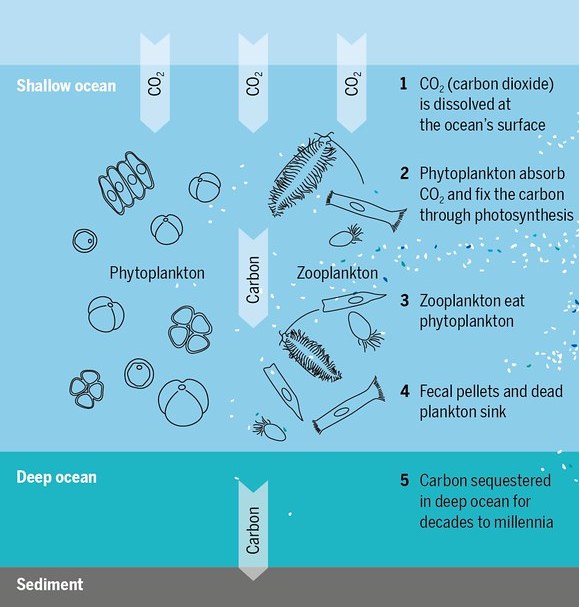
Carbon dioxide in the atmosphere dissolves into the ocean's surface waters. Here, phytoplankton absorb it during photosynthesis. Much of the carbon is released when zooplankton eat and decompose phytoplankton, giving off carbon dioxide as they do so. Phytoplankton that are not eaten die after a few days or weeks and start to sink down through the ocean waters. Along with the waste of zooplankton (faecal pellets), they form continuous falls of "marine snow". The dead or waste matter carries the carbon it contains down to the cold, dense waters of the deep ocean. It may remain there for thousands of years, some of it feeding deep-dwelling creatures. The rest settles on the seabed.
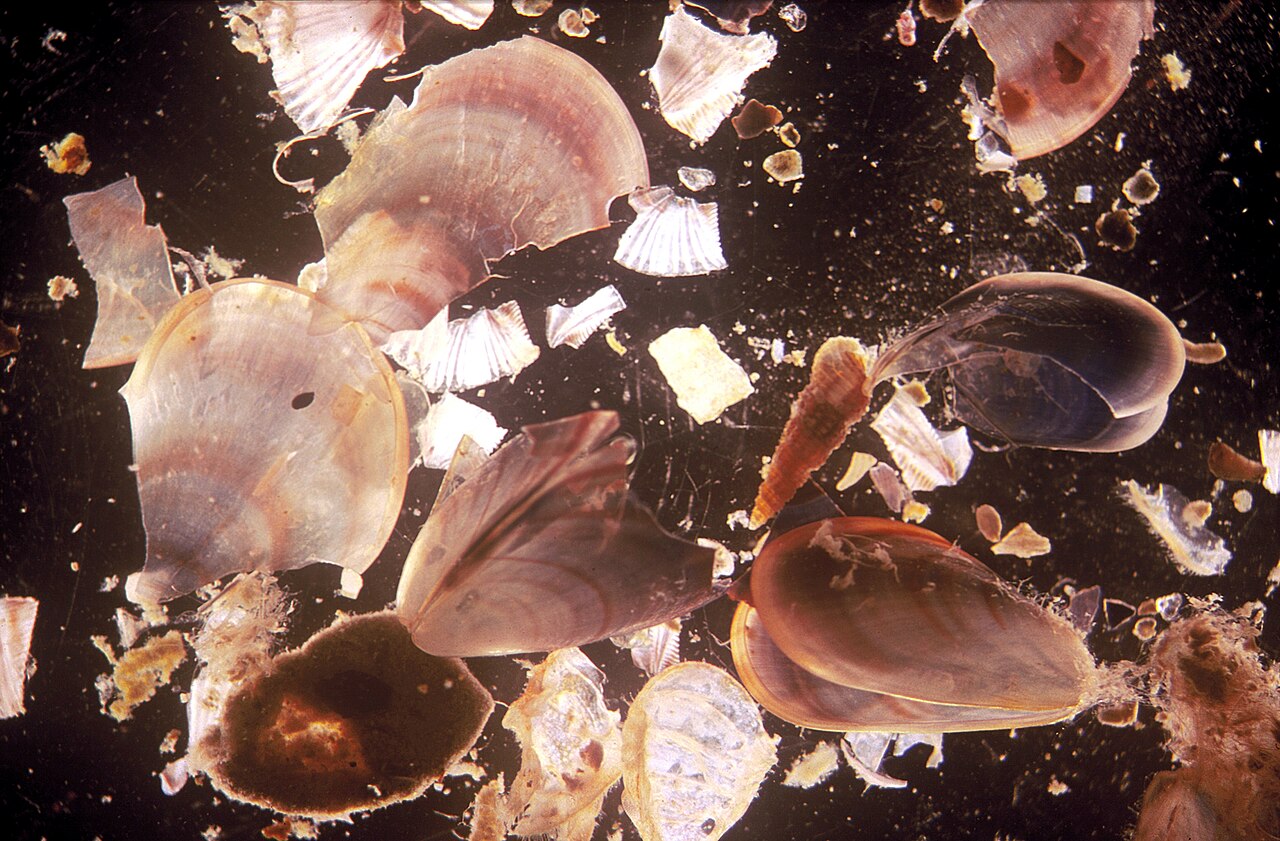
The dead or waste matter accumulates on the seabed in thick layers of slurry. This eventually compresses into rock, trapping carbon for millions of years. The process by which carbon dioxide is removed from Earth's atmosphere is known as carbon sequestration. The role plankton plays in this process is known as the biological pump. It reduces the level of greenhouse gases in the atmosphere, and thus has a great influence on the Earth's climate. An ocean without a biological pump would result in atmospheric carbon dioxide levels about 400 ppm (parts per million) higher than they are now.
Coccolithophores
Coccolithophores, microscopic single-celled phytoplankton, exist in huge numbers throughout the surface waters of the ocean. Each one is contained in a shell, called a coccosphere, made up of plates of calcium carbonate. The billions of coccolithophores absorb vast amounts of carbon from the atmosphere. After the organisms die, their shells sink through the water and accumulate on the seabed. Over millions of years, the shells turn to rock. Today, in some parts of the world this ancient seabed is now land—it has been pushed up above the water's surface by plate tectonics. Made of calcium carbonate, more commonly known as chalk, the rock forms, for example, the White Cliffs of Dover in southern England. The cliffs are made almost entirely of the shells of buried coccolithophores.


Consultant: Chris Jarvis