
Dinosaur species
Styracosaurus
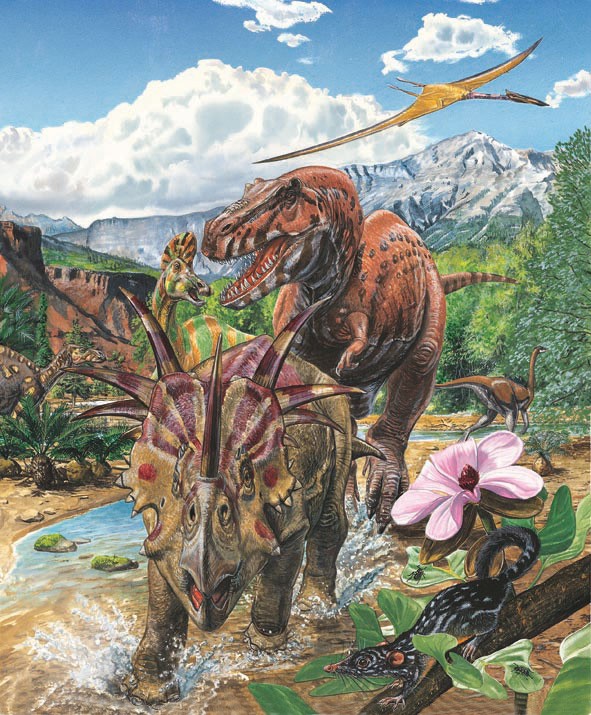
Styracosaurus was a ceratopsian, a horned dinosaur, that lived in North America in the Late Cretaceous Period, 76–66 million years ago, possibly living in the same environment as its relative, Triceratops. Styracosaurus had a long nose horn and a massive neck frill with six long spikes sticking out from around its edge. There were smaller knobs around the lower rim of the frill, and small horns on each cheek. Its skull was massive, with a toothless beak. The dinosaur's stocky, rhinoceros-like body had a short tail.

Spiky frill
Styracosaurus’s spiky frill was not solid bone but had wide openings covered in skin. Its longest spikes (and nose horn) were about 55 centimetres (22 inches) or about the average length of an adult human arm.
No one knows exactly what the frill was for. It may have protected the animal's neck and shoulders from attack. The large areas of skin over it may have also helped to regulate its body temperature, performing the same function as an elephant’s ears. In males the frill could have been used in fights with rival males, or to show off when in courtship with females, known as sexual display.
Ceratopsians
The ceratopsians were the last major group of ornithischian (“bird-hipped”) dinosaurs to evolve before the dinosaurs became extinct at the end of the Cretaceous. All ceratopsians had roughly the same body shape: massive head, pillar-like legs, neck frills, toothless beaks and horns on the nose and brow. Anchiceratops (“near-horned face”) had two brow horns and a short nose horn. Pachyrhinosaurus (“thick-nosed lizard”) had a thick pad of bone, called a boss, on its nose, and horns on its frill.

Ceratopsians probably used their chopping teeth to eat the toughest of plant foods. They would have lived in herds for protection against predators. The fact that many fossil skeletons of Centrosaurus individuals, for example, have been found buried close together, offers strong evidence for this.
Psittacosaurus
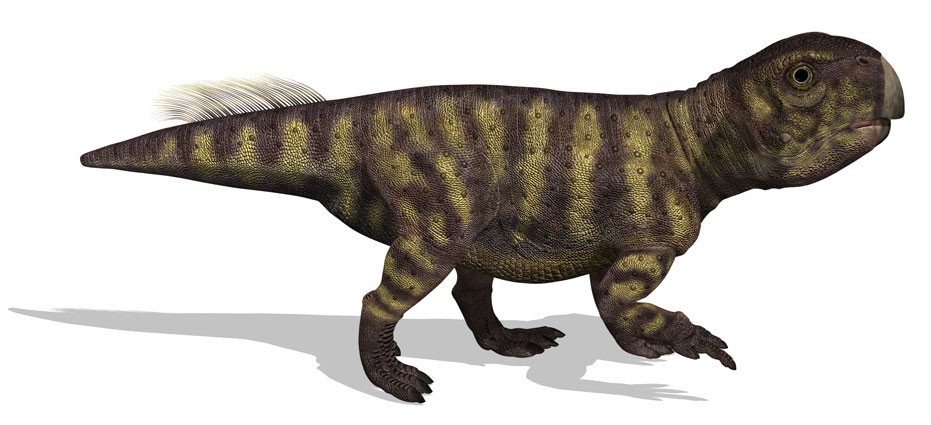
Psittacosaurus was a “parrot dinosaur”, an Early Cretaceous Asian ceratopsian (123–100 million years ago). It had neither horns nor frill and it could run on its back legs. Its horny, toothless beak, just like a parrot’s, was perfect for tearing off and eating plants that were too tough for many other dinosaurs of the time. It or a similar dinosaur may have been an ancestor of the later ceratopsians.

Leptoceratops
Leptoceratops (meaning “little-horned face”) was a 2-metre-long (6.6-foot) ceratopsian dinosaurs from Late Cretaceous Western North America. It could probably stand and run on its hind legs. With its powerful jaws, Leptoceratops was capable of chewing extremely tough plants with a combination of shearing and crushing.
Protoceratops

Protoceratops was a relatively small ceratopsian from Late Cretaceous Mongolia; it was 2 metres (6.6 feet) long. Its shearing teeth were perfectly suited to slicing up the tough semi-desert vegetation in its habitat. It laid its eggs in a nest on the ground, up to 18 at a time. The eggs were sausage-shaped and each about 20 centimetres (8 inches) long. Protoceratops was probably very protective of its eggs. Predators looking for an easy lunch were always a threat.
Centrosaurus
Centrosaurus, a ceratopsian from Late Cretaceous North America, was 6 metres (20 feet) long. Its skeleton reveals typical ceratopsian features: a frill with openings in the bone; massive back, shoulders and hip bones; deep ribcage; broad hoofed toes. Centrosaurus had heavy jaws and slicing teeth to cut up tough plant stems.

Facts about Styracosaurus
Pronunciation: Sty-RACK-oh-SAW-rus
Size: 5.5 m (18 ft) long and 1.8 m (6 ft) tall
Where and when: Open woodland in North America, 77-75 million years ago (Late Cretaceous)
Diet: Low-growing ferns and cycads, leaves and twigs
Predators: Albertosaurus, Daspletosaurus, Gorgosaurus
Features: Strong chopping teeth for eating tough plants
Relatives: Ceratopsian dinosaurs of the centrosaurine group: Centrosaurus, Pachyrhinosaurus, Avaceratops, Einiosaurus, Albertaceratops, Achelousaurus. Slightly more distant relatives were Chasmosaurus, Torosaurus and Triceratops.


Consultant: Chris Jarvis