
Planets and moons
Titan
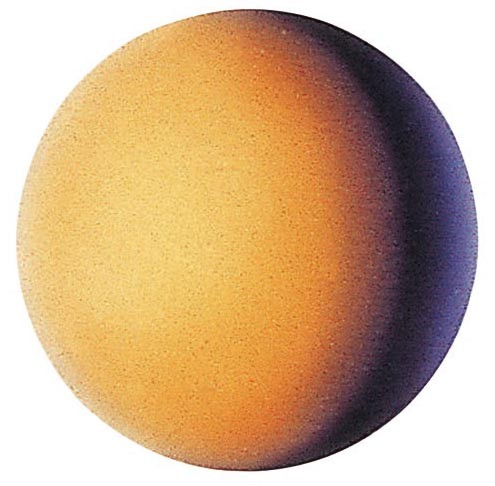
Titan, Saturn’s largest moon, with an average diameter of 5150 kilometres (3200 miles), is the second largest moon in the Solar System. Half as big again as Earth’s Moon, it is larger than the planet Mercury. It is the only moon known to have a thick atmosphere, almost entirely composed of nitrogen. Titan’s atmosphere is so thick, and its gravity so low, that humans could fly through it by flapping “wings” attached to their arms. The atmosphere contains small amounts of hydrocarbons, forming a haze. This reflects sunlight back to space, making the Titan's surface colder than the upper atmosphere.
Composition

Titan is the only other world apart from Earth where permanent areas of surface liquid exist. The liquids are not water, however, but methane and ethane—gases on Earth but which exist in a liquid state in Titan's -170°C (-275°F) temperatures. (The ethane is formed when sunlight breaks down methane in the atmosphere.) There are even methane/ethane clouds, rain and snow. Titan is thought to have an internal liquid layer between its crust and core made of liquid water and ammonia, which, along with methane, erupts at the surface through crustal cracks. Scientists think it is just possible there may be some kind of living things inhabiting this layer.
Landscape
The Cassini space probe was launched in October 1997. Its objective was to study Saturn and its moons. Attached to the probe was the Huygens lander. It separated from the main craft and descended through Titan's atmosphere to land on its surface in January 2005. It transmitted pictures and information back to Earth for a further 90 minutes, before its battery ran out.
Spectacular images captured by both Cassini and Huygens revealed a complex network of narrow drainage channels on Titan's surface, running from brighter highlands to lower, flatter, dark regions. These channels merged into river systems flowing into lake beds featuring offshore “islands” similar to those on Earth. However, the liquids involved are not water but methane and ethane, both liquids in Titan's incredibly cold surface temperatures.


Titan's lakes are the first stable bodies of surface liquid that have been found outside of Earth. Most of them lie close to the north pole, covering only a small portion of Titan’s surface, which is mostly an icy desert.
The ground is like a beach where the sand is made of ice grains and the pebbles are rounded pellets of ice. There are plains covered in long, narrow sand dunes formed by winds. Titan also has volcanoes, spewing out plumes of water and ammonia, and mountains with peaks covered in snow made of methane and ethane.

Consultant: Mike Goldsmith