
Planets and moons
Uranus
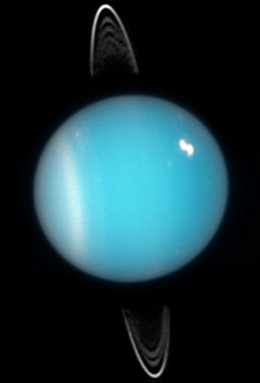
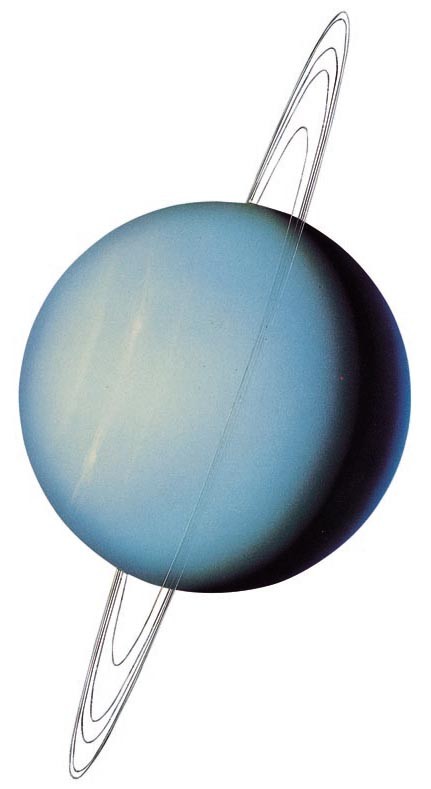
Uranus is the seventh planet from the Sun. Grouped with Neptune as one of the two "ice giants", it is the third largest planet in the Solar System. Mostly composed of gases and liquids, it has no solid surface. Uranus lies about twice as far from the Sun as Saturn. So when William Herschel, an amateur German astronomer living in England, discovered it in 1781 using a home-built telescope, his discovery doubled the span of the known Solar System. Seen through a telescope, Uranus looks like a pale blue-green disc. Seen comparatively close to by Voyager 2 during its fly-by in 1986, this most featureless of planets scarcely looks any different. Only a few wispy white clouds can be made out. They are, in fact, moving round the planet at around 1100 km/h (680 mph). Unlike all the planets except Venus, Uranus spins clockwise. Most unusually, it does so almost on its side.
Orbit
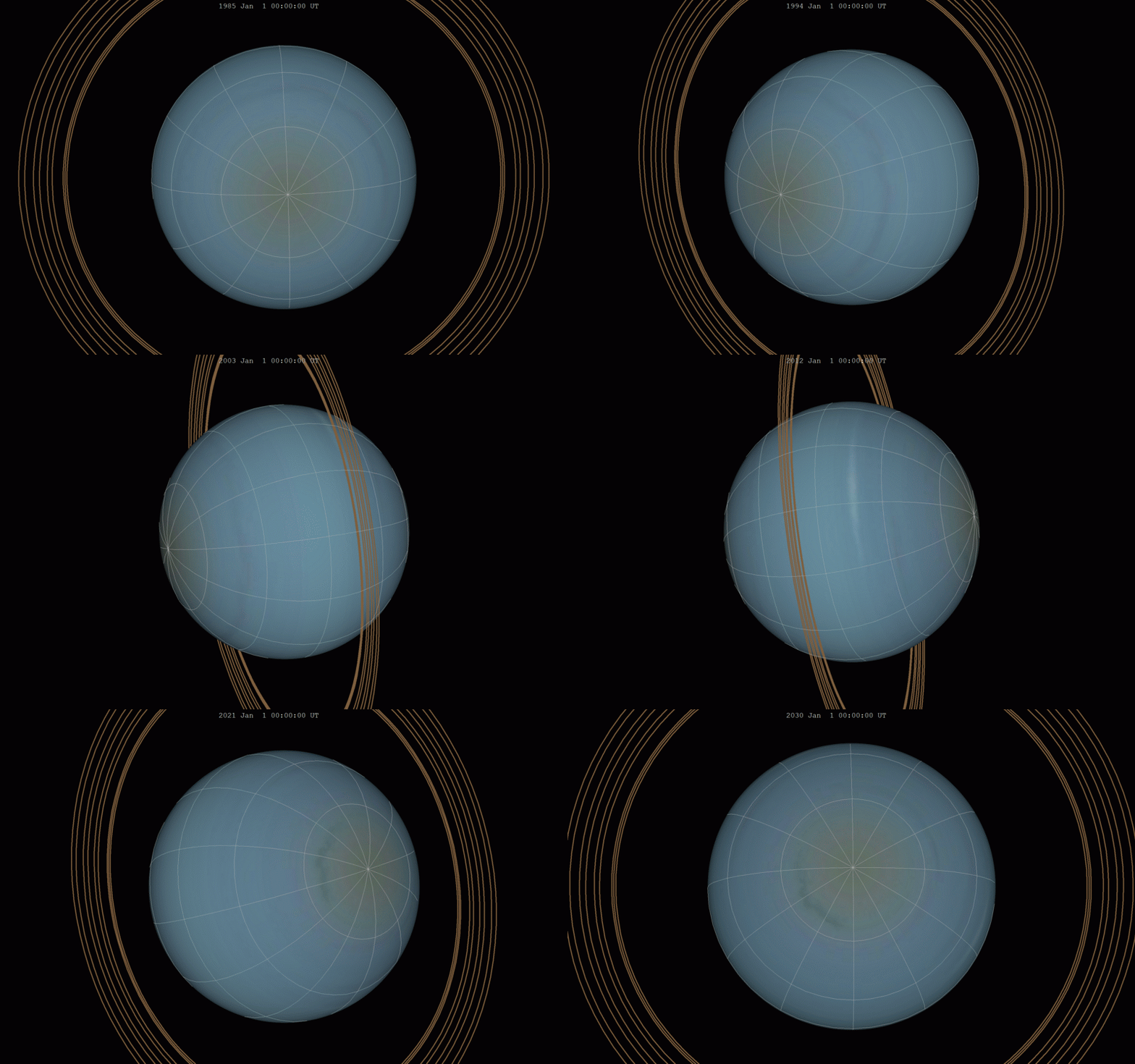
Tilted at 98° from the vertical, Uranus circles the Sun more or less on its side. Each pole has therefore 42 years of continuous sunlight followed by 42 years of continuous night. Astronomers think that, after Uranus formed, an Earth-sized object in the early Solar System may have collided with it, tipping it over. Possibly, the remnants of this object became one (or more) of the moons of Uranus.
Rings and moons
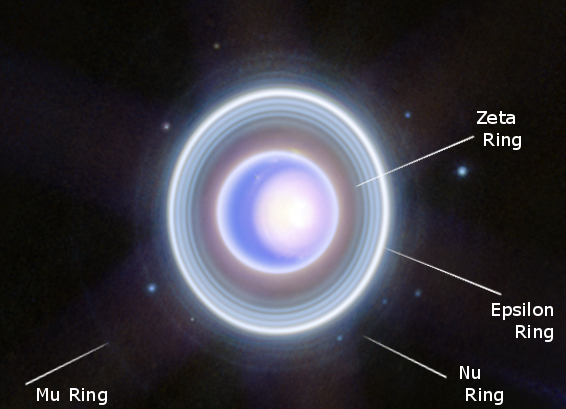
Like Saturn, Uranus has a family of rings, although they are far thinner and much less spectacular. Nine were discovered from Earth, Voyager 2 discovered two more, and two more have been discovered since. All circle Uranus’s equator. Probably made up of grains and lumps of ice mixed with unknown dark material, and measuring up to a few dozen metres across, the rings are likely to be the debris of several old moons, now broken up into fragments. One ring, called Epsilon, is held in place by the gravitational pull of two shepherd moons, orbiting either side of the ring. They are Ophelia (to the outside) and Cordelia (inside).
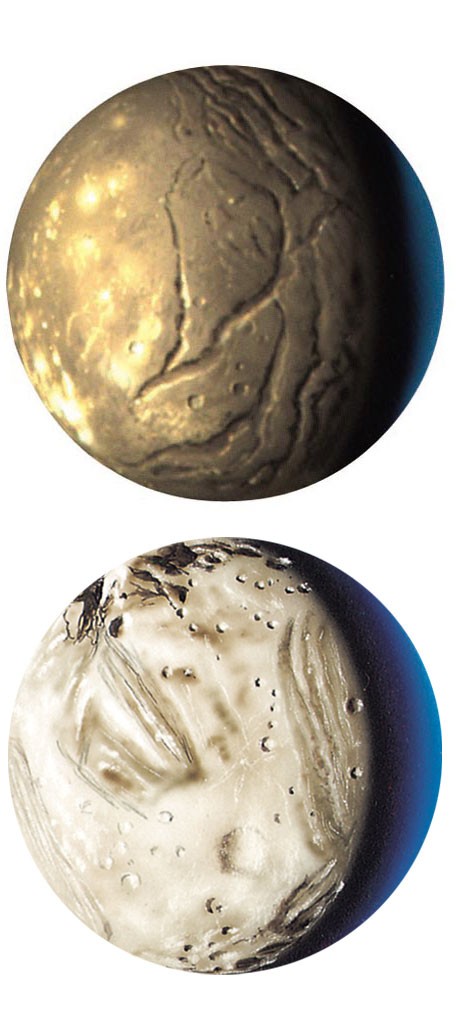
To date, we know of 28 moons orbiting Uranus. Voyager 2 revealed fascinating surface details on some of them. Umbriel has an icy surface peppered with craters. Ariel is marked by long rift valleys, some up to 30 kilometres (about 20 miles) deep, caused by faulting. This suggests that the moon has been geologically active more recently than the others, probably because of the effect of Uranus’s gravity.
Miranda
Miranda, only 470 kilometres (292 miles) in average diameter, is covered with an amazing variety of geological features. There are distinct zones marked by strange grooves, some oval in shape, another strikingly V-shaped. One great cliff is 20 kilometres (12 miles) high, well over twice the height of Earth’s highest mountain, Mount Everest. Called Verona Rupes, it may be the highest cliff in the Solar System.

The great globe of Uranus, about 129,000 kilometres (80,000 miles) away, would appear very large when viewed from Miranda's surface. Voyager 2 passed close to Miranda on its tour of the planets. The pictures it sent back revealed a landscape that looks as if it has been patched together from a number of other moons: it is a jumble of craters, cliffs and grooves.
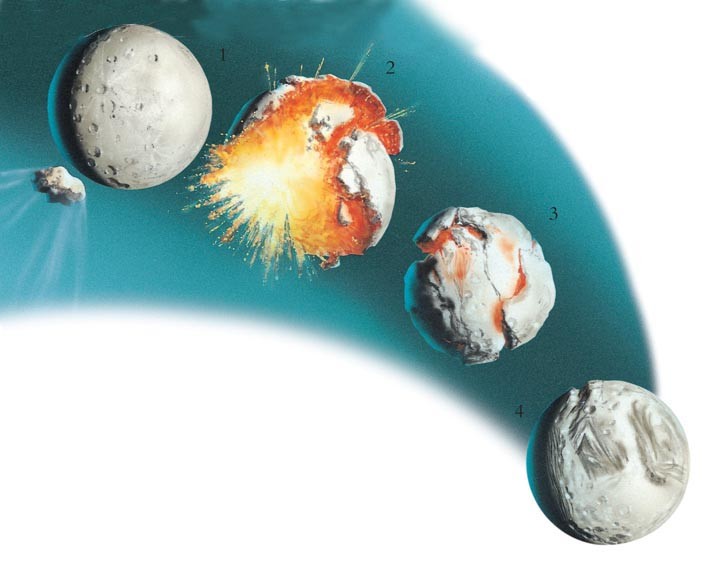
Formation of Miranda
Some astronomers think that Miranda, once a comparatively smooth moon (1), was blasted apart by a huge object: an asteroid or comet, perhaps (2). The exploded fragments did not disperse into space, however, but remained close together, eventually being pulled back together by gravity (3). There was not enough heat for the pieces to be melted into a smooth globe, however, so Miranda remained a lumpy ball of mixed-up fragments (4).
Many astronomers take an alternative view that the jumbled surface of Miranda is the result of different areas melting (as a result of bombardment by meteoroids) and refreezing.
Composition
Surrounding Uranus’s small, rocky core is a hot ocean of water mixed with ammonia. Scientists describe these compounds as "ices", even when they are liquid. For this reason, both Uranus and Neptune, which has a similar composition—and quite different to the gas giants Jupiter and Saturn—are known as ice giants. At a depth where the pressure is similar to that on the surface of the Earth, Uranus's thick atmosphere, is on average -197.2°C (-323°F). At the cloud tops, temperatures average -224°C (-371°F), making Uranus the coldest planet in the Solar System.
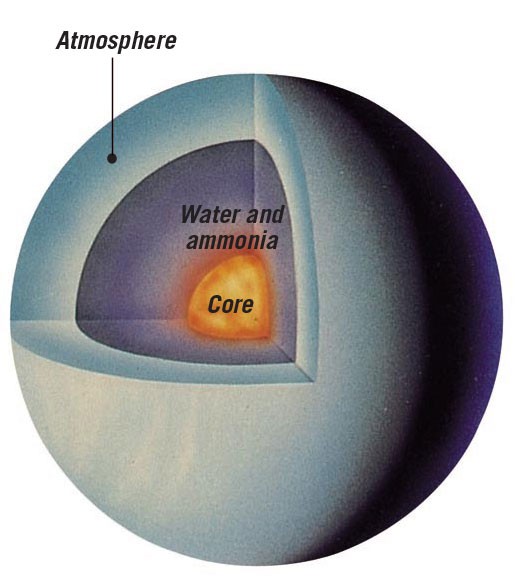
Uranus's atmosphere is composed mainly of hydrogen, with some helium and methane. It is the presence of methane that gives Uranus its bluish colour. Some scientists think that methane in the lowest levels of the atmosphere is under such extreme pressure that it separates into hydrogen and carbon, and the carbon forms diamonds, which rain down into the ocean beneath.
Factfile
Average diameter: 51,118 km (31,750 miles)
Mass: 14.5 (Earth = 1)
Average density: 1.3 (water = 1)
Surface gravity: 1.17 (Earth = 1)
Day: 17.2 hours
Year: 84 years
Average speed in orbit: 6.8 km/sec (4.2 miles/sec)
Average distance from the Sun: 2869 million km (1782 million miles)
Average temperature: -197.2°C (-323°F), the temperature at a depth in the atmosphere where the pressure is similar to that at the surface of the Earth
Atmosphere: hydrogen, helium, methane
Number of moons: 29
Name: the Greek god of the sky, the father of Cronus (Saturn) and the grandfather of Zeus (Jupiter).
Consultant: Mike Goldsmith