
Asia
Thailand
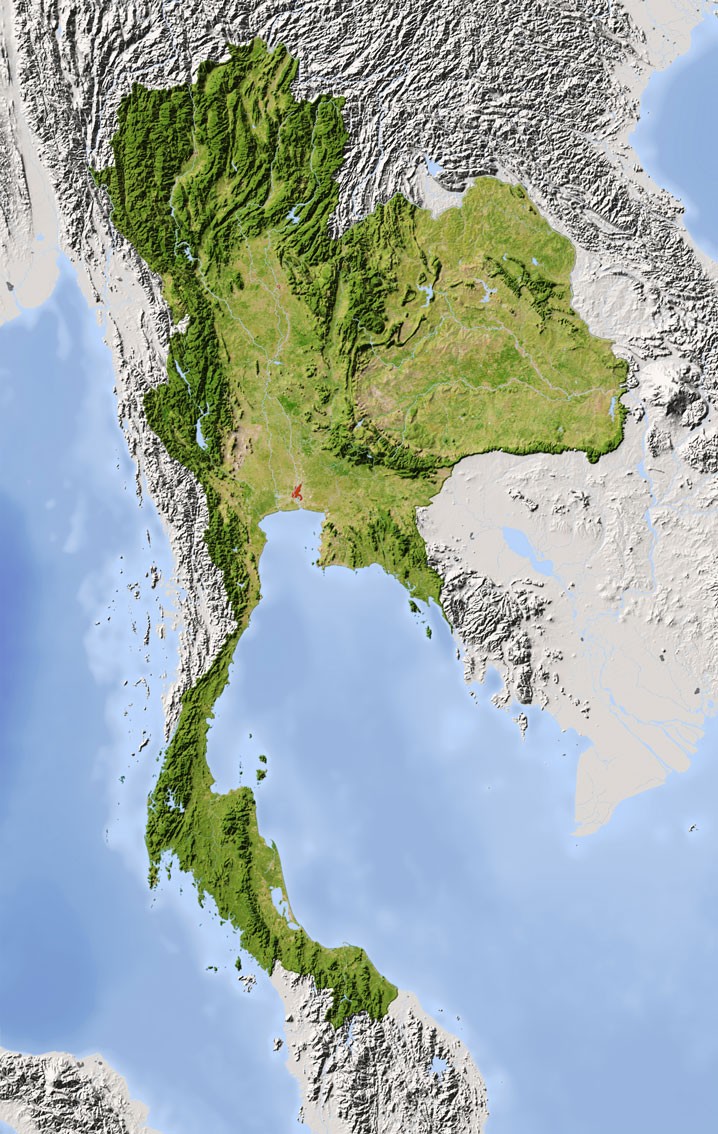
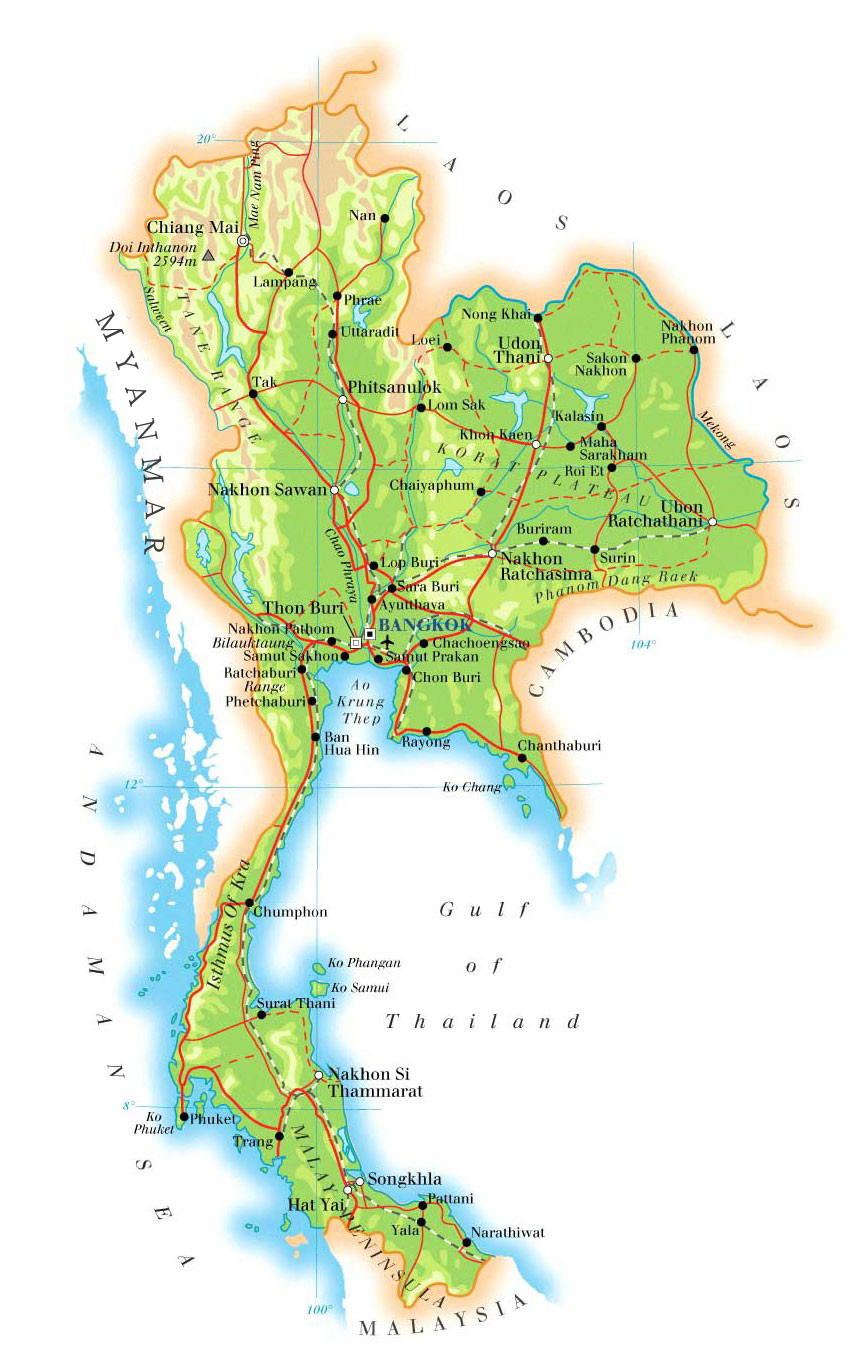
Lying close to the Equator, Thailand has a tropical climate, with hot, humid weather all year round and a rainy season between May and October. High, forested mountains mark its northern and western borders with Burma, while, farther south, the land slopes to the flat, fertile plains of the Chao Phraya River valley, home to most of the country’s population. At the mouth of the Chao Phraya River lies Thailand’s capital, Bangkok. To the east, on the Korat Plateau, the land is mostly level at an average altitude of 200 metres (660 feet). In the southwest, a long, narrow strip of land, the Kra Isthmus, extends southwards, opening out into a hilly region of tropical forests, lakes and islands where it joins Malaysia at its southern tip. Thailand is a constitutional monarchy. However, in May 2014 the Thai government was overthrown by the army, since when the country has been governed by a military junta (a committee of army leaders).
People
Around three-quarters of the population of Thailand are ethnically Thai. It is believed they are descended from settlers who arrived in the region from southern China over 2000 years ago. Other peoples represented in Thailand include Chinese, Malay, Khmer, Mon and the “hill tribes” of the northern regions, such as the Karen and Hmong.
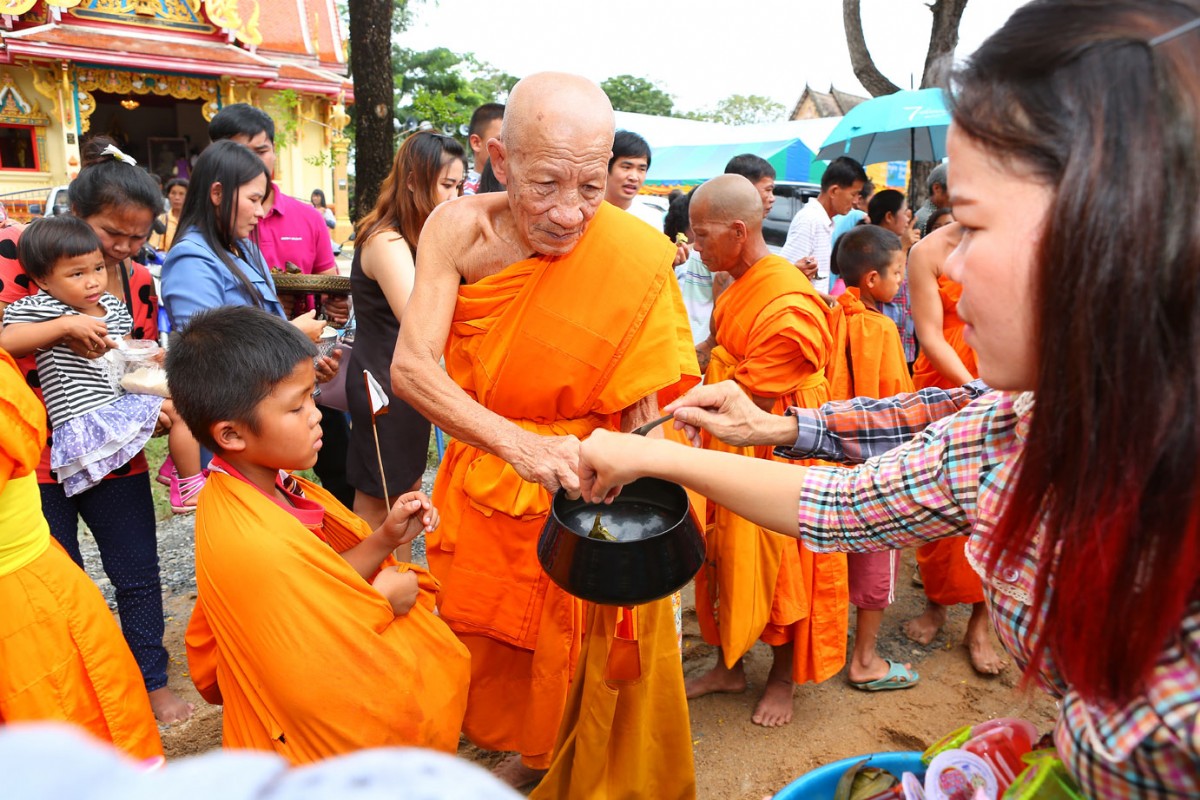
Buddhism is an important part of daily life. In Bangkok, huge Buddhist temples called pagodas rise above the city, and people make pilgrimages to visit giant statues of the Buddha. Although most Thai are Buddhists, Thailand is also home to around 3.5 million Muslims, the majority of whom live in the south near the Malaysian border.
Economy

Thailand is one of the world’s largest exporters of rice, which is grown on the fertile floodplains of the Chao Phraya River. Although agriculture is still important to Thailand’s economy, since the 1980s its manufacturing industries have grown rapidly. Today, it is a major producer of electronic parts such as computer circuit boards: the components are imported and the products assembled in Thai factories.

Tourism

Around 40 million foreign tourists visit Thailand each year. Tourism is one of Thailand’s major industries, in some years contributing as much as 17% of its gross domestic product (GDP; the value of all the country’s goods and services). Thailand’s Andaman Sea coast is one of the most popular tourist destinations in Asia. Its tropical beaches, resorts and islands attract many European and US visitors, along with visitors from other Asian countries, such as China, Japan and Malaysia. With more than 26 million tourists per year, Bangkok is one of the world’s most visited cities.
Consultant: Nicholas Harris
Facts about Thailand
Population 65,975,198 (2024 estimate)
Area 513,115 sq km (198,000 sq miles)
Highest point Doi Inthanon 2565 m (8415 ft)
Capital Bangkok (metro area population 17.4 million; city proper 9,034,000)
Other major cities Nonthaburi City (254,375), Hat Yai (191,696), Pak Kret (190,272)
Languages Thai (official language), Chinese, Lao, Yawi
Religions Buddhist 94%, Muslim 5%, Christian 1%
Ethnicity Thai 80%, Chinese 9%, Malay 3%, other 8%
Currency Thai baht (THB)
Chief exports Electronics, computer parts, vehicles, electrical appliances, machinery, textiles and clothing, fish, rice, rubber


History of Thailand
648
The Mon people, who establish their Buddhist Dvaravati civilization in central Thailand by the 6th century, found Lavo Kingdom with its capital city (modern Lopburi) on the banks of the Chao Phraya River
6th–11th centuries
Tai peoples migrated from southwestern China to present-day Thailand, a region inhabited by Mon, Khmer and Malay peoples
1238
The powerful Buddhist Kingdom of Sukhothai is established in the upper Chao Phraya River valley, and expands to rule much of modern-day Thailand
1351
The kingdoms of Lavo and Ayodhya (also called Xiān or Siam) join to form the Ayutthaya Kingdom, under Uthong, its first king. The capital is founded on an island located at the junction of three rivers; Chao Phraya, Lopburi and Pa Sak.
14th-17th centuries
The Ayutthaya Kingdom expands by conquest and intermarriage, absorbing the Sukhothai Kingdom, and seeking to dominate its neighbours, including the Khmer Empire and the Malacca Sultanate. It is briefly conquered by Burma in the Burmese-Siamese War (1568–69).
16th century
The first European traders from Portugal, France, Holland and Britain visit Thailand.
1656–88
Reign of King Narai in the Ayutthaya Kingdom. He is overthrown in the Siamese Revolution of 1688
1767
The Kingdom of Ayutthaya is invaded and conquered by Burmese forces.
1782
King Rama I of the Chakri dynasty founds the Rattanakosin Kingdom (also called the Kingdom of Siam) and establishes a new capital at Rattanakosin (Bangkok), replacing Thonburi.
1907
Franco-Siamese treaty, an agreement between France, the colonial rulers of French Indochina, and the Kingdom of Siam: France agrees to withdraw from Trat and Dan Sai while Siam agrees to cede the territories of Inner Cambodia (including the ancient Khmer capital of Angkor); the treaty also establishes the boundary between Siam and French Indochina.
1932
The nearly bloodless Siamese Revolution results in Siam changing from being an absolute monarchy—in which the monarch, Rama VII, has total power—to a constitutional monarchy: it has a democratic government in which the monarch is no more than a figurehead.
1939
Siam changes its name to Thailand.
2004
The Indian Ocean tsunami kills around 8000 people in Thailand and destroys communities on the southwest coast.
2006
Thailand's democratic government, led by prime minister Thaksin Shinawatra, is removed by a military junta in a coup d'état; after a period of military rule (martial law), new elections are held in December 2007
2010
Anti-government protests are crushed by troops, with 91 people killed
2014
After periods of crisis during which protests against the government are frequent (2008–10 and 2013–14), another coup d'état takes place and Thailand is once more under military rule
2016
King Bhumibol Adulyadej, who, as Rama IX, was Thailand's monarch since 1946, dies; Crown Prince Vajiralongkorn is proclaimed king
2017
King Vajiralongkorn approves new constitution that paves the way for a return to democracy
2020–21
Demonstrations against the government of Prime Minister Prayut Chan-o-cha. The protests include demands for reform of the Thai monarchy and are aimed at King Vajiralongkorn (mostly resident in Germany) who is criticized for intervening in Thai political affairs.
2025
Following a brief skirmish in May, the border dispute with Cambodia (which dates back to 1907 treaty) escalates in July after some Thai soldiers are injured by landmines supposedly laid by the Cambodian military. Thailand launches airstrikes and Cambodia reportedly fires rockets and artillery before a ceasefire is announced. Fighting breaks out again in December, when Thai air force jets bomb Cambodian military positions after a Thai soldier is killed in an exchange of fire at the border.
2025
(December) Cyclone Senyar causes heavy flooding and landslides across central and southern Thailand, especially in Songkhla province, where up to 1000 are feared dead
2026
(September 2026) Bangkok experiences 48 hours of continuous heavy rain, which submerges main roads and triggers mass evacuations. It is the worst flooding to affect Bangkok in 15 years