
Human body
Heart
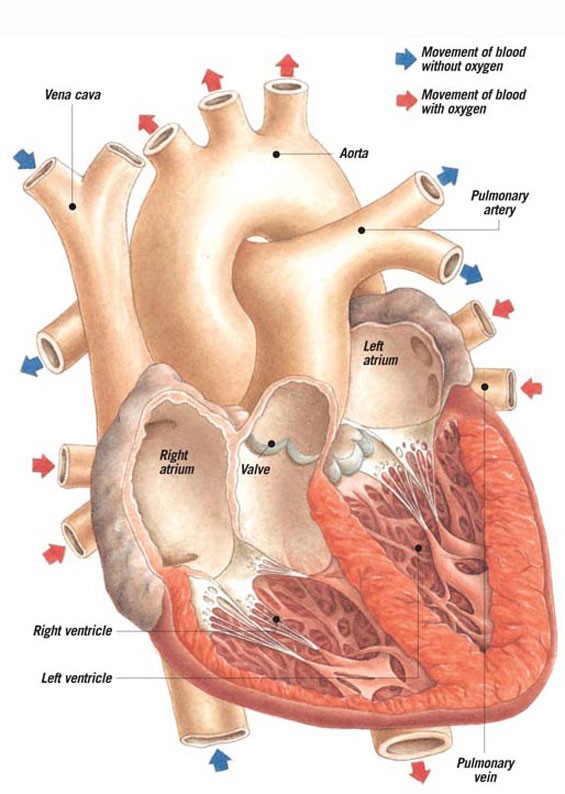
All of the body's cells, tissues and organs must be continuously supplied with food and oxygen in order to stay alive. This job is carried out by the circulatory system. The heart lies at the centre of the circulatory system and pumps blood around the body. About the size of your fist, it is an incredibly strong organ, made almost entirely of muscle. It beats more than two and a half billion times during the average life span of a person and pumps about 340 litres (75 gallons) of blood every hour—enough to fill a car’s petrol tank every seven minutes. The heart has four chambers (left and right atria, left and right ventricles). Flaps, called valves, slam shut to prevent blood leaking back once it has entered each chamber. This closing of valves produces the heartbeat that can be heard in a person’s chest.
What the heart does
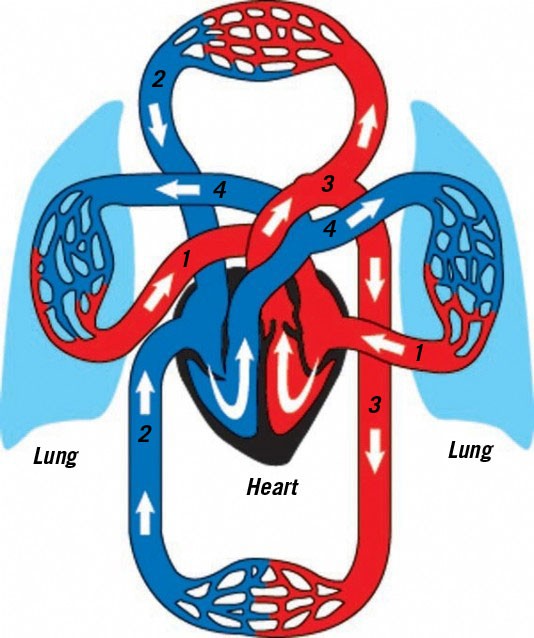
Blood rich in oxygen travels from the lungs to the left side of the heart through the pulmonary veins (1). At the same time, blood low in oxygen from the body’s tissues returns to the right side of the heart through large veins called the inferior (lower) and superior (upper) vena cava (2). The left side of the heart then pumps the oxygen-rich blood to body tissues along a large artery, the aorta (3). At the same time, the right side of the heart pumps oxygen-poor blood to the lungs along the pulmonary arteries (4) to take in oxygen and to get rid of waste carbon dioxide.
The heart pumps blood at high pressure along the arteries. You can feel this pumping action, or pulse, by pressing two fingers on the thumb side of your wrist where a main artery lies just under your skin.
How the heart beats
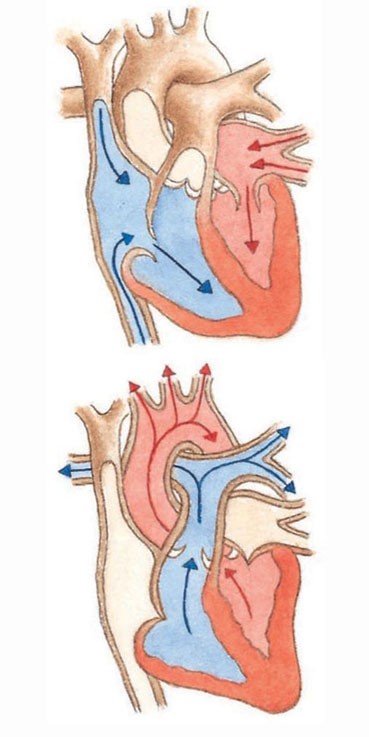
Each heartbeat involves the same sequence of events. Each side of the heart—left and right—has an upper chamber, the atrium, and a lower, more muscular chamber, the ventricle. At the beginning of each heartbeat, the heart muscle relaxes and the valves guarding the exits from the heart close. Oxygen-poor blood (shown as blue) from the body’s cells enters the right atrium and oxygen-rich blood (shown as red) from the lungs enters the left atrium. Blood on each side of the heart is then pushed downwards to the ventricles.
Then the two ventricles contract together, the right pushing oxygen-poor blood to the lungs and the left pushing oxygen-rich blood to the body. As this happens, the valves between each atrium and ventricle slam shut to stop blood flowing backwards in the wrong direction. The sounds created when valves close during each heartbeat can be heard by listening to a person’s heart using a stethoscope.
Valves
Heart valves prevent blood from flowing backwards during the heartbeat cycle. The valve between each atrium and ventricle is attached to thin tendons called chordae tendinae, or heartstrings, that are themselves anchored to the base of the ventricle. When a ventricle contracts and the valve closes, the heartstrings stop the valve turning inside out, like an umbrella in a gale.
Consultant: Richard Walker