
Famous inventors
Charles Babbage
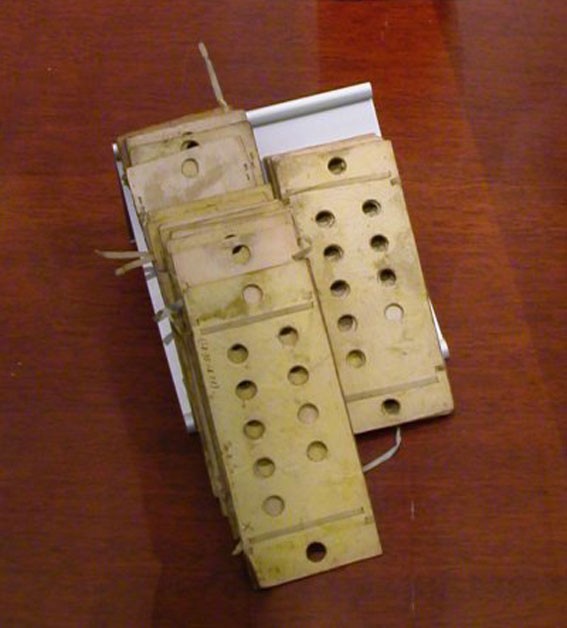
Sometimes called the "father of the computer", Charles Babbage (1791–1871), an English mathematician, invented the first mechanical computer on which more complex designs were later based. He directed the building of hand-powered machines, including what was called the Difference Engine in 1823, which could perform mathematical calculations. Another of Babbage's inventions, the more complex Analytical Engine, was a device intended to be able to perform calculations using punched cards.

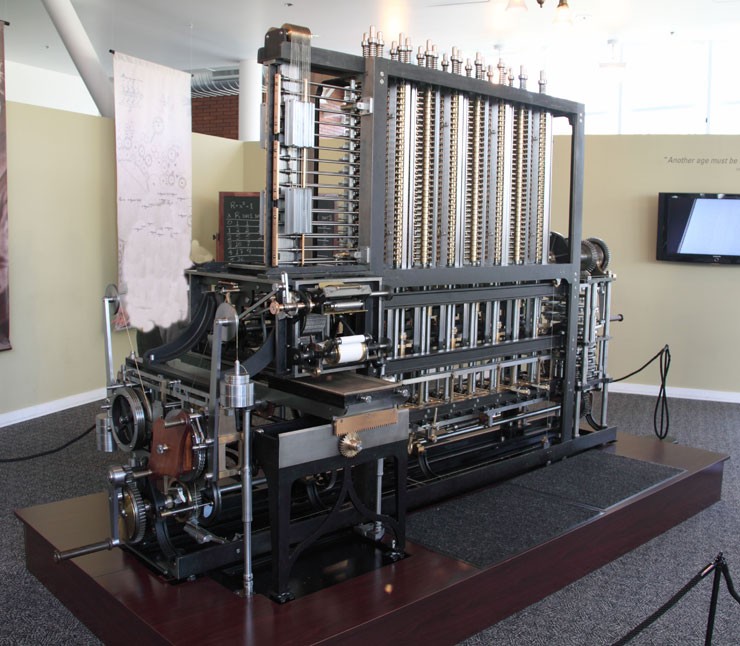
Difference Engine
Babbage was inspired to invented his device in order to eliminate errors in carrying out astronomical calculations. In Babbage's time, printed mathematical tables were calculated by hand. To build it, in 1823 Babbage asked the engineer Joseph Clement (1779–1844) to work from his designs. This machine, along with later versions of it, remained unfinished at Babbage's death. Although entirely mechanical, the basic design had some features in common with a modern computer: the data and program memory were separated and the operation was instruction-based.
Analytical Engine
With the attempts at making the first Difference Engine never fully realised, Babbage designed a more complex, steam-powered machine, called the Analytical Engine, first described in 1837. It was a device intended to perform calculations using punched cards that would submit instructions, and, like the Difference Engine, a memory unit that could store numbers. The Analytical Engine was designed to carry out any calculation its user wanted, which is the definition of a true computer. It was never built, but remained as a set of designs that Babbage worked on until his death in 1871. It was the earliest model of the design on which modern digital computers are based.

Ada Lovelace
English mathematician Ada Lovelace (1815–52) first met Babbage in 1833. In her Notes of 1843, accompanying an article explaining how the Analytical Engine would work, Lovelace wrote about her belief that computers could perform much more elaborate functions than simply making mathematical calculations. She demonstrated this by completing a program for the Analytical Engine: a method for calculating a certain mathematical sequence. Effectively, she had written the world's first algorithm, a step-by-step procedure for calculations. Ada Lovelace is often described today as the world's first computer programmer.
Consultant: Dave Hawksett