
Famous inventors
Joseph and Étienne Montgolfier
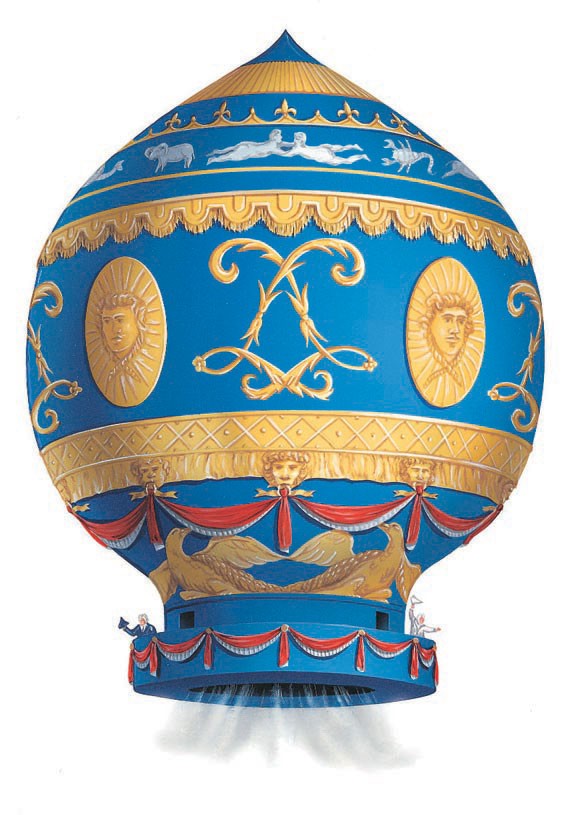
The first aircraft to carry humans free of the Earth’s surface was a balloon invented in 1783 by the French brothers Joseph (1740–1810) and Étienne (1745–99) Montgolfier. Searching for some kind of airborne craft which would make possible a military assault by air, Joseph was struck by the lifting force from the hot embers of a fire. Early experiments began with a small, box-like frame covered by cloth, before going on to build a much larger, globe-shaped structure. Joseph and his brother gave a public demonstration of this in June 1783. The craft flew for 10 minutes and reached about 2000 metres (6600 feet). The Montgolfier brothers had discovered that an airtight bag filled with hot air would rise.

First manned fight
Encouraged by its success, the Montgolfier brothers then built their first large-scale balloon from a lightweight cloth, coated with fireproofing varnish. They attached a wicker basket to it, and then, before the astonished gaze of King Louis XIV and Queen Marie Antoinette, sent a sheep, a cockerel and a duck on a short flight in September 1783. The craft reached about 460 metres (1500 feet) before landing safely.
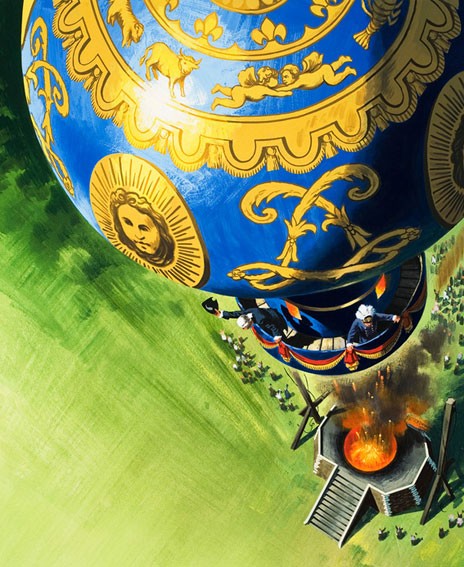
To make an airtight bag big enough to carry humans, the Montgolfier brothers immediately built another balloon that was about 23 metres (75 feet) tall. On 21st November, Pilâtre de Rozier and the Marquis d’Arlandes became the first aviators in history when the paper-lined, linen balloon lifted off to a height of 85 metres (279 feet). Powered by the rising hot air from a fire of burning straw, the Montgolfière drifted over Paris for 25 minutes before landing 8.5 kilometres (5.3 miles) away.
Consultant: Dave Hawksett