
Space transport
Story of space transport
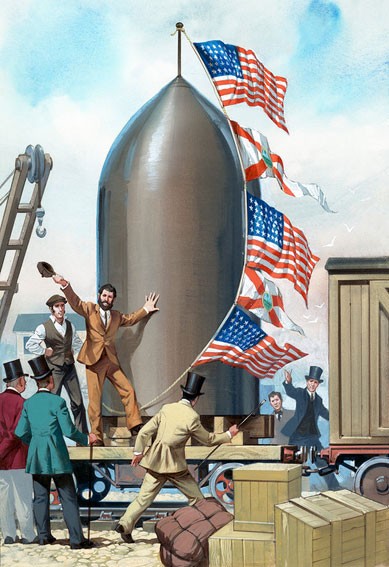
People dreamed of travelling in outer space long before rockets were invented. In 1865 the French science-fiction writer Jules Verne wrote a story about travellers to the Moon. The secret of space travel was the rocket—petrol or jet engines do not work in space. The first man who suggested that rockets might be used for space flight was a Russian teacher, Konstantin Tsiolkovsky, in 1903. No one took much notice then but the American scientist, Robert H. Goddard, built the first successful rocket, using liquid fuel, in 1926. While later rockets successfully reached heights above Earth of more than 100 kilometres (the height required by the international organization, Fédération Aéronautique Internationale to count as a space flight) the first true spacecraft—one capable of orbiting the Earth—Sputnik 1, was launched on 4th October 1957.
Updated 2nd June 2026
First rockets
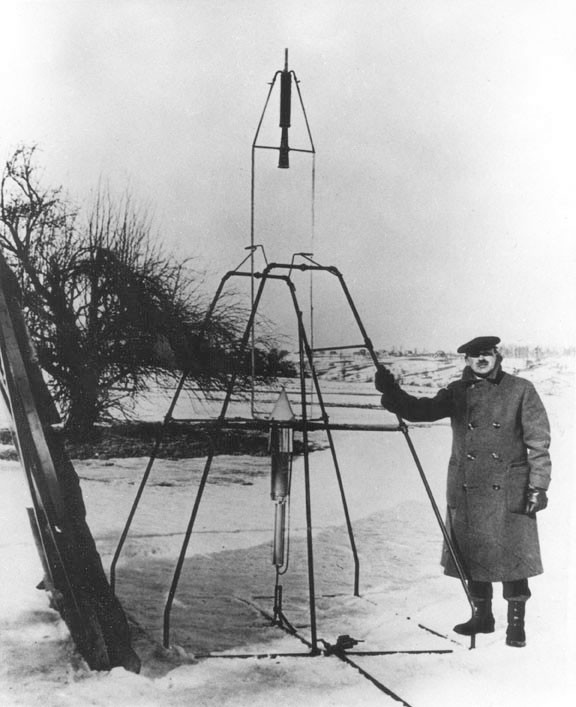
The first liquid-fuel rocket was built by American scientist Robert Goddard in 1926. Using gasoline and liquid oxygen for fuel, the 1-metre (3-feet) tall rocket, nicknamed "Nell", reached a height of 12.5 metres (41 feet). His later rockets reached heights of up to 2.16 kilometres (1.6 miles) at speeds of up to 885 km/h (550 mph).
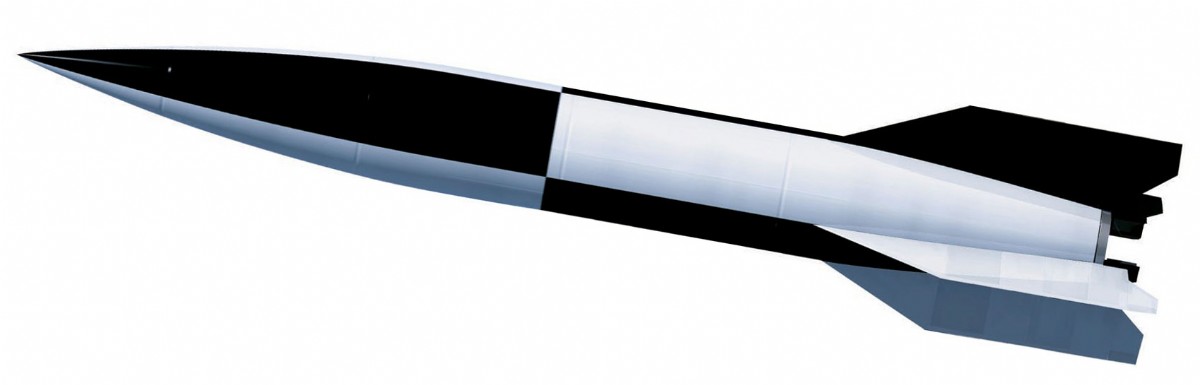
The first long-range rocket was the V-2 missile, designed by German engineer Wernher von Braun during World War II. The 14-metre (45-feet), liquid-fuelled rocket became the first manmade object in space in October 1942. It could reach an altitude of 206 kilometres (128 miles). After the war, von Braun worked for the US space programme.
Space Race
The first satellite to be launched into Earth’s orbit was the Soviet satellite, Sputnik 1. From then on, what became known as the Space Race took place between the Soviet Union (Russia and its territories from 1922 to 1991) and the United States. When the Soviet Union launched the first man into orbit in 1961, American president John F. Kennedy announced that the US would land a man on the Moon before the end of the 1960s. The first Moon landing duly took place on 20th July 1969. Since then most space exploration has been carried out by unmanned space probes flying close to the other planets in our Solar System.

Sputnik 1
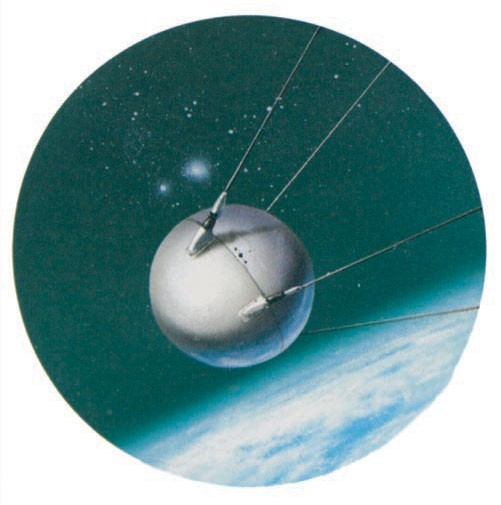
The Space Age really began on 4th October 1957 when the Soviet Union launched Sputnik 1, the first manmade satellite to orbit (travel around) the Earth. A small steel sphere weighing just 83 kilograms (183 pounds), Sputnik 1, remained in orbit for 92 days. It sent radio signals back to Earth via its four aerials.
First man in space
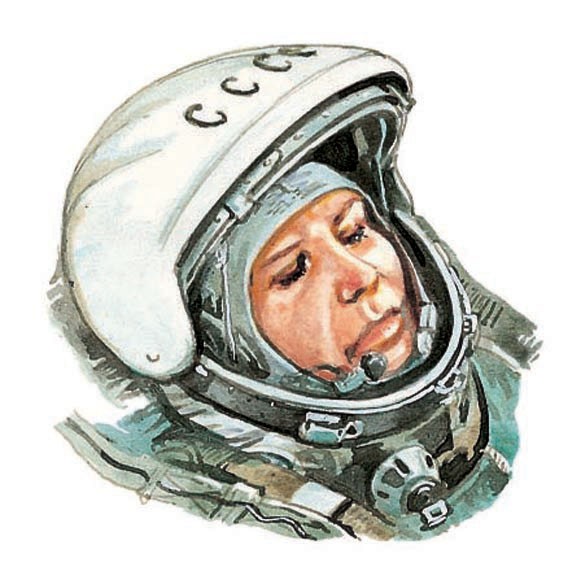
A dog called Laika was the first living thing to orbit the Earth. It was closely followed by the first human being, Soviet cosmonaut ("sailor of the universe") Yuri Gagarin, on 12th April 1961. His spacecraft, Vostok 1, reached a height of 344 kilometres (214 miles) and made one orbit of the Earth in a flight that lasted 108 minutes. The descent capsule, which measured just 2.3 metres (7.5 feet) across, landed in Russia but Gagarin was not in it: he had parachuted out at 6700 metres (22,000 feet). Yuri Gagarin was the first human being to travel outside the Earth’s atmosphere.

First space probe to
reach another planet
US spacecraft Mariner 2 became the first space probe successfully to reach another planet when it flew by Venus in December 1962. From a distance of 34,800 kilometres (21,600 miles), its detectors captured data from Venus’s surface. It carried no cameras because it was already known that Venus had a thick, featureless cloud cover.
First woman in space
The first woman in space was Valentina Tereshkova (born 1937) from the Soviet Union. She was also the first civilian (not in the armed forces) to fly in space. Before she was selected to be a cosmonaut, Tereshkova was a factory assembly worker and an amateur skydiver. She orbited the Earth 48 times on board Vostok 6 in 1963. In doing so, she logged more flight time than that of all American astronauts who had flown before then combined. It was not until 1982 that another woman, Soviet cosmonaut Svetlana Savitskaya, flew in space.

First space walk
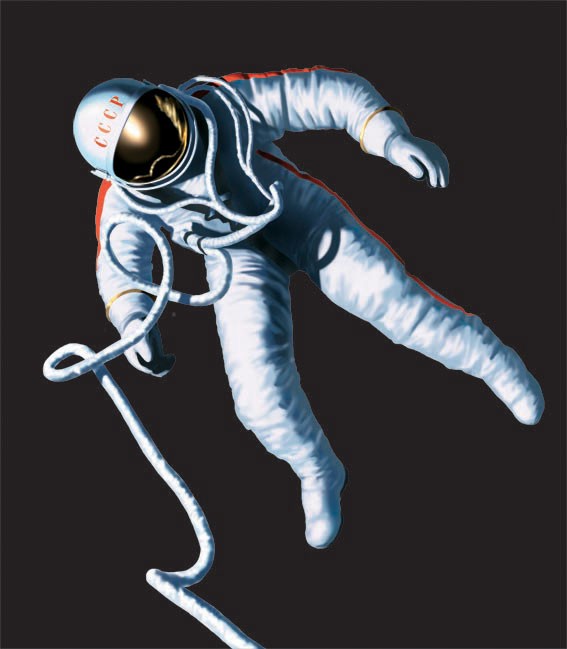
Soviet cosmonaut Alexei Leonov (1934–2019) became the first human to walk in space in March 1965. He left his spacecraft, Voskhod 2, via an airlock. With the door to the spacecraft shut behind him, the airlock was de-pressurized. He then opened the exit hatch and entered space. Attached to the craft by a cable, Leonov spent 10 minutes in space, taking pictures with a portable TV camera.
First long-term manned space flight
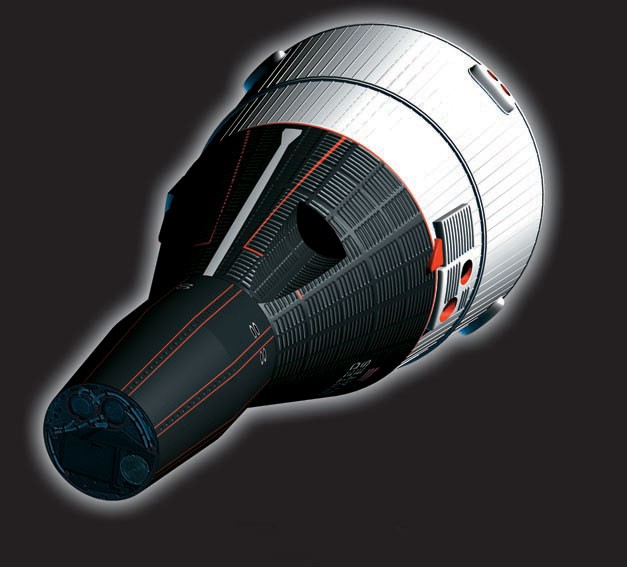
The first flight by a manned spacecraft to last more than a few days took place in December 1965. The purpose of Gemini 7’s mission was to discover the effects of 14 days in space on the human body. The crew of US astronauts Frank Borman and James Lovell spent nearly 14 days in space making a total of 206 orbits. At one point, Gemini 6A joined Gemini 7 in orbit. The two spacecraft performed the first manned rendezvous in space, with the two spacecraft manoeuvring to within of 30 centimetres (12 inches) of each other.
First landing
on the Moon
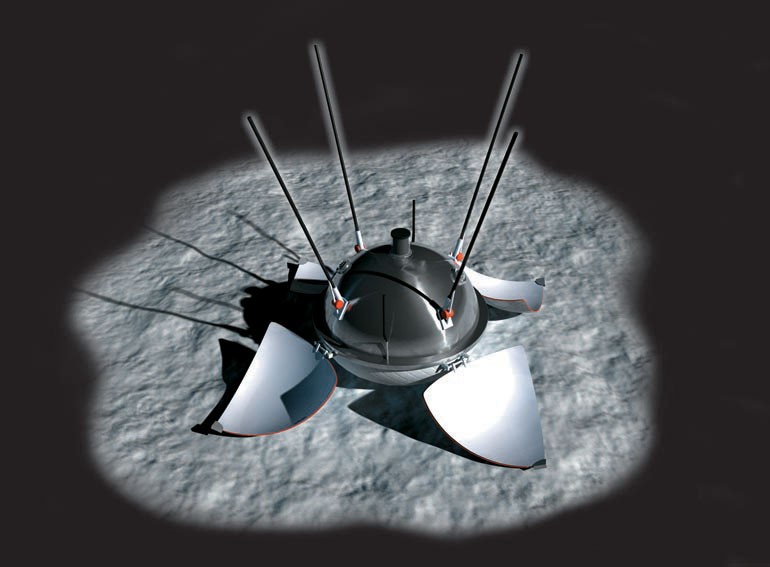
The first space probe to make a successful soft landing on the Moon was the Soviet Luna 9 in 1966. It was the first soft landing made by an manmade object on another world. Luna 9 sent back TV pictures after its protective “petals” opened. provided a panoramic view of the nearby lunar surface. The pictures included views of nearby rocks and the horizon, 1.4 kilometres (just under a mile) away.
First men on the Moon
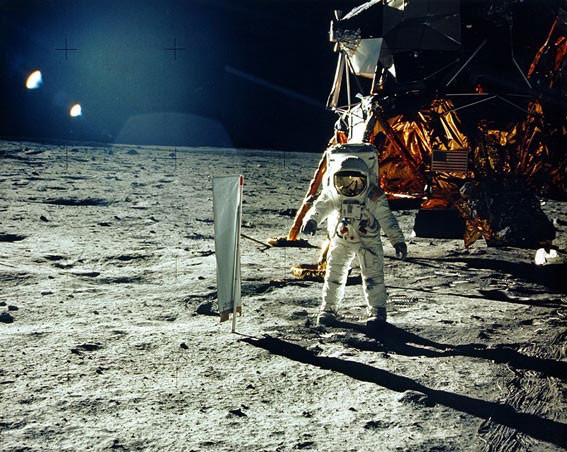
The first landing by a manned spacecraft on another body in the Solar System took place on 20th July 1969 when Apollo 11’s Lunar Module touched down on the surface of the Moon. A few hours later, in the early hours of 21st July, US astronaut Neil Armstrong (1930–2012) became the first person to step on to the lunar surface. He was followed by fellow astronaut Edwin "Buzz" Aldrin (born 1930). Armstrong and Aldrin spent 150 minutes gathering rock samples. Their footprints will still be there millions years from now, as there is no weather on the Moon to obliterate them. The Apollo astronauts were carried into space on their way to the Moon by the rocket, Saturn V.
First space station
The first space station, an orbiting laboratory for experiments in space, was launched by the Soviet Union in April 1971. Salyut 1 was 14.4 metres (47 feet) long and powered by wing-like solar panels. It was manned for 24 days by three cosmonauts who travelled up in a Soyuz spacecraft. Inside Salyut, the cosmonauts carried out experiments to see how people react to staying in space for long periods, and how plants and animals coped with very low gravity.
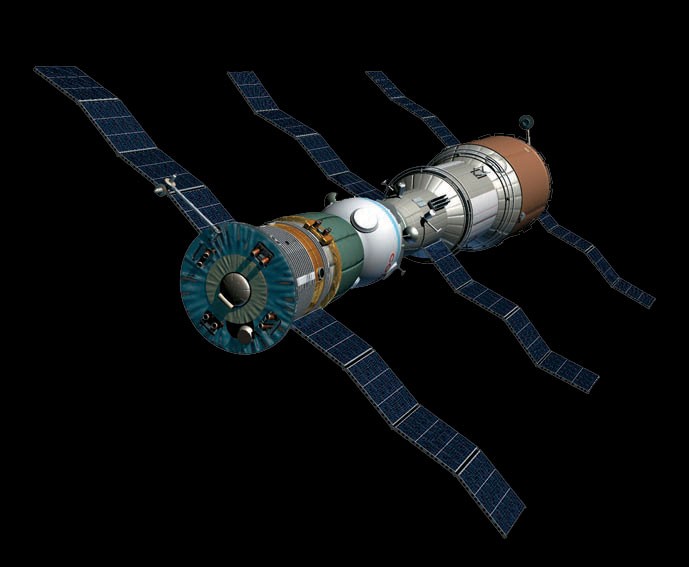
On their way home, all three cosmonauts died when their Soyuz spacecraft leaked air. No further missions were sent to the Salyut space station.
First space probe
to fly by Jupiter
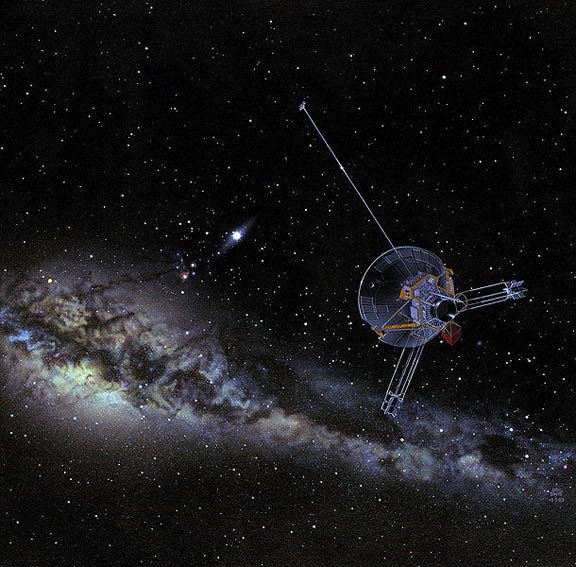
The US space probe Pioneer 10, launched in 1972, was the first probe to travel through the asteroid belt and fly by Jupiter. For the benefit of any intelligent aliens it may encounter, it carries on board a plaque showing the location of the Sun and planets, together with a picture of a man and a woman. Communications with Pioneer 10 were lost in January 2003, at which time it was 12 billion kilometres (7.5 billion miles) from Earth. Even at that distance, its radio signal could still be picked up by powerful receivers.
First successful
probes on Mars
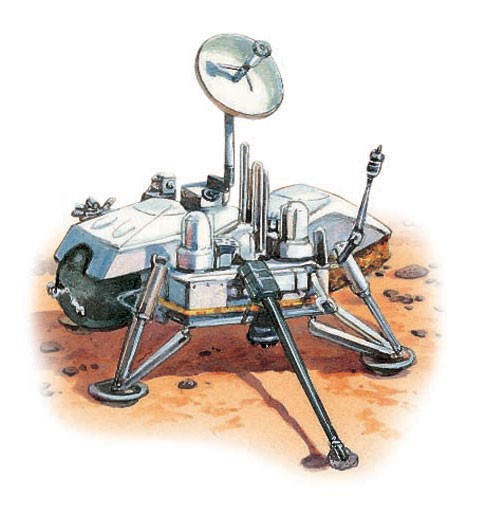
The twin US probes, Viking I and 2 touched down on the surface of Mars in July and September 1976. They took colour pictures of the rocky surface, recorded weather conditions and used their robotic arms to collect soil for analysis. They also sent back information that showed for the first time how Mars’s landscape had been sculpted by running water. Although several probes had landed on Mars before, the Viking mission was the first successful one: the Viking probes were the first to complete their missions.
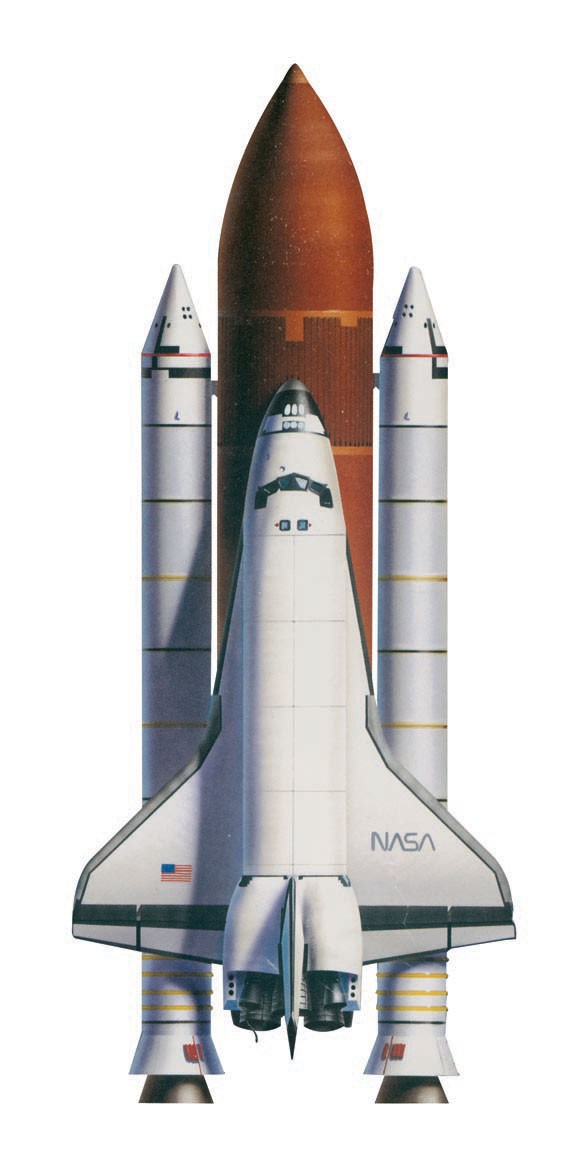
First re-usable spacecraft
The US Space Shuttle Columbia became the world’s first re-usable spacecraft when it made its second flight in November 1981. The Space Shuttle was designed as a re-usable spacecraft because of the huge cost of rockets, all the parts of which were completely destroyed during a mission. The five Shuttle spacecraft, Columbia, Challenger, Discovery, Atlantis and Endeavour, flew 135 missions between 1981 and 2011 to launch or repair satellites, service space stations, and carry out scientific and military research. The Space Shuttle flew into space like a rocket, then glided back to Earth like an aeroplane.
Voyager space probes
The twin space probes, Voyager 1 and Voyager 2, were launched in 1977. They took advantage of a rare alignment of the outer planets, Jupiter, Saturn, Uranus and Neptune, to make fly-bys of all four possible. The flight trajectory of Voyager 2 was carefully designed so that it could use the gravity field of each planet to provide the necessary force to to change the speed and direction of the spacecraft to get it from one planet to the next.

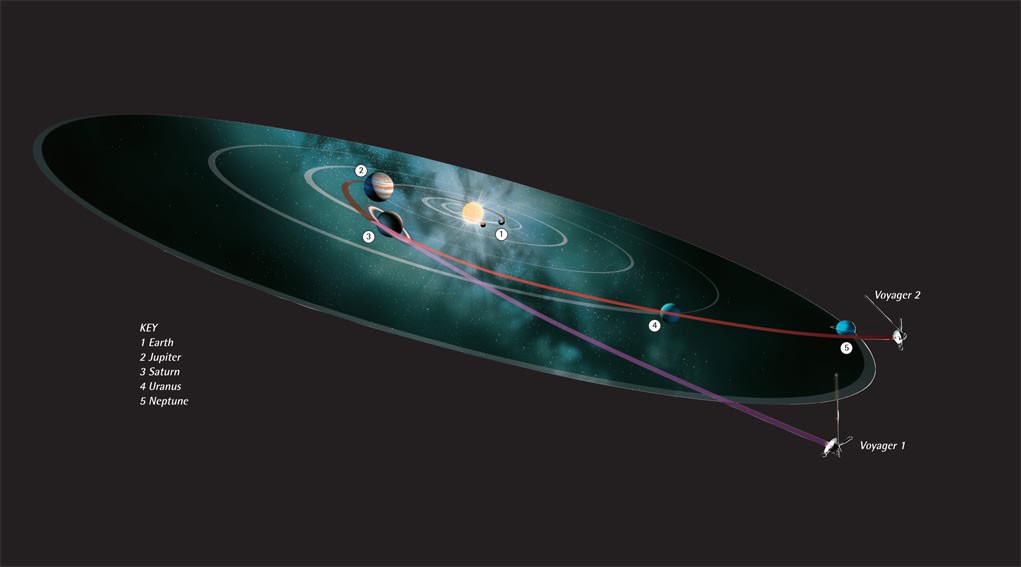
Although it took off slightly later than Voyager 2, Voyager 1 was the first to reach Jupiter in March 1979 and Saturn in November 1980. Both space probes took high-resolution images of the giants and their rings and moons. Voyager 2 flew by Uranus in January 1986 and Neptune in August 1989, sending back amazingly clear pictures of Neptune’s moon, Triton.
First untethered
space walk
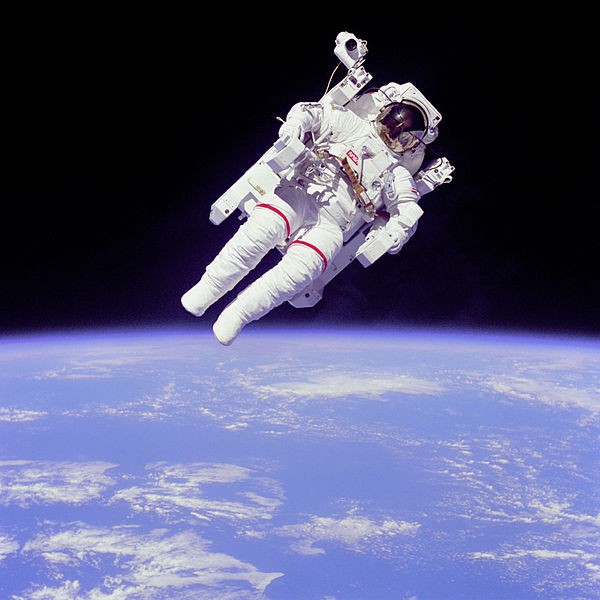
In 1984, US astronaut Captain Bruce McCandless, was the first person to go "outside" into space with no link to a spacecraft. He was the first human satellite. Together with Colonel Bob Stewart, they were out on extravehicular activity (EVA) for five hours, travelling in little vehicles like armchairs fitted with gas-powered thrusters called manned-manoeuvring units (MMUs)
Hubble Space Telescope
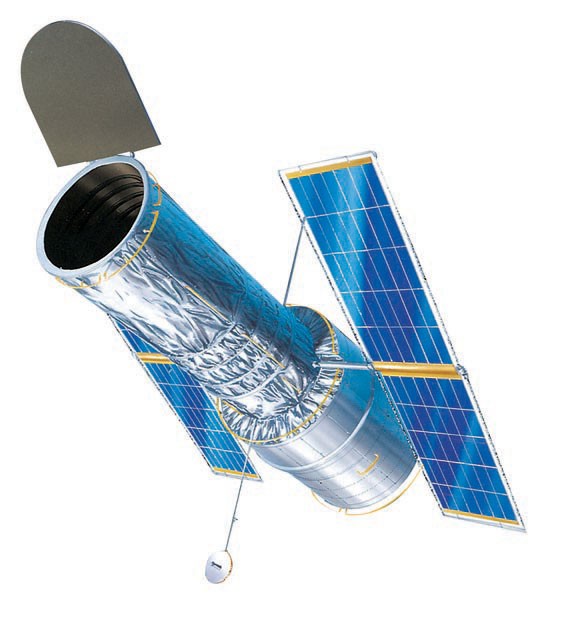
Launched by the Space Shuttle in 1990, the Hubble Space Telescope (HST) is an unmanned observatory. From its orbit 559 kilometres (347 miles) above Earth, the pictures it receives of distant regions of space are unaffected by the atmospheric disturbance that reduces the quality of images obtained from telescopes on Earth. The Hubble can detect visible light, infrared and ultraviolet rays. It has special mirrors to reflect and focus images and electronic detectors to record them. Images are sent to Earth via the space
telescope’s antennae.
Longest in space
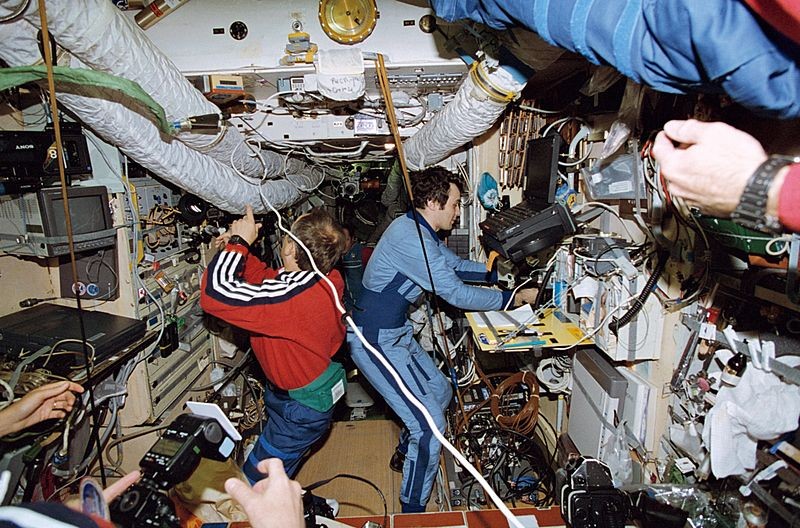
In the 1970s the Soviets and the Americans began building large space stations. These allowed crews to spend time carrying out scientific research. In 1987-88, Soviet cosmonauts (the Russian equivalent of astronaut) Musa Manarov and Vladimir Titov spent just short of 366 days in the Mir space station. Their record was broken by Valeri Polyakov (1942–2022) in 1995 who stayed aboard Mir for 437 days 18 hours—still the record for the longest continuous stay in space today (as of January 2025). On board Mir, he flew about 400 million kilometres (250 million miles)—well over the equivalent of a return trip to the Sun.
International Space Station
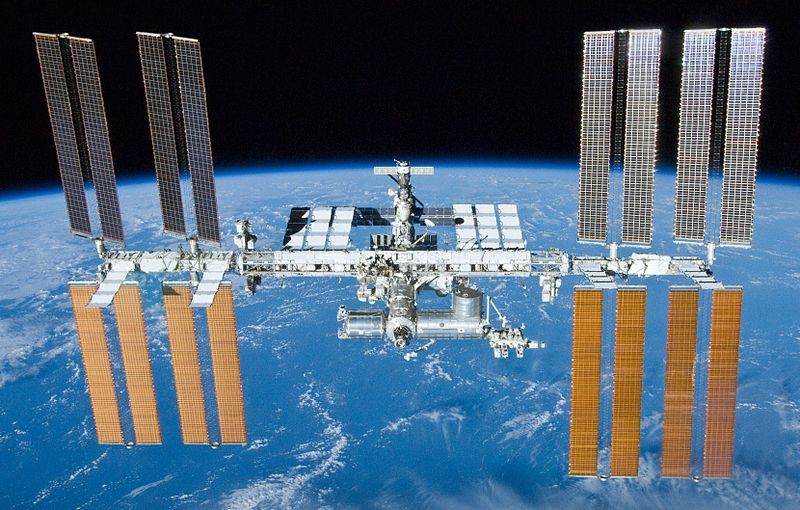
Orbiting 400 kilometres (248 miles) above the Earth is the International Space Station (ISS). It completes 15.51 orbits per day. The ISS is made up of several modules linked together. The two main sections are the Russian Orbital Segment (ROS) and the United States Orbital Segment (USOS), which is shared by many nations. Inside these are laboratories and living accommodation. Solar panels provide the ISS with electrical power. It also has several giant robotic arms.
The ISS is a microgravity environment: people and untethered objects float through the space station. In their sleeping quarters, crew members sleep in a tethered sleeping bag, so that they do not bump into anything during the night. Personal items are stored in drawers or nets attached to the walls. At mealtimes, drinks are sucked from a closed bag through a straw, and crew members must be careful not to make crumbs that could float into equipment.
The ISS is used for experiments, including the science of how living things survive in space. Experiments in fields such as meteorology (study of the atmosphere), astronomy and physics also take place. Crew members normally work for about 10 hours a day on weekdays, and 5 hours on Saturdays, with the rest of the time spent exercising, eating, listening to music, reading and chatting.
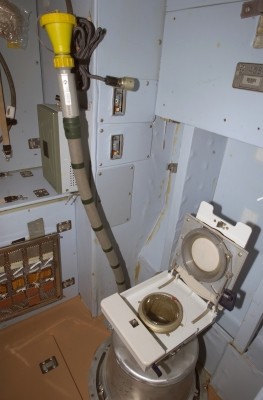
The ISS has been visited by astronauts and cosmonauts from 19 different countries. There are 12 docking ports for visiting spacecraft. Soyuz spacecraft were once used to carry Russian cosmonauts to and from Salyut and later Mir space stations. They are now among the small group of spacecraft used for transporting people, supplies and equipment to the ISS, having taken over from the US Space Shuttle, which was retired in 2011. One Soyuz spacecraft is docked to ISS at all times as an emergency escape craft.
First space probe
to orbit Jupiter
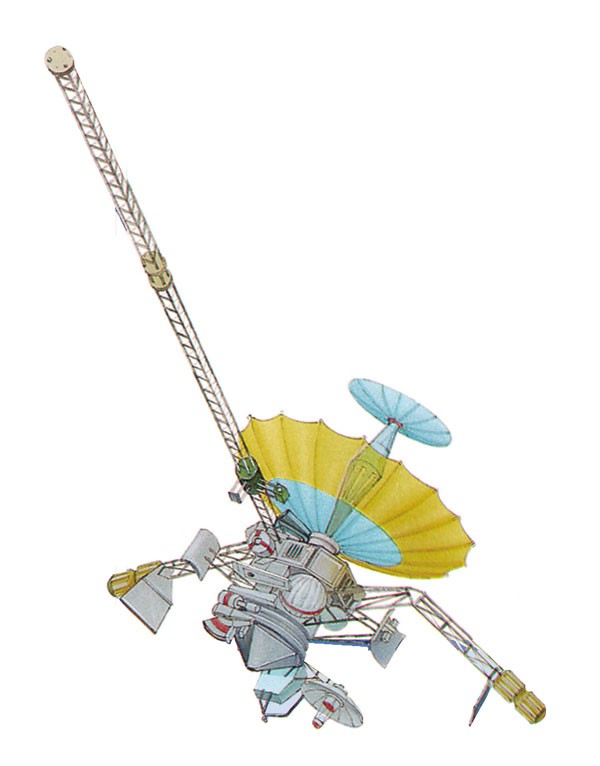
The Galileo space probe entered into orbit around Jupiter, the first probe to do so, in 1995. It carried a small descent probe, which it released into Jupiter’s atmosphere, from where it sent back data. Other detectors and cameras took images of Jupiter and its moons. The Galileo space probe was deliberately sent into Jupiter's atmosphere to destroy itself completely in 2003.
Cassini space probe
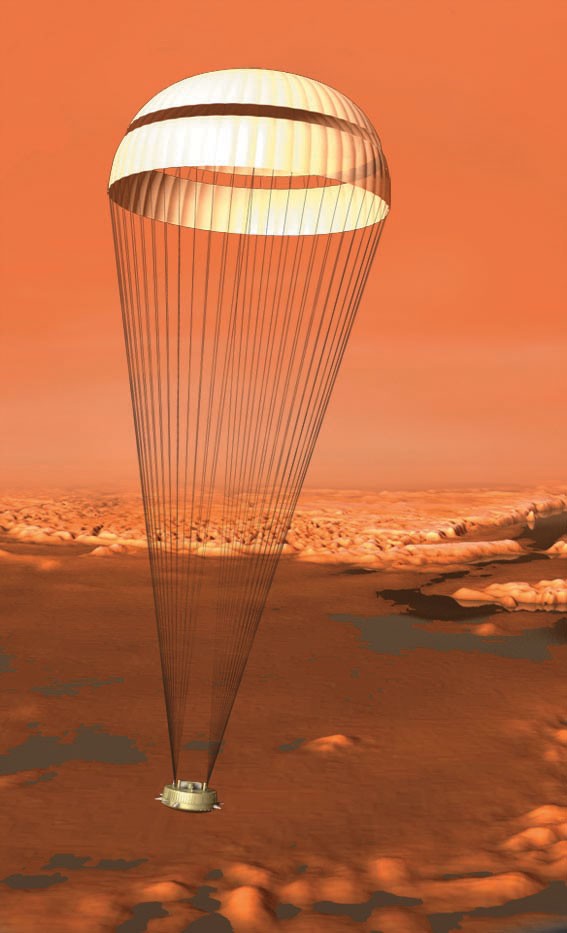
The Cassini space probe was launched in October 1997, with the objective of studying Saturn and its moons, especially Titan and Enceladus. It entered the orbit of Saturn in 2004. In January 2005 it released a lander probe, Huygens, bound for Titan. During its entry of Titan’s thick nitrogen atmosphere, it was protected against high by a heat shield. A parachute was deployed to slow its descent and permit a soft landing on Titan’s surface. It was the first landing made by a space probe on the surface of another planet's moon. For 90 minutes it transmitted pictures and information back to Earth, including images of rivers and lakes of liquid methane on Titan's surface. Cassini itself remained in orbit around Saturn, but was deliberately crashed into the planet in September 2017.
Rosetta and Philae
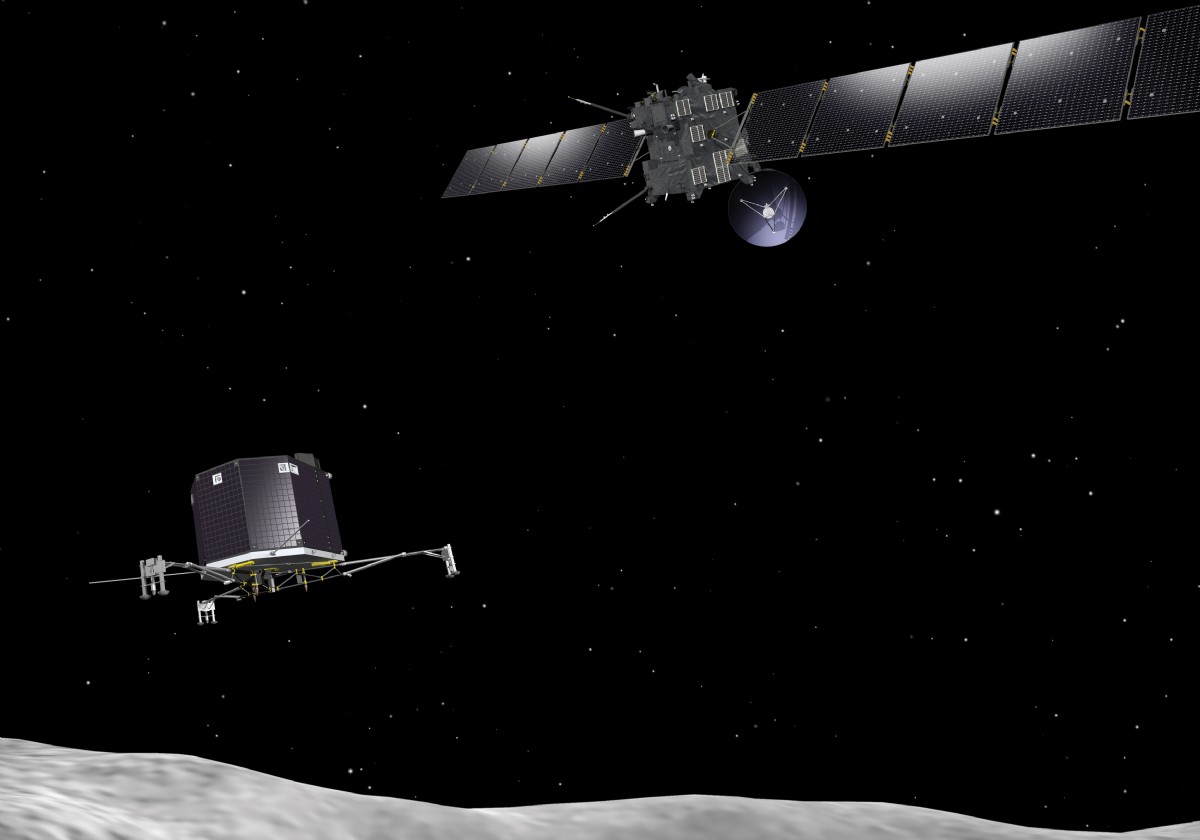
The space probe Rosetta was launched in March 2004. It reached Comet 67P/Churyumov–Gerasimenko in May 2014 and entered into orbit around the comet. In November, Rosetta released a small lander, called Philae, that descended on to the comet itself. It was intended that, on landing, two harpoons would fire into the comet's surface to prevent the lander from bouncing off. The harpoons failed to fire, but Philae still landed safely. The first images beamed back revealed a dramatic landscape of precipices, craters and boulders. Rosetta meanwhile continued in orbit for 17 months, carrying out a detailed study of the comet. On 30th September 2016 it made a controlled landing on Comet 67P, shutting down its systems for the final time on touchdown.
Space tourism
Space tourism is human travel in space that is not for purposes of scientific research but solely for pleasure. Several companies, including Blue Origin, Virgin Galactic and SpaceX, are working to develop vehicles that will carry tourists on suborbital trips. These are flights into outer space (above the Kármán line, 100 kilometres or 62 miles above the Earth's surface) but which return to Earth without completing an orbit of the Earth. Virgin Galactic's spaceplane, VSS Unity, completed a successful suborbital test flight with four passengers on 11th July 2021.
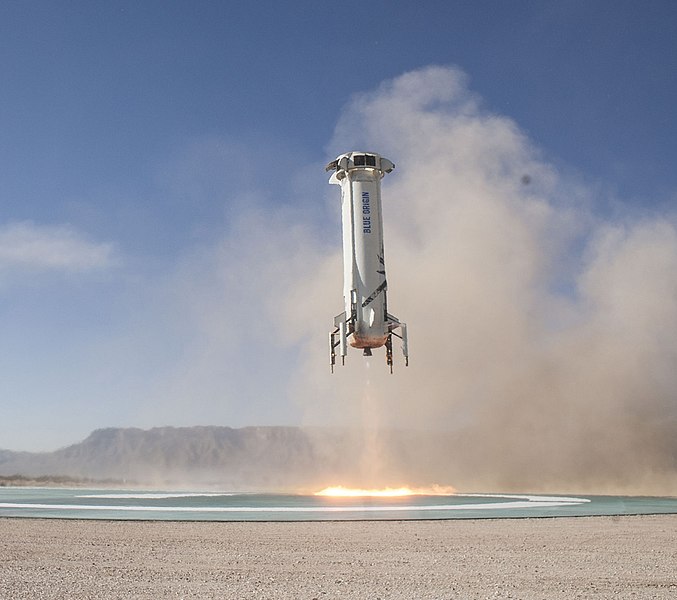
It was followed shortly afterwards on 20th July by Blue Origin's New Shepard, which reached an altitude of 107 kilometres (66 miles). New Shepard is a fully reusable, vertical takeoff, vertical landing (VTVL) launch vehicle composed of a crew capsule and a booster rocket. The flight was crewed by Blue Origin founder Jeff Bezos (he is also the founder of Amazon.com) and three others.
Tourists have already travelled on orbital flights—those in which a spacecraft remains in space for at least one orbit of the Earth. Between 2001 to 2009, seven space tourists made flights aboard a Russian Soyuz spacecraft to the International Space Station. The first was American billionaire Dennis Tito in 2001. In 2019, NASA announced that, starting in 2020, private astronauts would be allowed to visit the ISS with the use of SpaceX's Crew Dragon spacecraft and Boeing Starliner spacecraft.

Consultant: Chris Oxlade
Timeline
1926
The first liquid-fuel rocket is built.
1942
The V-2 missile becomes the first manmade object in space.
4th October 1957
The Soviets launch Sputnik 1, the first manmade satellite.
12th April 1961
Soviet cosmonaut Yuri Gagarin makes the first flight in a manned spacecraft, Vostok 1.
5th May 1961
First US astronaut Alan Shepard makes a 15-minute flight.
20th February 1962
John Glenn becomes the first US astronaut to orbit Earth.
16th June 1963
Soviet cosmonaut Valentina Tereshkova becomes the first woman in space.
18th March 1965
Soviet cosmonaut Aleksei Leonov makes the first space walk.
3rd February 1966
Soviet unmanned spacecraft Luna 9 makes the first soft landing by a manmade object on another world when it touches down on the Moon.
21st July 1969
US astronaut Neil Armstrong is the first man to walk on the Moon.
19th April 1971
Salyut 1, the first space station, is launched by the Soviet Union
November 1981
The US Space Shuttle Columbia becomes the world’s first re-usable spacecraft when it makes its second flight
7th February 1984
US astronaut Bruce McCandless performs the first untethered space walk.
24th April 1990
Hubble Space Telescope is launched by the Space Shuttle
1994–95
Russian doctor Valeri Polyakov spends a record 438 days in space.
7th December 1995
The Galileo space probe enters Jupiter's atmosphere, the first probe to do so
20th November 1998
The first module of the International space Station (ISS), Zarya, is launched
January 2004
Twin rovers Spirit and Opportunity are landed on Mars
15th January 2005
Space probe Cassini releases a lander probe, Huygens, on to the surface of Saturn's moon, Titan
22nd June 2007
US astronaut Sunita Williams sets the record, 195 days, for the longest space flight by a woman.
12th November 2014
Having entered into orbit around Comet 67P/Churyumov–Gerasimenko, Space probe Rosetta releases a small lander, called Philae, that descends on to the comet itself
14th July 2015
NASA’s New Horizons space probe becomes the first spacecraft to reach the dwarf planet Pluto, sending back pictures and data from the dwarf planet
October 2015
Cassini probe is steered through a fountain of icy spray that is spurting out of the ocean beneath Enceladus’s icy shell—an ocean that might have alien life-forms living in it.
1st March 2016
US astronaut Scott Kelly and Russian cosmonaut Mikhail Kornienko return to Earth after their 340-day mission aboard the International Space Station, then the longest recorded time for ISS crew members. (The record is held today by Russian cosmonauts, Oleg Kononenko and Nikolai Chub, who ended their stay of 374 days in September 2024.)
5th July 2016
Juno space probe goes into orbit around Jupiter; it is equipped with instruments to probe Jupiter's thick atmosphere and to carry out precise measurements of its gravity
15th September 2017
Cassini space probe is deliberately steered into Saturn's atmosphere, where it burns up in order to prevent any risk of contaminating Saturn's moons.
27th June 2018
Two robotic rovers from space probe Hayabusa2, launched by Japan Aerospace Exploration Agency (JAXA), successfully land on an asteroid, Ryugu. It marks the first time a mission has completed a successful landing on an asteroid.
3rd January 2019
China National Space Administration (CNSA) lands the space probe Chang’e 4 on the far side of the Moon. This is the first time any spacecraft has landed there.
19th April 2021
A mini-helicopter named Ingenuity, carried aboard the Mars rover, Perseverance, performs the first powered flight ever to take place on another world. The solar-powered drone hovers in the air at around 3 metres (10 feet) above the surface of Mars, before descending back to the ground.
26th September 2022
NASA’s Double Asteroid Redirection Test (DART) spacecraft successfully impacts Dimorphos, a moonlet of the asteroid Didymos, causing the shortening of its orbit around Didymos by 32 minutes
16th November 2022
Artemis I is launched on an uncrewed journey to the Moon and back. The spacecraft, comprising the Space Launch System (SLS) launch vehicle and Orion command and service module, is the forerunner of Artemis IV, scheduled to be the first crewed lunar landing since Apollo 17 in December 1972. The long-term aim is to establish a permanent base camp on the Moon which will in turn enable manned missions to Mars by the mid-2040s.
23rd August 2023
Chandrayaan-3 spacecraft’s Vikram lander successfully touches down on the surface of the Moon, marking India’s emergence as a space power. Vikram lands near the Moon's south pole—the first time this has been accomplished.
17th December 2024
Cai Xuzhe and Song Lingdong, part of China's three-person Shenzhou 19 mission, spend 9 hours and 6 minutes outside the Tiangong space station, breaking the record for the longest spacewalk
1st April 2026
NASA's Space Launch System rocket launches the Artemis II mission carrying astronauts to the Moon for the first time in almost 54 years. The 10-day test flight of their Orion spacecraft does not land on the Moon itself but performs a lunar flyby before returning to Earth. The flyby marks the first time since the Apollo 17 mission of December 1972 that humans have left Low Earth orbit.