
Planets and moons
Enceladus
Enceladus, one of Saturn’s moons, is a bright, silvery-white ball measuring only 498 kilometres (309 miles) across (on average). The surface of Enceladus reflects nearly all the light that reaches it. Part of its surface has craters but most other parts are smooth. The long grooves on Enceladus’s surface, some of them fringed by distinctive mint-green stripes, are thought to be faults (cracks) in the moon’s icy crust, possibly indicating the existence of a liquid layer lying beneath. The Cassini space probe made a series of flybys of Enceladus in 2015–17, sending back detailed images and information about the moon.


Eruptions of ice
There are craters and ridges in Enceladus's northern hemisphere, but its southern polar region is smooth. Astronomers think that Enceladus may be almost entirely coated by water ice. The ice has melted only recently, wiping out any craters from past meteorite bombardment. The surface is probably being regularly recoated by eruptions of ice bursting through cracks in the moon’s thin crust.
As Enceladus orbits Saturn, the planet's enormous gravitational force pulls at the moon, keeping it in orbit. Every so often Dione, another, larger moon orbiting further out, aligns with Enceladus, pulling it towards itself. Astronomers think this repeated gravitational tug-of-war, which stretches and squeezes Enceladus in turn, is keeping the moon's core warm.
Snaking across the smooth southern polar region of Enceladus are four long grooves, each fringed by a mint-green stripe. From these so-called “tiger stripes”, geyser-like ice "volcanoes" (known as cryovolcanoes) erupt fountains of water vapour and tiny hailstones 500 kilometres (300 miles) into space. The ice particles make up most of the material in Saturn’s E ring.

Possible existence of life
Many scientists believe that the eruptions from Enceladus's ice volcanoes come from a warm-water ocean lying just beneath the moon’s thin, icy crust. The presence of organic molecules, found in both the ice volcanoes and the "tiger stripes", increases the possibility that this ocean might harbour life.

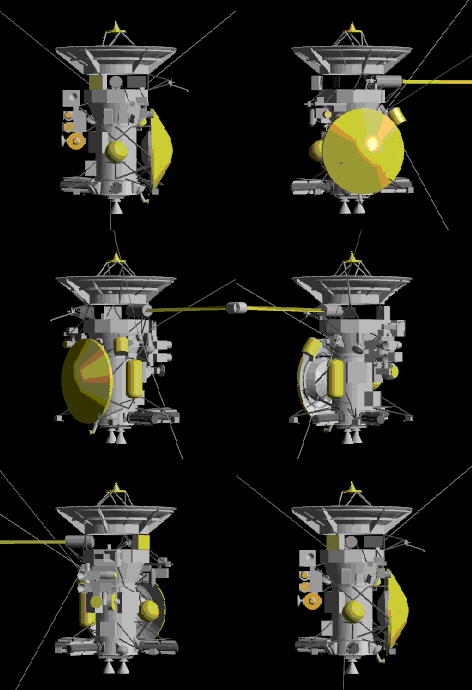
Cassini’s flyby
Saturn's moon Enceladus was examined for signs of life by the Cassini space probe. In October 2015, the probe was steered through a fountain of icy spray that is spurting out of the ocean beneath Enceladus’s icy shell—an ocean that might have alien life-forms living in it. Analysing exactly what chemicals are in the spray enabled experts to find out whether the moon had the right “ingredients for life”. Cassini next flew by Enceladus in December, this time at a higher altitude to measure the heat flowing from the moon's interior.
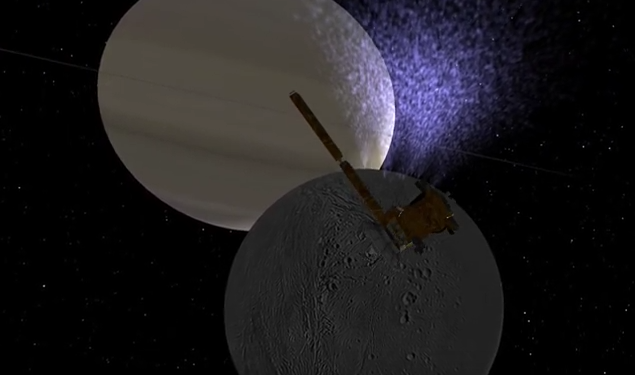
Plumes
The Cassini space probe flew through a plume shooting out of Enceladus’s south polar region 49 kilometres (30 miles) above its icy surface. During the approach, instruments on board the craft sampled the spray and analysed the chemicals within it. The low flight path enabled Cassini to sample heavier molecules, including organic chemicals.
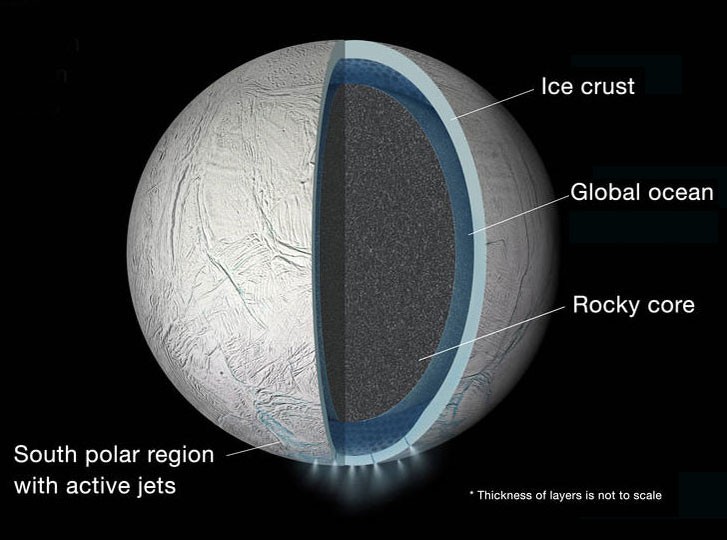
The plume had already been seen erupting from one of the "tiger stripes”: four 2-kilometre (1.2-mile) wide cracks, mint-green in colour, which are believed to be sites of regular volcanic activity on Enceladus. The plume is fed by geyser-like ice volcanoes which blast around 250 kilograms (550 pounds) of water vapour, ice particles and chemicals per second into space at more than 2000 km/h (1240 mph).
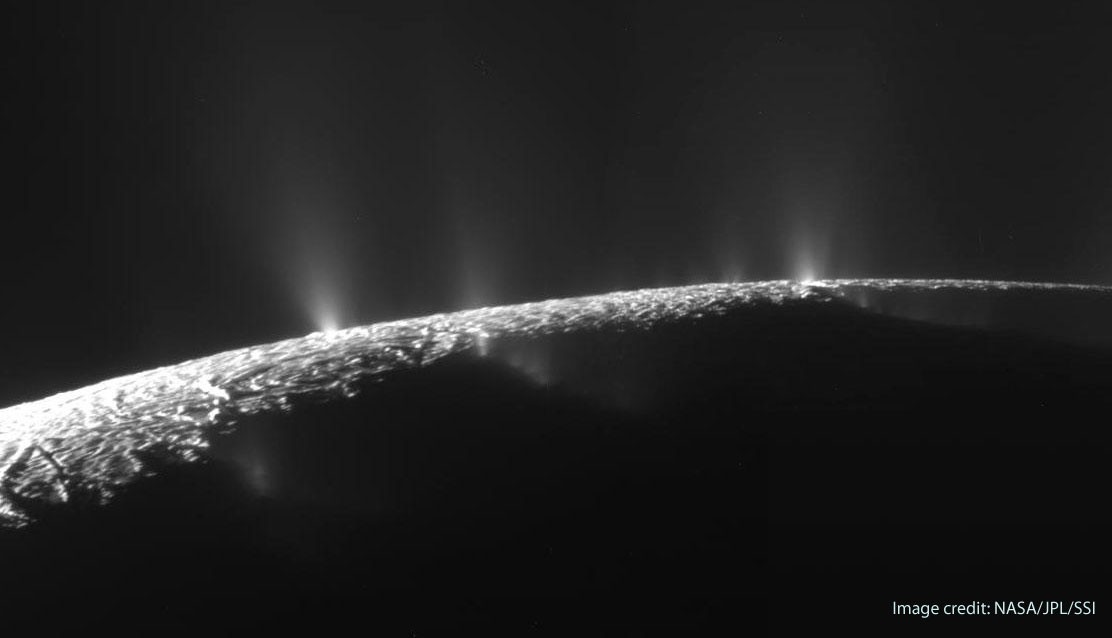
The cause of these ice volcano eruptions is unknown. In Earth’s oceans, the minerals contained in jets of water, known as “black smokers”, emitted from hydrothermal vents (fissures in the ocean bed through which sea water that has seeped into the bedrock has been heated to high temperatures and blasted upwards) provide nutrients for bacteria and teeming colonies of life-forms growing up around them. Scientists are keen to find out whether the same might be found on Enceladus. The detection of hydrogen molecules in the plume, which was confirmed in April 2017, provided researchers with evidence of the likely existence of hydrothermal vents on Enceladus.
Consultant: Mike Goldsmith